Inside Europe’s Grandest Celebration of Pop Culture: Five Defining Takeaways From the 60th Anniversary of Lucca Comics and Games

The historic medieval city of Lucca, nestled within Italy’s picturesque Tuscany region, has once again transformed into the undisputed epicenter of global pop culture. Celebrating its milestone 60th anniversary, the Lucca Comics and Games festival—widely recognized as Europe’s largest Comic-Con equivalent—drew massive crowds from October 28 to November 1. Over the course of the multi-day event, approximately 80,000 ticket-paying enthusiasts flooded the ancient, walled city daily. Navigating through a labyrinth of mediaeval streets, attendees explored diverse pavilions, immersive exhibitions, and meticulously crafted pop-up experiences dedicated to every facet of modern entertainment.
From legendary comic book architects and manga pioneers to the creative minds behind major streaming franchises, Hollywood showrunners, animators, and acclaimed actors, the festival served as a vibrant crossroads for the creative industries. As the dust settles on this historic diamond jubilee, an examination of the convention’s most significant highlights reveals clear trends regarding the intersection of nostalgic franchises, international fandoms, and the evolving landscape of live-action adaptations.
The Anticipation and Skepticism Surrounding HBO’s Upcoming Harry Potter Pavilion
Among the most heavily trafficked installations at this year’s festival was the dedicated pavilion for HBO’s highly anticipated television adaptation of the Harry Potter series. Long before the historic gates of Lucca opened each morning, winding queues formed, with lines stretching across public squares and doubling back on themselves in a massive serpentine formation.
Once inside, visitors were granted an exclusive preliminary look at physical props slated for use in the upcoming series. Fans also participated in interactive engagement stations, receiving commemorative temporary tattoos representing their chosen Hogwarts House. A major highlight for attendees was a specially recorded video message featuring prominent cast members John Lithgow and Nick Frost, who are set to portray Albus Dumbledore and Rubeus Hagrid, respectively.
Despite the palpable excitement, the absence of physical talent or exclusive video footage left some segments of the fan base tempered with caution. The exhibition underscored a broader industry phenomenon: adapting beloved, multi-generational literary properties carries profound risks. Interviews with attendees on the ground highlighted a sharp dichotomy in public sentiment. Stefano, a festival-goer dressed as a Jedi, expressed cautious optimism to media outlets, noting that it will be fascinating to see the original source material addressed with a deeper level of narrative exploration. Conversely, Alessia, visiting from Lake Como and dressed in elaborate Maleficent attire, voiced anxieties common among purists, expressing concern that creators may have introduced too many deviations from the established canon.
Industry analysts suggest that these preemptive anxieties reflect the immense pressure facing the showrunners ahead of the series’ scheduled Christmas Day release. By omitting live-footed previews at Lucca, network executives may have sought to shield the production from premature scrutiny while still leveraging the European convention circuit to maintain global momentum.
A Triumphant Presence for Percy Jackson and the Olympians
In stark contrast to the guarded optimism surrounding Hogwarts, the fandom dedicated to Disney+’s Percy Jackson and the Olympians demonstrated unbridled enthusiasm, establishing a towering physical and emotional presence at the festival. Key cast members—including Walker Scobell, Leah Sava Jeffries, and Aryan Simhadri—were joined by executive showrunners Jonathan E. Steinberg and Dan Shotz.
Following an intensive morning press panel, the creative team appeared on a sweeping architectural terrace overlooking the bustling Piazza della Magione. Below them, a sea of more than 8,000 passionate fans draped in the distinctive navy blue and orange colors of Camp Half-Blood erupted in applause. The scale of the turnout underscored the enduring global resonance of Rick Riordan’s mythological universe, proving that youth-oriented fantasy properties can command massive international footprints that rival traditional adult genre programming.
The European Premiere of the Blue Lock Live-Action Adaptation
Anime and manga enthusiasts were treated to a major cinematic milestone with the European premiere of the live-action film adaptation of Blue Lock. The property, which has captured the global sports-manga zeitgeist, shifts traditional athletic narratives into a high-stakes, psychological battleground.
Set within an authoritarian institutional regime, the narrative follows an unorthodox survival experiment designed to cultivate the ultimate ego-driven soccer striker from a pool of 300 candidates, all competing for the singular honor of representing Japan on the international stage. Critics and early screening audiences noted that the live-action adaptation remains remarkably faithful to its animated and printed predecessors. Stylistically, the film has been described by reviewers as a kinetic, high-octane synthesis of Kenta Fukasaku’s dystopian thriller Battle Royale and John Huston’s classic prisoner-of-war soccer drama Escape to Victory. The successful premiere signals a growing appetite among European distributors for live-action translations of complex, high-concept Japanese athletic thrillers.
Comic Book Royalty: Frank Miller and Go Nagai Honored in Lucca
Lucca Comics and Games has historically maintained a deep reverence for the foundational pillars of visual storytelling, and the 60th-anniversary programming heavily spotlighted legendary figures who defined modern sequential art.
The festival marked the triumphant return of Frank Miller, the visionary creator behind masterpieces such as The Dark Knight Returns and Sin City. Miller utilized the international platform to announce his latest creative endeavor: an ongoing collaboration with acclaimed artist Peach Momoko. The new project promises to fuse Miller’s gritty, noir sensibilities with thematic explorations inspired by traditional Japanese horror folklore.
Simultaneously, the festival paid tribute to groundbreaking Japanese manga artist Go Nagai. A dedicated, comprehensive exhibition titled Sun, Heart, and Steel celebrated Nagai’s immense contributions to global pop culture. The retrospective heavily featured his iconic creation Mazinger Z, the seminal work that single-handedly inaugurated the Mecha genre in anime and manga. Additionally, the exhibition celebrated Devilman, a property whose theological and visual foundations were fittingly inspired by the grotesque illustrations of Dante Alighieri’s Divine Comedy. The dual presence of Miller and Nagai reinforced Lucca’s status as a critical academic and cultural institution for the preservation and celebration of comic art history.
The Living Canvas: Cosplay Culture as a Public Spectacle
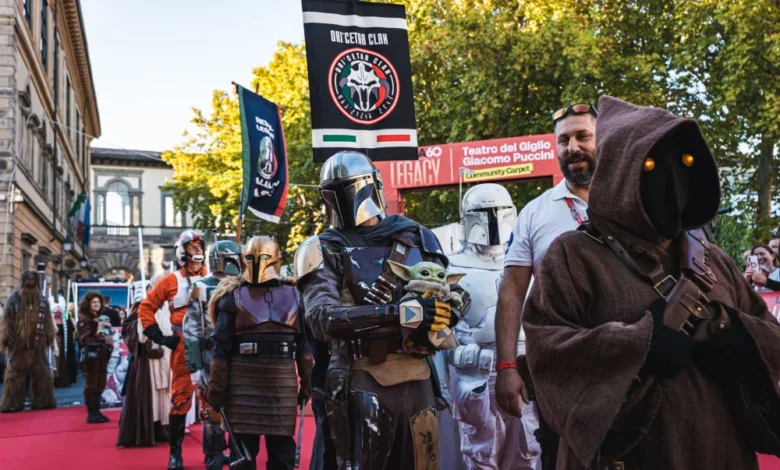
While official pavilions and celebrity panels draw considerable media attention, the true beating heart of Lucca Comics and Games remains its attendee base. For five days, the medieval Tuscan city effectively becomes a living, breathing Cosplay Utopia, characterized by the extraordinary dedication, imagination, and sartorial craftsmanship of thousands of costumed participants.
The narrow cobblestone streets formed a continuous, rolling panorama of pop culture icons. Representations spanned centuries and mediums, ranging from Tolkien’s Middle-earth and J.K. Rowling’s Wizarding Chapel to Nintendo’s Mario Bros. and Netflix’s Squid Game. Among the crowds, spotters easily identified meticulously detailed recreations, including Leon from Luc Besson’s 1994 cinematic classic Léon: The Professional—complete with a silenced prop pistol and a potted houseplant—alongside Walter White from Breaking Bad and groups cosplaying the original cast of Jurassic Park alongside a replica Jeep.
A notable highlight of the festival’s traditional Star Wars parade occurred when the procession was led by a Mandalorian whose identity remained concealed beneath Beskar armor for much of the event. It was later revealed that the person inside the suit was popular Italian author, archaeologist, and television personality Alberto Angela, who had spent the day navigating the ecstatic crowds completely incognito.
A Retrospective on the 60th Anniversary and Broader Industry Implications
The conclusion of Lucca Comics and Games on November 1 marks the end of another record-breaking chapter for European convention culture. Over six decades, the event has evolved from a modest regional trade fair into a global bellwether for the entertainment industry.
The convergence of 80,000 daily attendees in a preserved medieval environment presents unique logistical challenges, yet it also provides a uniquely intimate atmosphere that differentiates Lucca from its cavernous American counterparts in San Diego or New York. By embedding pop-up experiences directly into the historical architecture of Tuscany, the festival creates an immersive environment where historic heritage and futuristic commercial entertainment coexist.
From an analytical standpoint, this year’s data and public reactions point to several clear trajectories for the entertainment sector heading into 2026 and beyond. First, legacy IP holders are increasingly utilizing European festivals to gauge international sentiment before major multi-platform rollouts, as evidenced by the strategic positioning of the upcoming Harry Potter television property. Second, transmedia properties—spanning manga, anime, live-action cinematic adaptations, and streaming series—are experiencing unprecedented cross-market synergy, with European audiences proving eager consumers of niche Japanese storytelling styles. Finally, the sheer economic and social power of fan-driven spectacles, exemplified by the massive turnout for Percy Jackson and the ubiquitous presence of high-end cosplayers, demonstrates that physical, community-based fan gatherings are more vital to industry health than ever before. As Lucca looks toward its next decade, the festival remains an indispensable summit for creators and consumers alike.