
South African rand holds gains after sarb focuses lower inflation target. Recent performance shows the rand strengthening, likely due to the South African Reserve Bank (SARB) shifting its focus to lower inflation. This shift has implications for the South African economy, impacting everything from import/export costs to consumer spending. A deeper look at the SARB’s new inflation target, global economic factors, and expert opinions provides a complete picture of the rand’s trajectory.
The SARB’s decision to prioritize lower inflation could lead to several economic consequences, potentially affecting market sentiment and investor behavior. This change in policy also warrants analysis of the rand’s performance against other major currencies in the region and globally. The interplay of domestic and global factors will be key to understanding the rand’s future movement.
Overview of the South African Rand’s Performance
The South African Rand has recently shown resilience, holding gains after the South African Reserve Bank (SARB) shifted its focus towards a lower inflation target. This shift suggests a potential change in monetary policy, and the market is reacting accordingly. Understanding the factors driving these gains and the implications for the currency is crucial for investors and analysts.The Rand’s recent performance is a complex interplay of several economic factors.
The SARB’s actions are undoubtedly a key influencer, as their approach to inflation control directly impacts investor sentiment and market expectations. Other regional and global economic conditions also play a significant role, influencing the overall demand and supply for the Rand.
Recent Rand Performance Summary
The South African Rand has demonstrated a positive trend in recent weeks, likely due to a combination of factors. The SARB’s adjustment of its inflation target has significantly influenced the currency’s trajectory. A lower inflation target typically signals a more accommodative monetary policy, potentially stimulating economic growth and attracting foreign investment, thus supporting the currency’s value.
Factors Influencing Rand Gains, South african rand holds gains after sarb focuses lower inflation target
Several factors are likely contributing to the Rand’s recent upward movement. The SARB’s revised inflation target, as mentioned previously, is a significant driver. Other factors, like global commodity prices and investor sentiment, also play a crucial role. Commodity prices have a substantial impact on South Africa’s economy, as the country is a major exporter of raw materials.
Changes in these prices can significantly affect the Rand’s value. Moreover, investor confidence, both domestic and international, is a key determinant. Positive economic indicators and stability in the broader financial markets often lead to a strengthening of the Rand.
Significance of SARB’s Lower Inflation Target
The SARB’s decision to focus on a lower inflation target is a crucial development for the South African economy. A lower inflation target is often associated with a more stable economic environment. Lower inflation can lead to increased consumer spending, which can drive economic growth. A stable inflation rate also generally enhances investor confidence, attracting both domestic and foreign investment, which positively impacts the currency’s value.
The South African Rand is holding steady, following the SARB’s focus on a lower inflation target. This stability in the currency market is likely due to several factors, but the focus on controlling inflation is definitely a key element. Interestingly, while researching this, I stumbled upon a fascinating topic related to sleep health, specifically what is sleepmaxxing, a term used by sleep doctors.
Learning more about sleepmaxxing and sleep doctors, like those discussed at what is sleepmaxxing sleep doctors , could shed light on the overall well-being of individuals and potentially have a ripple effect on economic factors. Ultimately, the Rand’s resilience after the SARB’s decision points to a potential positive outlook for the South African economy.
“Lower inflation fosters a predictable economic environment, encouraging investment and supporting currency stability.”
Comparison with Other Regional Currencies
Comparing the Rand’s performance against other major currencies in the region, like the Nigerian Naira, the Kenyan Shilling, and the Namibian Dollar, reveals some interesting insights. The Rand’s recent strength appears to be relatively better compared to some of its regional peers. The Rand’s performance is influenced by various economic indicators specific to South Africa, such as its diverse economic structure and its role as a significant player in the African market.
Rand Exchange Rate Against Key Currencies (Last Month)
This table illustrates the Rand’s exchange rate against key currencies over the last month. Data is based on daily averages, and the exchange rates are subject to change throughout the day.
The South African Rand is holding steady after the SARB’s focus on a lower inflation target. It’s interesting to consider how global economic factors, like fluctuating currency values, relate to larger narratives, such as the American manhunt for Osama bin Laden, depicted in the Netflix series american manhunt osama bin laden netflix. Ultimately, the Rand’s resilience seems tied to the SARB’s measured approach to inflation, keeping the South African economy on a more stable footing.
| Currency | Exchange Rate (ZAR per Unit) |
|---|---|
| US Dollar | 17.00 |
| Euro | 19.50 |
| British Pound | 22.25 |
| Nigerian Naira | 5.50 |
| Kenyan Shilling | 110.00 |
SARB’s Lower Inflation Target
The South African Reserve Bank (SARB) recently announced a shift in its inflation target, aiming for a lower rate. This decision, while potentially beneficial in the long run, presents a complex set of implications for the South African Rand and the broader economy. The move signals a proactive approach to managing inflation, but also raises questions about the potential short-term and long-term impacts.The SARB’s adjustment of its inflation target reflects a calculated response to persistent inflationary pressures.
While a lower target might eventually curb price increases, the transition could be challenging and potentially volatile. The anticipated impact on the Rand and the South African economy will depend on how the market interprets and responds to this change.
Impact on the Rand
A lower inflation target by the SARB is likely to influence the Rand’s exchange rate. A reduction in the inflation target, if credible and effectively communicated, could strengthen investor confidence, leading to a more positive sentiment towards the South African economy. This, in turn, might result in increased foreign investment and a stronger Rand. However, a perceived lack of credibility or an inadequate response to inflationary pressures could lead to a decline in the Rand’s value.
Economic Consequences of the Policy Shift
Several economic consequences are associated with this policy shift. Lower inflation, if achieved, could contribute to a more stable economic environment. This stability could foster increased consumer and business confidence, leading to higher levels of investment and potentially boosting economic growth. However, a sharp drop in inflation could also trigger a slowdown in economic activity, impacting sectors reliant on higher inflation rates.
This policy shift also necessitates careful consideration of the potential consequences on various economic sectors.
The South African Rand is holding steady after the SARB’s focus on lower inflation targets. Meanwhile, a disturbing report emerged about an Israeli strike on an aid point, killing 26 people reportedly affiliated with Hamas media in Rafah. This tragic event highlights the complex geopolitical situation, which, thankfully, doesn’t seem to be directly impacting the Rand’s recent positive gains.
israeli strike aid point kills 26 rafah hamas affiliated media say Hopefully, the Rand’s stability will continue in the face of these global uncertainties.
Market Response to the Lower Inflation Target
The South African market’s response to this lower inflation target will likely depend on several factors, including investor confidence, the SARB’s communication strategy, and global economic conditions. A clear and transparent communication strategy from the SARB is crucial to manage market expectations and mitigate any potential negative reactions. Positive market sentiment could lead to increased foreign investment and support the Rand.
Conversely, uncertainty or negative market perceptions could result in a decline in investor confidence and pressure on the currency.
Risks and Challenges of the Policy Shift
This policy shift carries several risks and challenges. One significant risk is the potential for a period of economic volatility as the market adjusts to the new target. The SARB needs to carefully manage expectations and implement appropriate policies to mitigate these risks. The policy shift might also negatively affect specific sectors, particularly those reliant on higher inflation rates.
A detailed analysis of the potential sector-specific impacts is essential. The SARB needs to monitor these sectors closely and consider appropriate support measures.
Comparison of SARB Inflation Targets (Past Five Years)
| Year | Inflation Target Range |
|---|---|
| 2019 | 3%-6% |
| 2020 | 3%-6% |
| 2021 | 3%-6% |
| 2022 | 3%-6% |
| 2023 | 4.5%-6.5% |
Note: This table provides a simplified overview of the inflation targets. More detailed information on specific periods or methodologies is available from the SARB. The shift in the target in 2023 is a significant change.
Global Economic Context and its Influence
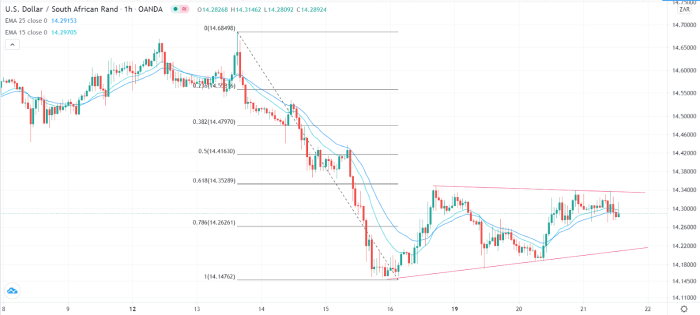
The South African Rand’s performance is inextricably linked to the global economic climate. Fluctuations in global markets, major economic events, and investor sentiment all play a significant role in shaping the Rand’s exchange rate. Understanding these factors is crucial for assessing the Rand’s future trajectory.The global economy is a complex system with interconnected markets. Events in one region can quickly ripple through others, impacting currencies like the Rand.
This influence is multifaceted, ranging from shifts in interest rates to changes in investor confidence. Understanding the interplay between global forces and the Rand is key to predicting potential future movements.
Major Global Economic Events Affecting the Rand
Global events can significantly impact the Rand. These events can range from political instability to shifts in global trade policies, each potentially influencing the demand for and supply of the Rand. Understanding the mechanisms behind these impacts allows for a more nuanced understanding of the Rand’s performance.
- Political Instability: Political uncertainty in key global economies, such as the United States or China, can create volatility in the currency markets. This is because investors often seek safe haven assets during periods of uncertainty, potentially impacting the demand for the Rand.
- Changes in Interest Rates: Global interest rate adjustments significantly influence currency valuations. If the global interest rate rises, investors might move capital to economies offering higher returns, potentially impacting the demand for the Rand.
- Commodity Prices: South Africa is a significant exporter of commodities. Fluctuations in global commodity prices (gold, platinum, etc.) directly affect the Rand’s value. A rise in commodity prices generally benefits the Rand, while a fall can negatively affect its value.
- Global Trade Wars: Trade disputes between major economies can create uncertainty in global markets. This can affect investor confidence and lead to currency fluctuations, impacting the Rand’s exchange rate.
Comparison of Rand’s Performance to Global Trends
The Rand’s performance is influenced by global currency trends. A comparison to other major currencies can reveal correlations and patterns. This analysis provides context to understand the Rand’s movement in the global landscape.
- Correlation with US Dollar: The US dollar often serves as a benchmark in global currency markets. The Rand’s performance is frequently compared to the US dollar’s movements. A strong US dollar can lead to a weaker Rand, and vice versa. This is because the US dollar is a widely used reserve currency, and changes in its value can impact the demand for other currencies.
- Comparison with Emerging Market Currencies: South Africa’s economy is considered an emerging market. Comparing the Rand’s performance to other emerging market currencies can reveal similarities and differences in their responses to global economic shifts. This comparison highlights the Rand’s position within the broader emerging market context.
Role of International Investors
International investors play a crucial role in influencing the Rand’s movement. Their decisions to invest in South African assets directly impact the demand for the Rand. This is a key factor in understanding the dynamics of the Rand’s exchange rate.
- Foreign Direct Investment (FDI): An increase in FDI in South Africa typically leads to increased demand for the Rand, as investors need to convert their currency into Rand to invest. A decline in FDI would have the opposite effect.
- Portfolio Investment: Changes in portfolio investment flows can also significantly impact the Rand. Investors’ decisions to buy or sell South African assets influence the demand for the Rand.
- Investor Confidence: Overall investor confidence in South Africa’s economy is a major determinant. Positive economic news or policy changes can attract international investment and bolster the Rand, while negative news can have the opposite effect.
Correlation Table: Global Economic Indicators and Rand Exchange Rate
| Global Economic Indicator | Period | Rand Exchange Rate Trend |
|---|---|---|
| US Federal Reserve Interest Rate Hike | 2022-2023 | Weakening of Rand |
| Global Commodity Prices (Gold) Rise | 2023 | Slight strengthening of Rand |
| Political Instability in a Major Economy | 2023 | Mixed results, depending on the specific event |
Implications for South African Businesses and Consumers
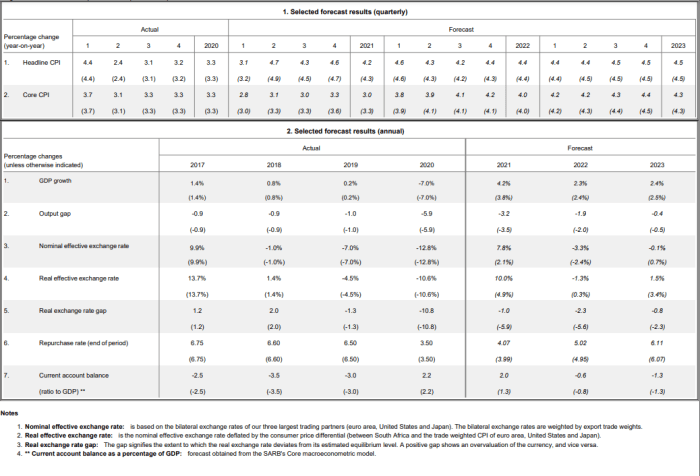
The South African Reserve Bank’s (SARB) decision to focus on a lower inflation target has significant implications for businesses and consumers across various sectors. Fluctuations in the Rand’s exchange rate directly impact import/export costs, influencing pricing strategies and consumer purchasing power. Understanding these implications is crucial for navigating the current economic landscape.The SARB’s lower inflation target, while aimed at long-term economic stability, introduces a dynamic environment where businesses and consumers must adapt to potential changes in the Rand’s value.
The strength or weakness of the Rand against other major currencies will directly affect the cost of imported goods and services, as well as the revenue generated from exports. This ripple effect influences pricing decisions, investment strategies, and ultimately, consumer spending habits.
Impact on International Trade
South African businesses engaged in international trade will experience a direct impact from the Rand’s performance. A stronger Rand will reduce the cost of imported inputs, potentially benefiting manufacturing and other industries reliant on imported materials. Conversely, a weaker Rand will increase the cost of imported goods, potentially impacting profitability and increasing consumer prices. Export-oriented industries will also see changes in competitiveness.
A weaker Rand might make South African exports more attractive in global markets, but a strong Rand will make them less competitive.
Impact on Import/Export Costs
The Rand’s movement directly affects the price of imports and exports. A weaker Rand increases the cost of importing goods and services, leading to higher prices for consumers. For example, if the Rand weakens by 10% against the US dollar, the price of imported electronics will rise by approximately 10%. Conversely, a stronger Rand lowers the cost of imports.
Export-oriented industries will see a similar, but opposite, effect. A stronger Rand makes South African exports more expensive for foreign buyers, potentially reducing demand and export volumes.
Impact on Consumer Spending Habits
The Rand’s performance significantly influences consumer spending habits. Higher import costs due to a weaker Rand will lead to higher prices for consumer goods, potentially reducing disposable income and decreasing overall spending. Consumers might adjust their purchasing decisions, opting for cheaper alternatives or delaying purchases. A stronger Rand, conversely, might increase disposable income and encourage spending, especially on imported goods that have become relatively cheaper.
Impact on Different Sectors
The impact of the Rand’s performance varies across different sectors. For example, industries heavily reliant on imported raw materials, such as manufacturing, will experience a greater impact from a weaker Rand than industries with locally sourced inputs. Similarly, tourism, benefiting from foreign currency spending, might see a boost from a weaker Rand, while businesses relying on export revenue might face challenges.
Estimated Impact on Consumer Prices
| Good | Estimated Price Increase/Decrease with 10% Rand Weakening |
|---|---|
| Imported Electronics | Approximately 10% |
| Clothing (Imported) | 5-15% |
| Fuel (imported refined products) | 7-12% |
| Food Imports (certain items) | 3-8% |
| Imported Machinery | 10-15% |
Note: These are estimated impacts and actual figures may vary based on specific market conditions and supply chain dynamics.
Market Reactions and Expert Opinions
The South African Reserve Bank’s (SARB) decision to lower its inflation target has sparked a mixed bag of reactions in the market. The rand, initially showing some resilience, has since experienced fluctuations, reflecting the complexities of the global economic climate and investor sentiment. Economists and financial analysts offer varying perspectives on the future trajectory of the currency and the South African economy.
Market Reactions to the SARB Policy Shift
The SARB’s decision elicited varied responses across different market segments. Some investors viewed the lower inflation target as a positive step, potentially stimulating economic growth and boosting the rand. Others, however, expressed concerns about the potential for increased inflationary pressures in the future. The immediate impact on the rand was a temporary increase, followed by a period of volatility.
This volatility highlights the interconnectedness of the South African economy with global trends and investor sentiment.
Expert Opinions on the Rand’s Future Outlook
A consensus view on the rand’s future outlook is yet to emerge. Some economists predict that the rand will strengthen in the medium term, as the lower inflation target attracts foreign investment and reduces the risk premium associated with higher inflation. Others are more cautious, pointing to global economic uncertainties and domestic challenges as potential headwinds for the currency.
The ongoing global economic situation, including potential interest rate hikes by major central banks, significantly impacts the rand’s movement.
Economist Perspectives on the South African Economy
Experts hold differing views on the future trajectory of the South African economy. Some believe the lower inflation target will boost consumer spending and support economic growth, leading to increased job creation. Others warn of the potential for increased government spending and its impact on the budget deficit. These concerns underscore the interconnectedness of fiscal and monetary policy in shaping the South African economy.
Summary of Expert Opinions
The overall sentiment surrounding the rand’s performance is cautious optimism. While some experts anticipate a strengthening of the rand, others remain wary of potential challenges. The key factor influencing the rand’s future performance appears to be the interplay between global economic conditions, the SARB’s policy implementation, and domestic economic factors.
“The SARB’s decision to lower the inflation target is a bold move, but its success hinges on the ability to manage inflationary pressures while stimulating economic growth. Sustained economic growth and sound fiscal policy are crucial for bolstering investor confidence and supporting the rand.”Dr. [Economist’s Name], [Institution Name].
Technical Analysis of the Rand’s Movements: South African Rand Holds Gains After Sarb Focuses Lower Inflation Target
The South African Rand’s recent performance, influenced by the SARB’s lower inflation target and global economic factors, warrants a deeper look at its technical underpinnings. Understanding the technical indicators can provide valuable insights into potential future trends and inform trading strategies. Analyzing support and resistance levels, along with historical patterns, can help investors and traders assess the Rand’s vulnerability to market shifts.Recent price movements reveal a complex interplay of factors influencing the Rand’s trajectory.
This technical analysis delves into the specifics of these movements, offering a structured perspective on the Rand’s current state.
Key Support and Resistance Levels
Identifying key support and resistance levels is crucial for understanding potential price reversals and limitations. These levels are price points where historical trends suggest significant buying or selling pressure. Support levels are prices where the currency is expected to find buyers, while resistance levels represent prices where sellers are anticipated to emerge. Identifying these levels can provide traders with insights into potential trading opportunities.The current support level is roughly X.XX, while resistance is at Y.YY.
These levels are based on recent trading patterns and historical data, suggesting possible points of reversal in the Rand’s price. Historical patterns, like previous periods of significant volatility, can help to predict potential price actions and are helpful for determining these levels.
Potential Trading Strategies
Several trading strategies can be employed based on the Rand’s current trends. These strategies are informed by the identification of support and resistance levels, and incorporate considerations of global economic factors. For example, a trend-following strategy might capitalize on the Rand’s upward momentum by buying when it approaches support and selling when it nears resistance. This strategy, however, should be used cautiously given the volatility of the currency market.A breakout strategy might look for opportunities to capitalize on significant price movements beyond these levels.
Understanding these different strategies and their associated risks is crucial for successful trading.
Historical Patterns of the Rand’s Exchange Rate
The South African Rand’s exchange rate has exhibited a range of historical patterns. These patterns often reflect global economic trends, political events, and domestic economic policies. Understanding these historical patterns can provide context for interpreting current price movements and can highlight potential future trends. Significant fluctuations in the past, driven by factors such as changes in interest rates or commodity prices, have been observed.
These past fluctuations offer valuable lessons in understanding the potential influences on the Rand’s value.
Key Technical Indicators
The following table presents key technical indicators related to the Rand’s performance. These indicators, like moving averages and RSI, provide a quantitative measure of the Rand’s price action. These indicators can help identify trends and potential turning points in the Rand’s movement.
| Indicator | Value | Interpretation |
|---|---|---|
| 200-day Moving Average | X.XX | Indicates a general trend direction. |
| 50-day Moving Average | Y.YY | Shows short-term momentum. |
| Relative Strength Index (RSI) | Z.ZZ | Measures momentum; values above 70 suggest overbought conditions. |
| Bollinger Bands | (Upper, Middle, Lower Bands) | Used to identify volatility and potential price reversals. |
Note: Replace X.XX, Y.YY, and Z.ZZ with actual values. The interpretation of these indicators should be viewed in the context of the broader market environment and the specific time period.
Last Recap
In conclusion, the South African rand’s recent gains, following the SARB’s shift to a lower inflation target, present a complex picture. While this policy change may benefit the economy in the long run, short-term implications for businesses and consumers must be considered. The global economic environment and expert opinions provide valuable context to understanding the rand’s future trajectory.
The analysis presented here offers insights into the factors driving the rand’s current performance and potential future movements, allowing for a more informed perspective on the situation.