NASA Astronaut Andre Douglas Inspects RS-25 Engine Ahead of Artemis III Preparations at Kennedy Space Center

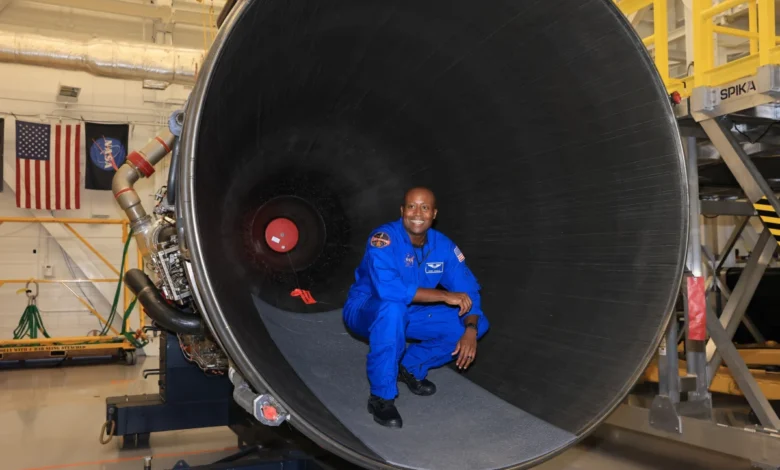
NASA astronaut and Artemis III mission specialist Andre Douglas recently conducted a comprehensive on-site inspection of an RS-25 engine test article within the iconic Vehicle Assembly Building at the agency’s Kennedy Space Center in Florida. The visit highlights the steady, meticulous progress of the United States’ flagship lunar exploration program, which aims to return human beings to the surface of the Moon for the first time in over half a century.
As preparations for upcoming crewed missions intensify, engineers, technicians, and astronauts are working in tandem to review the critical hardware that will launch humanity back into deep space. The RS-25 engines represent a cornerstone of this technological endeavor, serving as the powerhouse for the Space Launch System (SLS) rocket core stage.
The Anatomy of the SLS Powerhouse
During the Artemis III mission, a cluster of four RS-25 engines will ignite to provide the staggering thrust required to lift the Space Launch System off the pad and propel the Orion spacecraft out of Earth’s atmosphere. These engines are among the most sophisticated and reliable liquid-propellant rocket engines ever designed. Inheriting the legacy of the Space Shuttle Main Engines (SSME), the modernized RS-25s have been upgraded with advanced controllers, improved nozzle insulation, and the capability to operate at higher power levels to meet the demanding parameters of deep-space exploration.
Each engine burns liquid hydrogen and liquid oxygen, producing a combined sea-level thrust of more than two million pounds at liftoff. When operating in conjunction with the twin solid rocket boosters, the SLS core stage delivers the immense velocity necessary to break free from Earth’s gravitational pull and set the Orion capsule on its trajectory.
For astronaut Andre Douglas, closely examining the hardware firsthand is a vital part of mission specialization. Mission specialists undergo rigorous training regimens that encompass not only flight simulations and geological fieldwork but also hands-on familiarization with the mechanical systems that will carry them into orbit. Understanding the physical scale, integration points, and maintenance access of the propulsion systems ensures that crew members maintain a comprehensive grasp of their vehicle’s architecture.
Mission Architecture and Strategic Adjustments for Artemis III
The scope and flight profile of Artemis III have evolved through careful planning by NASA leadership and international partners to maximize safety and mission assurance. Originally envisioned as the historic landing mission that would return astronauts to the lunar south pole, mission planning was subsequently adjusted to optimize the sequence of complex operational milestones required in orbit.
Under the current mission architecture, the SLS rocket will launch the Orion spacecraft into low Earth orbit with its crew aboard. Once in orbit, the mission will focus on conducting critical rendezvous, proximity operations, and docking tests with human lunar lander systems. These orbital checkouts are vital. They allow the crew and ground controllers to thoroughly evaluate the life support systems, navigation instruments, and docking mechanisms in the actual space environment before executing a full lunar landing.
By validating these capabilities during Artemis III, NASA establishes a secure operational baseline. The rigorous testing clears the technical pathway for the subsequent Artemis IV mission, which is scheduled to carry astronauts all the way down to the lunar surface. This incremental testing philosophy mirrors the successful methodology of the historic Apollo program, where intermediate orbital steps—such as Apollo 9 and Apollo 10—were used to test lunar modules in Earth and lunar orbits before attempting touchdown.
Chronology of the Artemis Program
The path leading to Andre Douglas’s inspection at the Kennedy Space Center is built upon years of cumulative milestones, technological development, and uncrewed test flights:
- December 2017: Space Policy Directive 1 is signed, officially refocusing NASA’s exploration program on a human return to the Moon, followed by missions to Mars.
- November 2022: Artemis I successfully launches as an uncrewed flight test, sending the Orion spacecraft around the Moon and back to Earth, proving the flight readiness of the SLS rocket and Orion capsule.
- April 2023: NASA announces the four-person crew for the Artemis II mission, marking the first crewed flight test around the Moon.
- November 2026: Astronaut Andre Douglas inspects RS-25 engine hardware inside the Vehicle Assembly Building at Kennedy Space Center, emphasizing the operational readiness preparations for Artemis III.
- Future Projections: Following the execution of Artemis III and its low Earth orbit rendezvous and docking evaluations, Artemis IV will target the actual landing of astronauts on the lunar surface.
Technical Specifications and Supporting Data
The scale of the Space Launch System and its supporting infrastructure is unprecedented in modern aerospace engineering. The Vehicle Assembly Building (VAB) at Kennedy Space Center, where Douglas conducted his inspection, stands as one of the largest buildings in the world by volume, offering the massive vertical clearance required to stack the SLS core stage, boosters, and Orion spacecraft together.
Key technical parameters of the SLS Block 1 configuration used for early Artemis missions include:
- Height: Approximately 322 feet (98 meters), taller than the Statue of Liberty.
- Total Thrust at Liftoff: 8.8 million pounds, generating about 15% more thrust than the historic Saturn V rocket used during the Apollo program.
- Core Stage Fuel Capacity: Over 733,000 gallons of super-cold liquid hydrogen and liquid oxygen.
- Orion Capacity: Designed to support a crew of four astronauts for missions lasting up to 21 days in deep space.
These metrics illustrate the immense logistical and engineering challenges involved in returning humans to the lunar neighborhood. Every component, from the avionics systems to the RS-25 turbopumps, must function flawlessly under extreme thermal and mechanical stress.
Official Responses and Industry Perspectives
While visiting the Kennedy Space Center, mission leadership underscored the collaborative nature of the Artemis program, which relies on thousands of suppliers, contractors, and international space agencies.
"The progress we are seeing on the flight hardware floor reflects the dedication of the entire aerospace workforce," noted a senior NASA program official familiar with the integration efforts. "When astronauts like Andre Douglas step inside the VAB to inspect engines like the RS-25, it bridges the gap between the engineers who build the vehicle and the professionals who will fly it. Every inspection, every test firing at Stennis Space Center, and every structural check brings us closer to establishing a sustainable human presence in deep space."
Contractor partners responsible for manufacturing the RS-25 engines have similarly emphasized quality control and technological refinement. By transitioning from the heritage Space Shuttle engines to newly manufactured units utilizing advanced 3D printing and digital manufacturing techniques, the production lines have successfully reduced per-unit costs while maintaining rigorous aerospace standards.
Broader Impact and Geopolitical Implications
Beyond the immediate technical milestones, the Artemis program serves as a cornerstone of modern international diplomacy and technological innovation. Through the Artemis Accords—a set of principles governing civil exploration and use of outer space—NASA has partnered with dozens of nations to establish norms for peaceful, transparent, and cooperative space exploration.
The successful execution of Artemis III and its precursor missions carries significant implications for the future commercialization of low Earth orbit and deep-space infrastructure. As private companies develop human landing systems and commercial space stations, NASA’s role is shifting toward acting as an anchor customer while fostering a robust lunar economy.
Furthermore, the technological spinoffs generated by the development of the SLS rocket, advanced life support systems, and high-efficiency propulsion will continue to benefit terrestrial industries. Innovations in materials science, cryogenic fluid management, and radiation shielding developed for Artemis missions frequently find applications in commercial aviation, medicine, and clean energy sectors on Earth.
As preparations continue at Kennedy Space Center, the focused efforts of astronauts like Andre Douglas and the thousands of technicians supporting them ensure that the United States remains on track to write the next chapter of human exploration, setting the stage for sustainable voyages to the Moon and, eventually, to Mars.