Mercedes Acknowledges Strongest Power Unit Amidst Red Bull’s ADUO Scrutiny and Potential Upgrades

Mercedes has openly admitted to possessing the most potent Formula 1 power unit on the grid, a statement that has predictably amplified scrutiny and interest from rivals, particularly Red Bull, as the FIA’s Aerodynamic and Undercutting Optimization (ADUO) system comes under renewed focus. This development injects a fresh layer of intrigue into a season already marked by intricate technical regulations and strategic power unit development.
The ADUO system, introduced at the dawn of the current F1 era, has been a persistent political talking point. Initially, the FIA’s assessment placed Red Bull-Ford Powertrains as the benchmark engine manufacturer, a conclusion that Red Bull itself subsequently requested a review of, suggesting potential discrepancies in the methodology or interpretation of the data. This initial assessment dictated the upgrade allowances for each manufacturer, influencing their development paths for the season and beyond.
While Red Bull has publicly accepted the initial ADUO results, they remain steadfast in their belief that Mercedes’ power unit is superior. Their concern centers on the potential for rivals to leverage upgrade opportunities, theoretically designed to balance the field, while Red Bull might be restricted from making equivalent improvements to their own V6 engines, thereby potentially preserving Mercedes’ advantage at the top of the ADUO rankings.
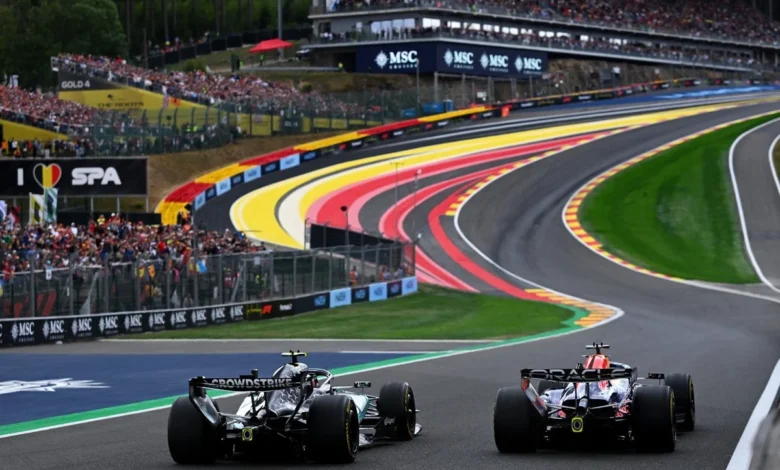
The latest wave of attention was triggered by Mercedes’ Team Principal, Toto Wolff, following the Belgian Grand Prix. Wolff candidly discussed the team’s ongoing reliability challenges, inadvertently confirming their engine’s raw performance. "We had an issue on all Mercedes engines that we lacked the power on the straight and that beat him [George Russell] badly, it 100% goes on us," Wolff stated to Sky Sports F1, referencing an incident where a lack of straight-line speed hampered George Russell’s race and contributed to his contact with teammate Lewis Hamilton, ultimately leading to Hamilton’s retirement.
Wolff further elaborated on the team’s predicament, stating, "We’re trying our best as a team, we have the most powerful power unit, we have a strong car that is capable of winning, everybody gives its maximum to minimise the mistakes and still it happens because we are humans at work. We let Kimi [Antonelli] down in Silverstone where George got a podium that was maybe better than the result should have been, and then one DNF’d in Montreal, the other one DNF’d in Barcelona, that’s a little bit the story of our season here. It’s a technical sport, mechanical sport." This admission, while framed within the context of reliability issues, unequivocally points to the inherent strength of Mercedes’ internal combustion engine.

Chronology of ADUO Scrutiny and Development
The ADUO system’s timeline is crucial to understanding the current situation. The system is designed to monitor and regulate power unit performance over designated periods, with manufacturers receiving upgrade tokens based on their relative performance.
- Initial Assessment Period: This period, which predates the start of the season, established the baseline for power unit performance. The FIA’s assessment placed Red Bull-Ford Powertrains at the top, indicating they were within a certain performance delta of the theoretical optimum. Mercedes, Ferrari, Audi, and Honda were assessed as being further behind.
- Upgrade Allocations (First Period): Based on the initial assessment, manufacturers considered to be within 2-4% of the benchmark were allocated one upgrade for the current season and one for the following season. Those deemed more than 4% behind received two upgrades per season. This meant Red Bull-Ford Powertrains, as the benchmark, received no upgrade tokens under this allocation. Mercedes, being within the 2-4% bracket, received one upgrade token for the current season and one for the next. Ferrari, Audi, and Honda, falling into the over 4% bracket, were granted two upgrades for the current season and two for the next.
- Second ADUO Period: This crucial period commenced at the Monaco Grand Prix and is set to conclude with the Hungarian Grand Prix. The results of this period will dictate further upgrade allowances for the remainder of the season and into the next.
- FIA Review and Delayed Publication: A significant factor contributing to the current tension is the delay in the official publication of the first ADUO period’s results. This delay is reportedly linked to Red Bull’s request for a review of the initial assessment, adding an element of uncertainty to the regulatory landscape.
Red Bull’s Perspective and Concerns
Following Wolff’s candid remarks, Red Bull’s Team Principal, Laurent Mekies, echoed the sentiment, confirming his team’s agreement with Mercedes’ assessment of their power unit’s supremacy. "Toto is right. I also think that they have the most powerful power unit," Mekies stated after the Belgian Grand Prix. "And certainly they had a sizeable advantage on the straight this weekend again. But it’s not the first weekend. They have an advantage on the straight most weekends. And this weekend a bit more with the track sensitivity. So we will see what’s happening. As you said, the second period closing in Budapest in a week’s time. We’ll see what’s happening."
Mekies’ comments highlight a key concern for Red Bull: the consistent straight-line speed advantage exhibited by Mercedes. While track characteristics can amplify such advantages, the recurrence of this performance differential throughout the season suggests a fundamental superiority in Mercedes’ engine power. The approaching end of the second ADUO period in Hungary intensifies the focus on the FIA’s upcoming decisions.
The Implications of ADUO and Potential Upgrades

The ADUO system’s fundamental objective is to foster closer competition by preventing any single manufacturer from establishing an insurmountable technological advantage. By allocating upgrade tokens based on performance differentials, the FIA aims to allow trailing teams to catch up while preventing those at the front from further extending their lead.
If the upcoming ADUO assessment were to place Mercedes at the top of the V6 power standings, it would have significant ramifications. For Red Bull’s power unit to remain eligible for upgrade opportunities, it would need to be at least 2% off the performance level of Mercedes’ engine. This creates a delicate balancing act for Red Bull; they must not only improve their own performance but also ensure they remain within the specified performance delta to be eligible for further development.
The delay in publishing the first ADUO results adds another layer of complexity. If the second period’s results are processed and published promptly after the Hungarian Grand Prix, there could be a scenario where the regulatory landscape shifts significantly. The FIA’s decision on whether to acknowledge Mercedes’ perceived power unit advantage and the subsequent upgrade allocations will be closely watched.
Broader Impact on the Championship
The performance of the power unit is a critical factor in Formula 1, impacting everything from straight-line speed on long straights to the efficiency of energy deployment through corners. A superior power unit can provide a tangible advantage, allowing drivers to defend more effectively or make crucial overtakes.
For Mercedes, acknowledging their power unit’s strength, even amidst reliability woes, signifies a significant achievement in their technical development. It suggests that their design philosophy and execution in the hybrid era have yielded a highly competitive engine. However, the recurring reliability issues demonstrate that raw power alone is insufficient; consistent performance and robustness are equally vital for championship contention.

For Red Bull, the situation presents a challenge. While they have historically excelled in chassis development and aerodynamic efficiency, a deficit in power unit performance can become a limiting factor, especially on tracks that favor engine power. Their focus will undoubtedly be on extracting the maximum from their current package while strategically utilizing any available upgrade tokens.
The ongoing debate and the approaching ADUO assessment deadline highlight the intricate interplay between technical regulations, manufacturer development, and on-track performance in modern Formula 1. The decisions made by the FIA in the coming weeks will not only shape the remainder of the current season but also influence the strategic direction of power unit development for years to come, ensuring that the quest for ultimate performance remains a dynamic and closely scrutinized endeavor.
The potential for Mercedes to receive additional upgrade tokens, based on a revised ADUO assessment, could offer them a pathway to resurgence, provided they can resolve their current reliability concerns. Conversely, if the system continues to favor Red Bull or maintain a similar balance, it will underscore the importance of their ongoing chassis and aerodynamic advancements. The coming races, particularly following the Hungarian Grand Prix, are poised to reveal the true impact of these regulatory dynamics on the championship battle.