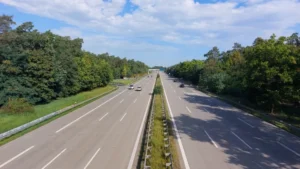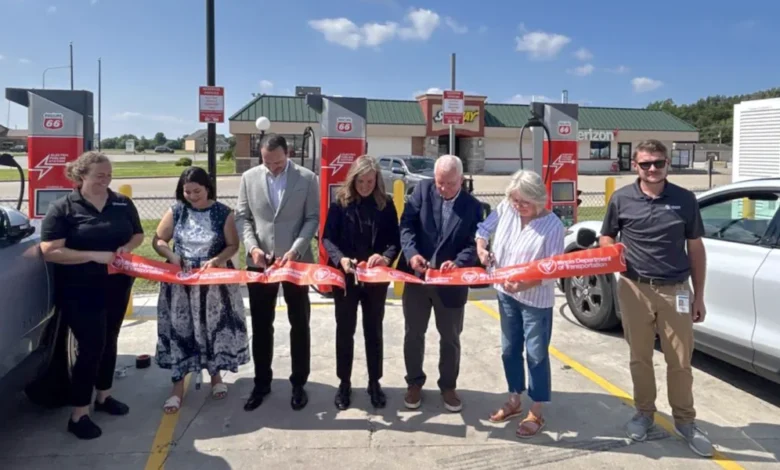
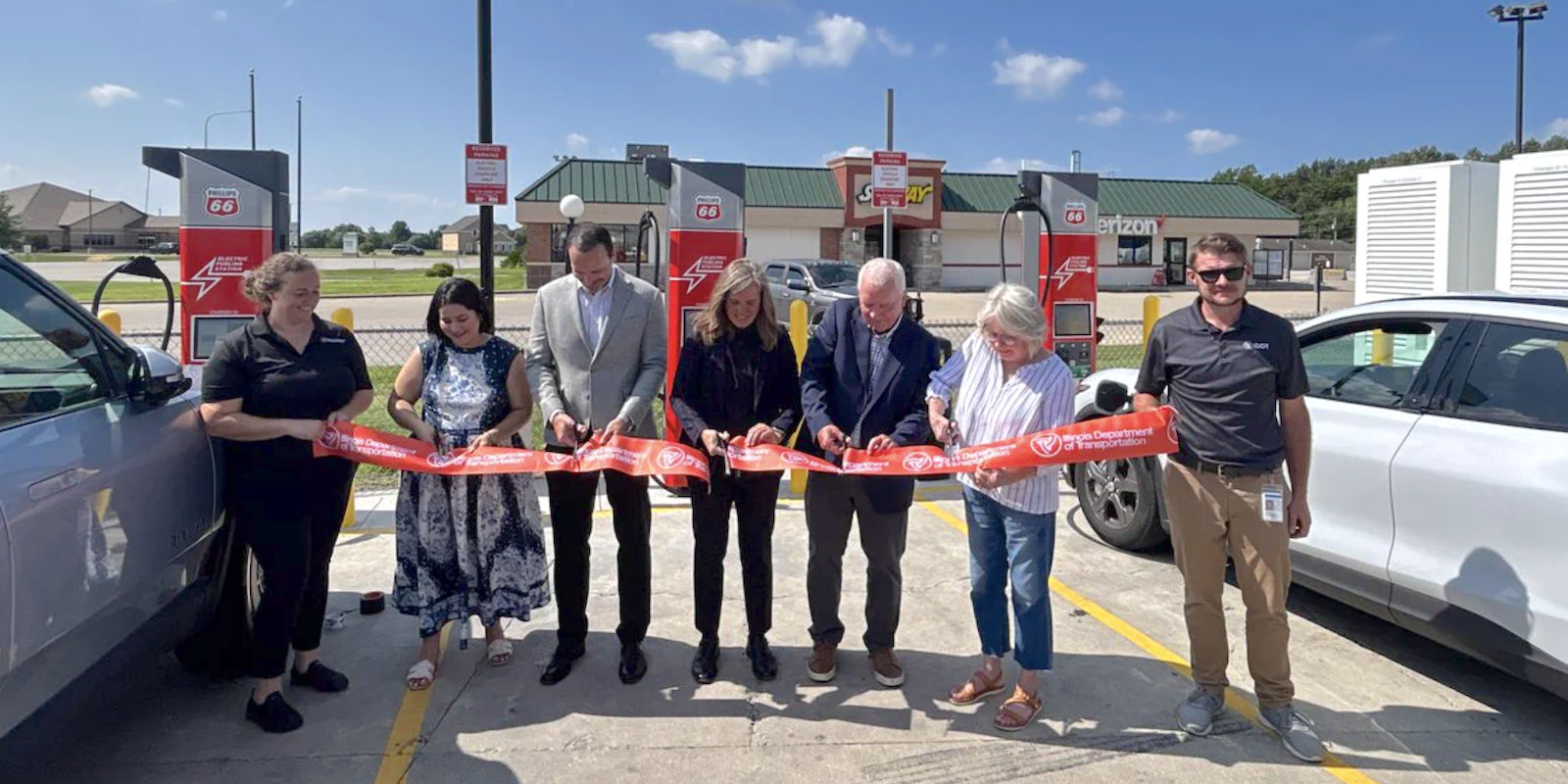
The new charging hub is situated on Illinois 49, strategically positioned near the intersection with Interstate 70. This location was chosen to serve both local residents and long-distance travelers traversing one of the Midwest’s most heavily trafficked east-west arteries. The station features four high-speed direct-current fast charging ports integrated into the Electrify America network. Each port is capable of delivering up to 350 kW of power, a specification that allows most modern electric vehicles to recharge from 10% to 80% capacity in approximately 15 to 20 minutes, depending on the vehicle’s battery architecture.
The deployment in Casey was funded through an $854,641 competitive grant awarded to Phillips 66 as part of the initial wave of NEVI disbursements. The project serves as a "proof of concept" for the state’s broader strategy to eliminate range anxiety and ensure that the benefits of the electric vehicle transition are felt in rural communities as well as urban centers.
Strategic Framework and the NEVI Program
The National Electric Vehicle Infrastructure program was established by the 2021 Bipartisan Infrastructure Law, which allocated $5 billion over five years to create a nationwide network of 500,000 electric vehicle chargers. Illinois is slated to receive approximately $148 million of this total funding through 2026. The primary objective of the program is to ensure that fast-charging stations are available at least every 50 miles along designated Alternative Fuel Corridors, and within one travel mile of those highways.
For Illinois, the Casey station is the first of many. The Illinois Department of Transportation has developed a comprehensive "Drive Electric Illinois" plan that prioritizes the build-out of these corridors to facilitate interstate commerce and tourism. Federal guidelines for these stations are stringent: each site must include at least four ports capable of simultaneous 150 kW charging, maintain a 97% uptime reliability rate, and utilize non-proprietary charging connectors to ensure accessibility for all EV makes and models.

The energization of the Casey site marks a transition from the planning phase to the execution phase of the state’s electrification roadmap. By leveraging private-sector partnerships, such as the one with Phillips 66 and Electrify America, the state aims to build a resilient network that does not rely solely on public management but integrates into existing commercial ecosystems like gas stations, convenience stores, and shopping centers.
Chronology of the Illinois EV Rollout
The path to the Casey ribbon-cutting involved several years of legislative and administrative preparation. In 2021, Governor JB Pritzker signed the Climate and Equitable Jobs Act, which set an ambitious goal of putting one million electric vehicles on Illinois roads by 2030. This state-level mandate provided the policy momentum necessary to aggressively pursue federal NEVI funds.
Following the passage of the Bipartisan Infrastructure Law in late 2021, IDOT submitted its initial Electric Vehicle Deployment Plan to the Joint Office of Energy and Transportation in mid-2022. After receiving federal approval, the state opened its first round of competitive bidding for grants in 2023. These grants were designed to incentivize private entities—ranging from small-town retailers to international energy corporations—to host and maintain charging infrastructure.
Throughout late 2023 and early 2024, construction commenced at several priority sites along I-70, I-55, and I-94. The Casey location emerged as the frontrunner for completion due to existing grid capacity and the readiness of the host site. The successful energization last week was followed by a formal ceremony this week, attended by state transportation officials and local leaders, signaling the start of a rapid deployment phase that will continue through the end of the decade.
Expansion and Round 3 Funding Details
Concurrent with the opening of the Casey station, Illinois officials announced a significant expansion of the program with the unveiling of $23.5 million in "Round 3" NEVI funding. This latest injection of capital is designed to facilitate the construction of 140 new charging ports across 29 unique locations. When combined with the first two rounds of funding, IDOT has now conditionally awarded more than $67 million for the development of 91 charging stations.
The cumulative goal of these first three rounds is to energize 489 public EV charging ports. The geographic distribution of the Round 3 awardees highlights a balanced approach between high-density suburban areas and critical rural junctions. For instance, Heartland Charging Services received over $1.3 million for a site in Oak Park and another $1.35 million for a facility in Aurora, addressing the needs of the Chicago metropolitan area. Conversely, Universal EV was awarded $644,418 for a site at a Days Inn in Springfield and $656,320 for a Subway location in Lebanon, ensuring that the state’s capital and southern regions are not overlooked.
The inclusion of diverse host sites—ranging from public libraries in Arlington Heights to commercial developments in Mokena—suggests a strategy intended to integrate charging into the daily routines of Illinoisans. By placing chargers at locations where drivers already spend time, such as hotels, restaurants, and municipal buildings, the state hopes to make EV ownership practical for those without dedicated home charging capabilities.
Economic Implications and Rural Development
One of the most significant aspects of the Casey opening is its potential impact on rural economic development. Transportation Secretary Gia Biagi emphasized that the interest in EV infrastructure is particularly high in rural areas. Small towns located along major interstates view charging stations as "digital-age hitching posts" that encourage travelers to exit the highway and spend time in the community.
When a traveler stops to charge an electric vehicle for 20 to 30 minutes, they are likely to patronize nearby businesses. In Casey—a town famous for its "World’s Largest" attractions—the addition of a high-tech charging hub provides an additional reason for tourists to stop. This "charge-and-shop" model creates a new revenue stream for local retailers and tax bases for small municipalities.
Furthermore, the construction and maintenance of these stations provide a boost to the local labor market. The NEVI program requires that the installation of charging equipment be performed by electricians certified through the Electric Vehicle Infrastructure Training Program (EVITP). This requirement ensures high-quality installations while promoting specialized vocational training and job creation within the state’s electrical unions and contracting firms.

Technical Analysis and Grid Readiness
The deployment of 350 kW chargers, such as those in Casey, requires significant coordination with local utility providers. These chargers draw a substantial amount of power from the grid, necessitating upgrades to transformers and, in some cases, the installation of on-site battery storage to manage peak demand. The Mach 1 station in Casey serves as a template for how existing retail petroleum sites can transition into multi-energy hubs without compromising grid stability.
The choice of the Electrify America network for the Casey site also reflects a move toward standardization. As the industry shifts toward the North American Charging Standard (NACS), state-funded stations are being designed with future-proofing in mind. Current NEVI requirements mandate the Combined Charging System (CCS) plug, but many newer stations are being built with modular cables or adapters to accommodate the growing number of vehicles adopting the NACS port.
Reliability remains the primary concern for EV adoption. To address this, the NEVI program includes provisions for ongoing operations and maintenance. Grant recipients are often required to provide five-year maintenance plans, ensuring that the chargers do not fall into disrepair—a common complaint with earlier, non-federally funded charging networks.
Broader Policy Context and Future Outlook
The Casey station is a single component of a much larger national and state-level policy shift. At the federal level, the Biden-Harris administration has pushed for a rapid decarbonization of the transport sector, which accounts for the largest share of greenhouse gas emissions in the United States. At the state level, Illinois is positioning itself as a leader in the "Electric Vehicle Revolution," not only through infrastructure but also through manufacturing.
Illinois is home to major EV production facilities, including the Rivian plant in Normal and the upcoming Gotion battery factory in Manteno. By building out a robust charging network, the state is creating the domestic market necessary to support its own industrial base. The "Drive Electric Illinois" initiative is thus both an environmental policy and an economic development engine.

Looking ahead, the state faces the challenge of scaling this network to meet the "one million EVs" goal. While the current 489 planned ports are a significant start, thousands more will be needed over the next decade. Future rounds of funding will likely focus on "gap-filling" in underserved urban neighborhoods and increasing the density of chargers in high-traffic corridors.
The success of the Casey station will be measured not just by the number of kilowatt-hours delivered, but by its ability to convince skeptical drivers that the transition to electric mobility is feasible, even in the heart of rural America. As more stations come online in Urbana, Dixon, Ottawa, and beyond, the map of Illinois will increasingly reflect a state that is prepared for a post-internal combustion engine future. The ribbon-cutting in Casey was more than just a local event; it was the formal start of a new era for Illinois transportation.