Revealing the True Face of Andromeda: How Astrophotographers Strip Away Earthly Interference to Capture Deep Space

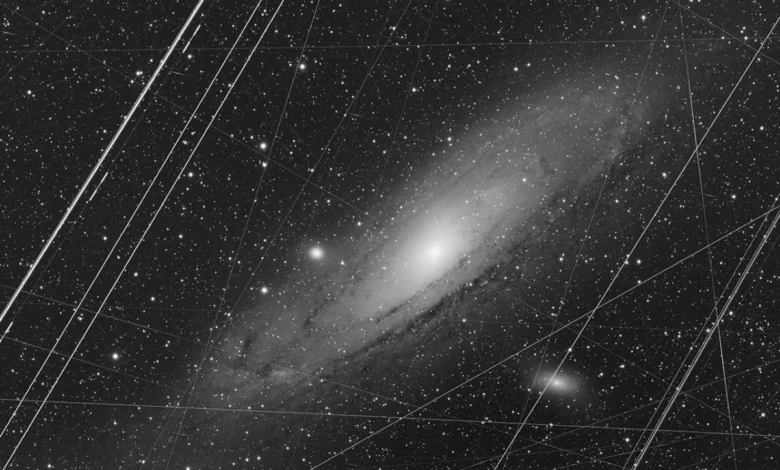
The pursuit of deep-space astrophotography is a delicate exercise in subtraction as much as it is in capture. When a backyard observer points a camera at the Andromeda Galaxy (M31), the resulting light carries not only the ancient photons emitted by a trillion stars 2.5 million light-years away, but also a chaotic layer of modern interference. A striking pair of images recently highlighted by NASA’s Astronomy Picture of the Day (APOD) demonstrates the vast chasm between raw photographic data and true astronomical representation. By comparing a raw, blemished composite stacked from hundreds of long exposures with a cleanly processed final product, astronomers and imaging specialists have once again shed light on the rigorous methodologies required to peel back the atmospheric and technological veils of our modern world.
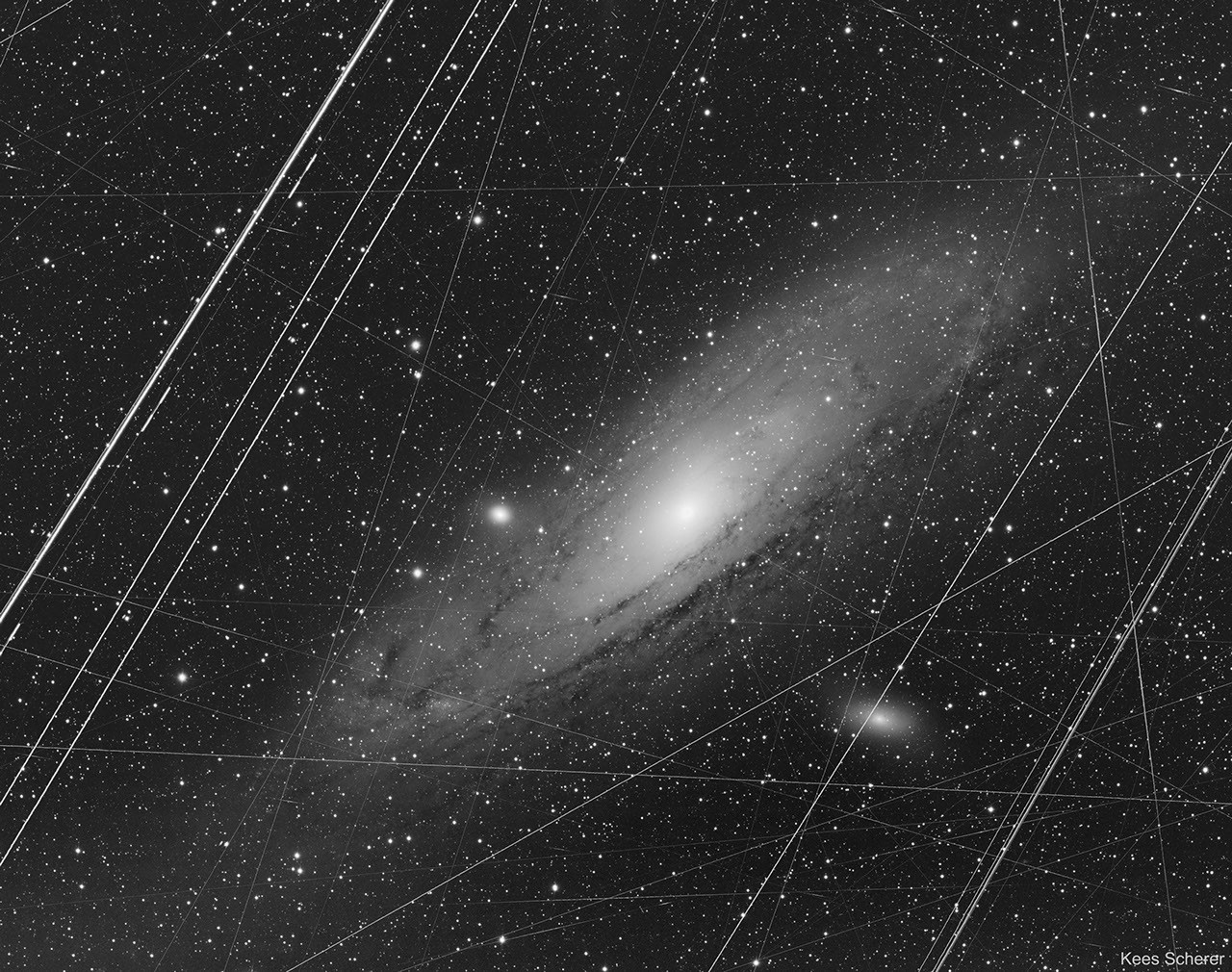
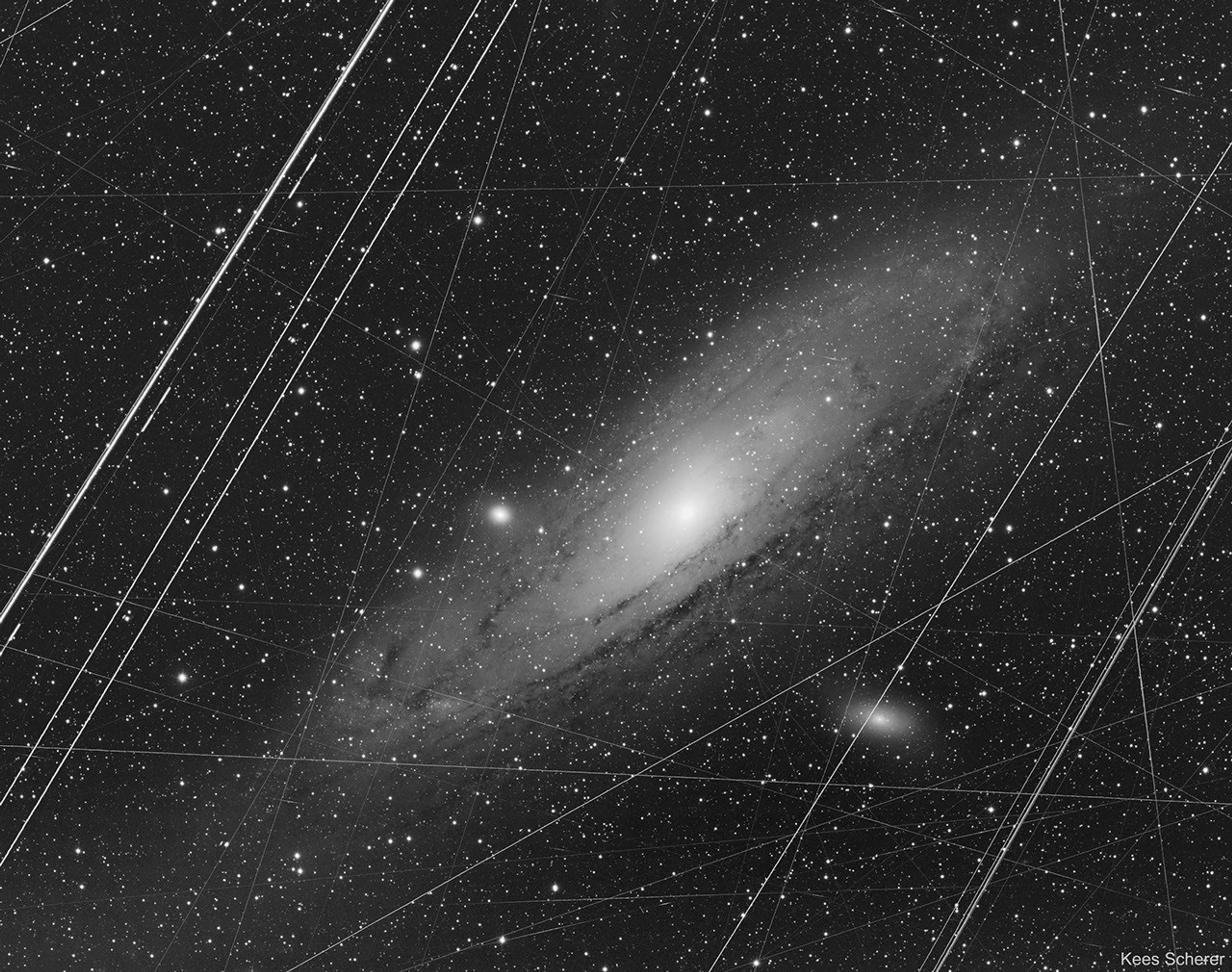
The raw image of the Andromeda Galaxy, captured by astrophotographer Kees Scherer from a garden observatory in Portugal, exposes the harsh realities of modern ground-based imaging. Marred by jagged parallel streaks from commercial airliners, glowing continuous lines left by low-Earth-orbit satellites, sharp cosmic ray hits, and the static glare of dead or hot camera pixels, the "before" image looks less like a window to another galaxy and more like a scratched glass pane. Yet, this cluttered mosaic is the fundamental baseline of ground-based astronomy. It represents 223 individual frames, each capturing a 300-second exposure accumulated over the course of 2019. Far from being a failure of craft, the raw image is a testament to the sheer volume of data collection necessary to drag faint celestial objects out of the background noise of the universe.
The Anatomy of a Backyard Observatory Integration
Capturing deep-sky objects from a terrestrial vantage point requires navigating a gauntlet of obstacles unique to the twenty-first century. The Earth is enveloped in a dynamic, turbulent atmosphere, bathed in artificial light pollution, and increasingly congested with orbital hardware. When Scherer set up his equipment in Portugal in 2019, each 300-second exposure functioned as an open net, catching everything crossing the telescope’s field of view.
The resulting data set included several distinct categories of artifacts:
- Artificial Satellites: With thousands of active and inactive spacecraft orbiting Earth, long-exposure astrophotography is regularly intersected by reflective metal surfaces catching the sun long after dusk or before dawn. These leave long, continuous linear tracks across the frame.
- Commercial Aviation: Flight paths crisscross the globe continuously. Even in remote garden observatories, high-altitude commercial jets pass overhead, leaving bright, parallel streaks of landing lights and strobe reflections.
- Cosmic Rays: High-energy subatomic particles originating from outside the solar system strike camera sensors directly, depositing charge into pixels and creating short, sharp diagonal lines or bright points.
- Sensor Imperfections: Digital cameras operate under thermal stress during long exposures. "Hot pixels" remain permanently bright regardless of incoming light, while "dead pixels" fail to register data entirely.
Individually, these artifacts ruin a single frame. Cumulatively, across hundreds of frames, they pose a formidable data-processing challenge that requires sophisticated software intervention to resolve.
From Raw Data to Scientific Clarity: The Processing Pipeline
The transformation from the chaotic "before" image to the pristine "after" depiction of the Andromeda Galaxy relies not on artistic embellishment or deceptive airbrushing via programs like Adobe Photoshop, but on mathematical reduction and specialized stacking algorithms. Programs such as Astro Pixel Processor, DeepSkyStacker, and PixInsight form the backbone of modern amateur and professional astrophotography processing pipelines.
These software packages utilize advanced rejection algorithms—such as Winsorized sigma clipping or median combining—to evaluate pixel data across the entire stack of 223 images. If a satellite or airplane passes through a specific coordinate in frame 45, but is absent from frames 1 through 44 and 46 through 223, the algorithm identifies that specific line of pixels as an statistical outlier. By calculating the median value of the stack rather than a simple average, transient anomalies like satellite trails, cosmic rays, and airplane paths are mathematically excised.
Simultaneously, calibration frames—known as darks, flats, and biases—are subtracted from the data to neutralize sensor-specific thermal noise and optical vignetting. The goal of this meticulous digital hygiene is not to invent a digital fantasy, but to strip away the anthropogenic and atmospheric pollution that has nothing to do with the distant galaxy, thereby revealing what M31 actually looks like under ideal viewing conditions.
Background Context and the Growing Challenge of Orbital Congestion
The release of these comparative Andromeda images arrives at a critical juncture for both professional and amateur astronomy. The night sky is undergoing a rapid, unprecedented industrialization. With the deployment of massive commercial satellite mega-constellations in low-Earth orbit, the frequency of satellite streaks in astronomical imagery has surged exponentially over the past half-decade.
Astronomers worldwide have raised growing concerns regarding the long-term viability of ground-based observations. While sophisticated stacking software can effectively remove satellite trails from deep-field images of static targets like galaxies and nebulae, the process becomes infinitely more complex when observing transient events, such as near-Earth asteroids, supernovae, or gamma-ray burst afterglows. In these scenarios, losing data to a satellite streak can mean missing a critical scientific window. Furthermore, the cumulative background glow caused by thousands of orbiting objects scattering sunlight threatens to raise the baseline brightness of the night sky globally, degrading the sensitivity of even the largest ground-based telescopes.
The situation underscores the vital importance of the work performed by citizen scientists and backyard observers. Amateurs equipped with off-the-shelf tracking mounts, moderate-aperture refractors or reflectors, and dedicated cooling cameras now routinely achieve image quality that rivals professional observatories of the late twentieth century. By mastering the software pipelines necessary to clean raw data, these observers contribute to a deeper public appreciation of the cosmos while documenting the shifting environmental conditions of Earth’s skies.
Institutional Shifts and the Evolution of the Astronomy Picture of the Day
As imaging techniques and digital dissemination methods evolve, the infrastructure supporting public astronomical education is also transforming. The NASA Astronomy Picture of the Day, a cornerstone of online science outreach curated by professional astronomers Robert Nemiroff and Jerry Bonnell since 1995, has announced significant administrative updates.
The primary home of APOD on the web is transitioning its main NASA web address from its long-standing URL at apod.nasa.gov to a modernized domain housed within the broader NASA Science architecture at science.nasa.gov/apod. This migration reflects an agency-wide effort to unify and streamline scientific content delivery, ensuring that millions of daily visitors continue to access daily astronomical imagery paired with expert commentary. Additionally, the platform updated its public email channels for image submissions, adapting to shifting cybersecurity and organizational protocols to manage the vast influx of astrophotography submitted by global contributors.
These logistical updates, though administrative in nature, highlight the enduring relevance of APOD as a bridge between professional research, advanced amateur astrophotography, and the general public. By featuring contrasting images like Scherer’s study of the Andromeda Galaxy, the platform demystifies the photographic process, educating the public that what appears effortless and serene in final astronomical plates is actually the product of immense patience, algorithmic precision, and a constant battle against earthly obstruction.
Broader Implications for Science Communication and Public Perception
The side-by-side presentation of the raw and processed Andromeda Galaxy serves a dual educational purpose. First, it combats scientific misinformation and skepticism. In an era where digital tools can easily generate hyper-realistic artificial imagery via generative artificial intelligence, transparency regarding how scientific and aesthetic images are processed is paramount. Demonstrating that software is used to subtract interference rather than add fictitious galactic structures reinforces the authenticity of astronomical photography.
Second, it highlights the resilience of human curiosity. Despite the growing density of low-Earth orbit, the proliferation of urban light pollution, and the physical limitations of Earth-bound optics, individuals continue to peer past the noise. Through persistence, mathematical rigor, and technical innovation, humanity maintains a clear, unyielding view of the universe, bridging the staggering gulf between a backyard in Portugal and a majestic stellar island 2.5 million light-years away.
Related posts: