Mapping the Invisible Web: How Advanced Simulations and Cosmic Observations Reveal the Universe’s Dark Architecture

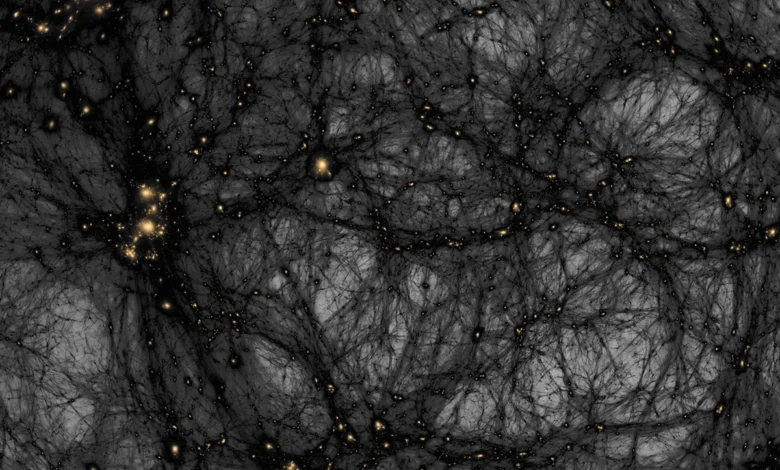
For centuries, humanity has gazed up at the night sky, charting the luminous tapestry of stars, glowing nebulae, and sweeping galaxies. Yet, modern astrophysics reveals a humbling reality: everything humans can see, touch, and interact with—from the smallest grain of sand to the most massive supercluster of galaxies—constitutes only a tiny fraction of the cosmos. The vast majority of the universe remains entirely invisible, composed of mysterious components known as dark matter and dark energy. A striking visualization featured by NASA’s Astronomy Picture of the Day (APOD), originating from the American Museum of Natural History’s Hayden Planetarium Space Show, Dark Universe, brings this invisible architecture into sharp focus, offering a glimpse into the cosmic web that shapes our reality.
The Enigma of Unseen Mass
The visualization presents a high-resolution frame from a complex computer simulation illustrating the distribution of matter across the universe. In this rendered cosmic map, intricate filaments of dark matter are depicted in a stark, contrasting dark tone, stretching across space like an immense, ethereal spider web. Interspersed within this dark framework are rare, glowing clumps of familiar baryonic matter—the protons, neutrons, and electrons that make up stars, planets, and living beings.
While dark matter itself emits, absorbs, or reflects no light, making it entirely undetectable by traditional telescopes, its presence is betrayed by its gravitational influence. Decades of rigorous astronomical observations have confirmed that the visible mass of galaxies is far too small to generate the gravitational pull required to hold them together. Without an invisible anchor of mass, the outer stars of spiral galaxies would be flung out into the void due to their rapid rotational speeds. Similarly, individual galaxies within massive clusters orbit one another at velocities that would otherwise cause them to escape the cluster’s gravitational well.
Furthermore, dark matter acts as a cosmic lens. Through a phenomenon known as gravitational lensing, massive concentrations of dark matter warp the fabric of space-time, bending and magnifying the light of distant background galaxies into glowing arcs and distorted rings. By mapping these distortions, astronomers can reconstruct the hidden distribution of mass across the universe, confirming that dark matter forms a sprawling, interconnected scaffolding upon which visible galaxies are built.
A Historical Timeline of Discovery
The realization that the universe is dominated by unseen material did not happen overnight; it is the result of nearly a century of theoretical breakthroughs and observational milestones.
- 1933: Swiss-American astronomer Fritz Zwicky, working at the California Institute of Technology, studied the Coma Cluster of galaxies. By measuring their velocities, he calculated that the cluster possessed vastly more mass than could be accounted for by the visible stars alone. He coined the term dunkle Materie—dark matter—to describe this missing mass, though his revolutionary ideas were largely overlooked for decades.
- 1970s: Vera Rubin and her colleague Kent Ford at the Carnegie Institution of Washington revolutionized observational astronomy. By measuring the rotational curves of spiral galaxies, Rubin discovered that stars on the outskirts of galaxies rotated just as fast as those near the center. This defied Newtonian physics unless an immense, unseen halo of mass enveloped each galaxy. Rubin’s work transformed dark matter from a fringe hypothesis into a leading pillar of modern astrophysics.
- 1990s–2000s: The advent of advanced space telescopes, such as Hubble and Chandra, allowed astronomers to map gravitational lensing with unprecedented precision. Projects like the Sloan Digital Sky Survey (SDSS) began charting the three-dimensional positions of hundreds of thousands of galaxies, revealing a vast cosmic web of filaments and voids.
- 2005: The Millennium Simulation, executed by an international consortium of astrophysicists, tracked the evolution of over 10 billion dark matter particles in an expanding universe. It demonstrated that simple gravitational laws acting on cold dark matter could naturally produce the intricate cosmic structures observed in the real universe.
- 2013–Present: Collaborations involving massive supercomputers continue to refine these simulations. Productions like the Hayden Planetarium’s Dark Universe bridge the gap between complex numerical models and public education, translating petabytes of simulation data into immersive visual experiences.
Supporting Data and Scientific Consensus
Modern cosmological models, most notably the Lambda-Cold Dark Matter ($Lambda$CDM) paradigm, rely on precise measurements from cosmic microwave background (CMB) surveys—such as those conducted by NASA’s WMAP satellite and the European Space Agency’s Planck observatory.

Data from the Planck mission, released in the 2010s, provided the most accurate inventory of the universe’s contents to date. According to these findings, normal baryonic matter accounts for only about 4.9% of the universe. Dark matter comprises a much larger share, approximately 26.8%. The remaining 68.3%—an absolute majority—consists of dark energy.
The computer simulations highlighted by the Hayden Planetarium match these statistical distributions with astonishing accuracy. When astrophysicists feed the Planck parameters into supercomputers and let virtual universes evolve over billions of years, the resulting digital cosmos spontaneously generates web-like filaments, dense cluster nodes, and vast empty voids that mirror the large-scale structure of our actual universe.
The Even Greater Mystery: Dark Energy
While dark matter remains intensely puzzling because scientists have yet to identify its fundamental particle nature—leading to candidates ranging from Weakly Interacting Massive Particles (WIMPs) to axions—it is no longer considered the strangest source of gravity in the cosmos. That distinction belongs to dark energy.
Unlike dark matter, which exerts an attractive gravitational pull that binds galaxies and structures together, dark energy behaves as a repulsive force. Discovered in 1998 through observations of distant Type Ia supernovae, dark energy is driving the accelerated expansion of the universe. While dark matter acts as the cosmic glue, dark energy acts as a cosmic accelerator, pushing distant galaxies away from one another at ever-increasing speeds.
The interplay between dark matter and dark energy dictates the ultimate fate of the cosmos. As dark energy expands the space between galaxies, the attractive pull of dark matter works to slow down this separation locally. Understanding how these two invisible phenomena interact remains the preeminent challenge for twenty-first-century physics.
Broader Implications and Future Horizons
The exploration of dark matter and dark energy extends far beyond theoretical astrophysics; it touches upon the fundamental laws of nature and particle physics. Laboratories deep underground, such as the Sanford Underground Research Facility in South Dakota and the Gran Sasso National Laboratory in Italy, house ultra-sensitive detectors shielded from cosmic rays, patiently waiting for the rare, elusive interaction of a dark matter particle with normal matter. Simultaneously, space-based observatories like the James Webb Space Telescope and the recently launched Euclid telescope are peering deeper into the infrared sky, measuring galaxy shapes and distributions with unprecedented clarity to test the limits of our cosmological models.
Visualizations and simulations like those developed for the Hayden Planetarium serve a vital dual purpose. Scientifically, they validate mathematical models against observational data, allowing researchers to test hypotheses about galaxy formation and cosmic evolution. Culturally, they provide a tangible bridge for the public, transforming abstract equations and invisible forces into visceral, comprehensible imagery. As humanity continues to probe the dark architecture of the cosmos, each simulation and telescope observation brings us one step closer to understanding the true nature of the universe we call home.