The Final Countdown for Hubble: NASA Looks to Private Aerospace to Save Its Legendary Space Telescope

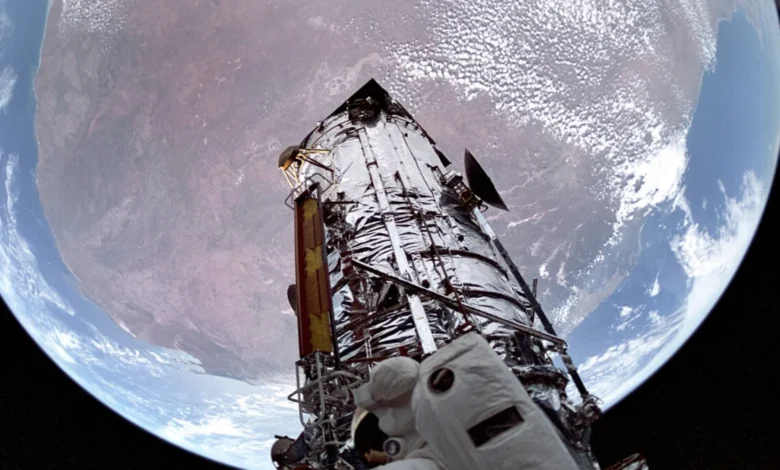
Launched into low-Earth orbit in April 1990 aboard the Space Shuttle Discovery, the Hubble Space Telescope has spent more than three decades redefining humanity’s understanding of the cosmos. Responsible for capturing some of the most scientifically invaluable and aesthetically breathtaking images in astronomical history, Hubble is now facing an inevitable descent. Atmospheric drag, caused by the subtle yet persistent presence of residual gases at the edge of space, has been slowly pulling the observatory downward for years.
Without external intervention, NASA’s most famous orbital observatory is projected to re-enter Earth’s atmosphere sometime between 2033 and 2034. When that happens, the spacecraft will break apart in a fiery display reminiscent of a falling meteor. While much of the telescope is expected to burn up during descent, surviving fragments could potentially pose risks to populated areas or maritime routes.
However, this fiery fate is not entirely set in stone. NASA has signaled a willingness to explore innovative solutions, issuing a formal Request for Information (RFI) to the rapidly expanding commercial spaceflight sector. The space agency is looking for private industry partners capable of executing one of two complex tasks: either executing a high-altitude orbital boost to extend Hubble’s operational lifespan or safely guiding the massive telescope down into a remote ocean crash site when its time finally comes.
A History of Resilience: The Legacy of Hubble Servicing Missions
To understand the current crisis facing Hubble, one must examine its unique design and operational history. Unlike its modern successor, the James Webb Space Telescope—which resides roughly one million miles away at the second Lagrange point (L2)—Hubble was designed from the outset to be serviced by human astronauts. Orbiting at an altitude of approximately 340 miles (547 kilometers), Hubble was visited five times by Space Shuttle crews between 1993 and 2009.
These ambitious missions were triumphs of engineering. The first servicing mission in December 1993 famously corrected a flaw in Hubble’s primary mirror, transforming blurry initial images into crystal-clear windows across the universe. Subsequent missions replaced worn-out gyroscopes, installed upgraded cameras, and added cutting-edge spectrographs, effectively breathing new life into the aging platform decade after decade.
The retirement of the Space Shuttle fleet in 2011 fundamentally changed the equation. Without a government-operated crewed vehicle capable of reaching low-Earth orbit with the payload capacity and robotic manipulation tools required for Hubble servicing, the telescope was left isolated. As its altitude continued to decay due to solar cycle fluctuations and atmospheric expansion, NASA faced a hard technological limit imposed by orbital mechanics and federal budget constraints.
The Technical Challenges of an Orbital Rescue
The prospect of rescuing Hubble through private enterprise is as daunting as it is ambitious. According to NASA’s RFI specifications, any successful attempt to elevate the telescope would require pushing it into an orbit more than 370 miles (600 kilometers) above Earth’s surface. This is not merely a matter of a minor thruster burn; it requires a precision rendezvous in low-Earth orbit, secure physical docking with a spacecraft that lacks modern standardized docking rings, and the application of massive propulsion force.
From a purely technical perspective, executing such a mission requires advanced autonomous guidance, navigation, and control (GNC) systems, robust mechanical gripping mechanisms, and heavy payload capabilities. The commercial sector has made staggering leaps in these domains over the past decade. Companies such as SpaceX, Northrop Grumman, and Rocket Lab have routinely demonstrated autonomous docking with the International Space Station, orbital debris tracking, and precision spacecraft capture. Yet, servicing or boosting a non-standard, aging satellite like Hubble represents an unprecedented engineering hurdle.
Official Responses and the Rise of Commercial Space Collaboration
NASA leadership has openly acknowledged that solving the Hubble dilemma requires looking beyond traditional federal procurement models. Nicky Fox, associate administrator for NASA’s Science Mission Directorate, emphasized the maturation of the private sector in an official statement released by the agency.
"Commercial industry has rapidly evolved in recent years to offer new capabilities for in-space satellite capture and servicing," Fox stated. "Given the time we have until Hubble’s anticipated re-entry, we are eager to explore the breadth of possibilities to boost Hubble to a higher orbit while we develop the flagship mission to follow."
This sentiment reflects a broader strategic pivot within NASA. In recent years, the agency has increasingly leaned on private industry to handle routine and complex operational tasks in low-Earth orbit. A prominent example occurred when NASA partnered with SpaceX to return stranded astronauts Suni Williams and Butch Wilmore safely to Earth using the Dragon spacecraft following unexpected technical delays with Boeing’s Starliner capsule.
Furthermore, prominent industry figures have expressed enthusiasm regarding public-private partnerships for scientific preservation. Leaders within companies like SpaceX and Rocket Lab—the latter having gained international renown for catching returning rocket boosters mid-air with helicopters—possess the technological infrastructure and risk appetite required to tackle complex orbital challenges.
Economic Realities and Scientific Implications
The financial investment required to service or safely deorbit Hubble is a primary factor driving NASA’s reliance on commercial Requests for Information. Federal funding for space science is tightly allocated across multiple competing priorities, including Artemis lunar exploration missions, planetary defense initiatives, and the ongoing operation of the James Webb Space Telescope and the Nancy Grace Roman Space Telescope. Allocating dedicated government funds for a Hubble rescue mission is politically and economically challenging without private co-financing or innovative service-level agreements.
The scientific stakes, however, remain exceptionally high. Even after thirty-four years of continuous service, Hubble maintains an active research schedule, frequently collaborating with newer observatories like James Webb to provide ultraviolet and optical data that infrared telescopes cannot capture alone. Astronomers rely on Hubble for tracking shifting weather patterns on outer gas giants, observing distant supernovae, and measuring the expansion rate of the universe through observations of Cepheid variables.
Allowing Hubble to burn up uncontrolled in the atmosphere without a guided descent profile carries statistical risks to life and property on Earth, though the vast majority of the planet’s surface is covered by oceans. Conversely, a successful altitude boost could secure Hubble’s place in orbit well into the 2030s, allowing it to operate concurrently with next-generation space-based instruments.
Looking Forward: The Final Decade of an Icon
As NASA evaluates the responses submitted through its commercial RFI, the aerospace community watches with bated breath. The coming years will determine whether private enterprise can successfully intervene to save an instrument that fundamentally transformed human perspectives on space and time.
Whether Hubble is granted a second life at a higher altitude or engineered for a controlled, graceful plunge into the Pacific Ocean, its scientific legacy is already permanently secured. For now, the legendary telescope continues its silent vigil in low-Earth orbit, capturing the light of distant galaxies while the clock ticks down toward its historic finale.