The Leek, the Legend, and a Century of Rugby: Inside John Lovell’s Extraordinary Memorabilia Archive


For more than four decades, English teacher and rugby historian John Lovell has dedicated his personal life to preserving the tangible heritage of international and club rugby union. Housed within the walls of his Yorkshire Dales home sits an extraordinary archive of approximately 550 items, spanning over a century of social and sporting history. From fragile, pocket-sized Five Nations programmes dating back to the 1930s to iconic artifacts from the dawn of the professional era, Lovell’s collection serves as an invaluable physical repository for a sport undergoing continuous transformation.
The Genesis of an Obsession: The 1983 Scotland-Wales Clash
The foundation of Lovell’s lifelong pursuit can be traced back precisely to a chilly spring morning in 1983. At the age of ten, a young Lovell piled into the back of a Vauxhall Cavalier alongside his Welsh father, David, and family friend Frank House. Destination: Edinburgh, for the high-stakes Five Nations encounter between Scotland and Wales.
The journey itself encapsulates a bygone

era of British sporting culture. Strapped to the vehicle’s radio aerial was a fresh leek harvested from David Lovell’s garden. Traveling without pre-purchased tickets, the group relied on traditional matchday methods: the elder Lovell scoured local Edinburgh pubs for face-value admissions while young John waited outside with a bottle of Coca-Cola and a packet of crisps.
It was during this roadside wait that the defining transaction of Lovell’s life occurred. Approached by a jubilant, intoxicated Welsh supporter, the young boy sold his father’s garden leek for fifty pence. Walking immediately to a stadium programme booth, Lovell exchanged the coin for his first official matchday programme. Surrounded by the dense haze of cigarette and cigar smoke and the communal sharing of hip flasks, Lovell watched Staff Jones score a pivotal try. The sensory experience cemented a permanent fascination with the printed ephemera of the game.
Strategic Acquisition and the 1991 World Cup Adventure
Over the ensuing decades, Lovell’s methodology expanded far beyond attending local fixtures at Wharfedale RUFC or traveling to Neath’s historic Gnoll ground. While approximately a quarter of his current archive stems from matches he attended personally, the remainder reflects a global network of correspondence, opportunistic purchasing, and sheer audacity.
A critical turning point occurred in 1989 when Lovell dispatched a speculative letter to NZ Rugby magazine inquiring about surplus programmes. The publication responded by dispatching a box filled with vintage New Zealand provincial and Test programmes from the 1960s, 1970s, and 1980s.

This initial international correspondence facilitated an extraordinary escapade during the inaugural 1991 Rugby World Cup hosted across the UK and France. Through his connection with New Zealand sports journalist Ray Cairns—who boarded with Lovell’s grandparents during the tournament—a seventeen-year-old Lovell acquired a counterfeit accreditation pass for Twickenham ahead of the opening match between England and New Zealand. Functioning temporarily as a freelance journalist, Lovell attended historic fixtures, including Western Samoa’s legendary upset victory over Wales at Cardiff Arms Park and Australia’s thrilling encounter against Argentina at Stradey Park.
Evolution of Collecting: From Pocket Editions to A4 Artifacts
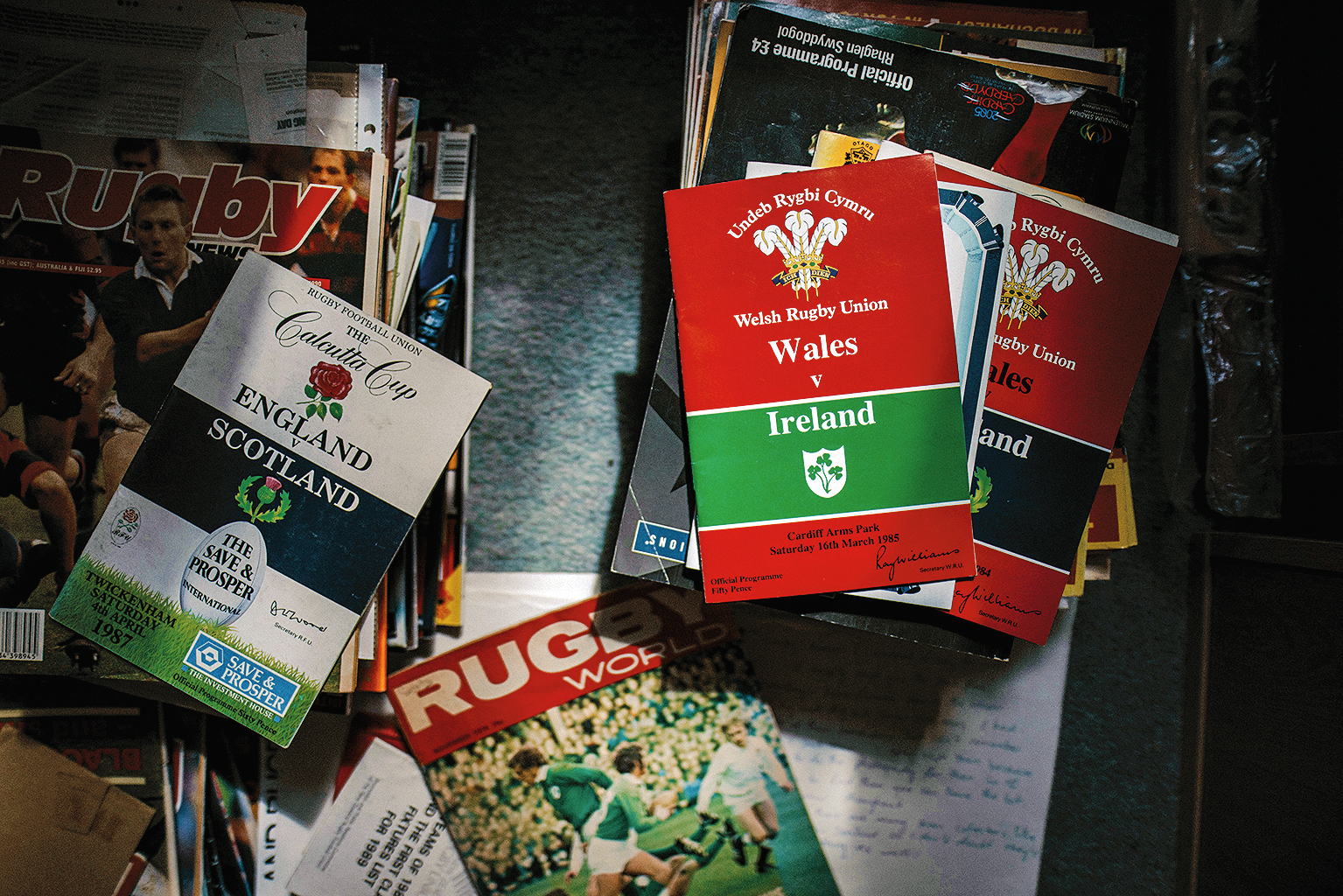
Lovell’s archive mirrors the broader design and structural evolution of rugby union publications throughout the twentieth century. Early programmes were intentionally compact, designed to fit easily into a spectator’s overcoat pocket. This physical dimension contributed significantly to their longevity, as supporters frequently retained them as pocket souvenirs.
These vintage publications offer a fascinating socio-historical window into the advertising and cultural norms of their respective eras. Pages featured prominent promotions for tobacco brands such as Super Kings—marketed explicitly for offering extended length at equivalent pricing—alongside contemporary automotive advertisements for models like the MG Maestro. Furthermore, the artistic direction of mid-century programmes relied heavily on intricate pencil illustrations depicting dynamic outside-halves breaking defensive lines, contrasting sharply with the stark, gothic typography favored by New Zealand rugby publishers during the 1960s.
The structural integrity of programmes shifted dramatically toward the turn of the century. As international governing bodies modernized matchday experiences, publications expanded into large-format A4 editions. While offering enhanced visual layouts, these larger formats proved notoriously difficult to preserve without sustaining spine damage, presenting unique preservation challenges for modern collectors.
Valuation, Sentimentality, and the Secondary Market
Within the specialized collector’s market, premier rugby ephemera commands significant financial valuations. Rare interwar artifacts, such as a 1930s British & Irish Lions versus New Zealand programme, can achieve auction prices ranging between £800 and £1,200. Similarly, official programmes from the 1995 Rugby World Cup final—historically significant for marking South Africa’s reintegration into global sport under the stewardship of President Nelson Mandela—routinely command upwards of £70 to £100 due to their scarcity in mint condition.
Despite participating selectively in online marketplaces such as eBay and Vinted, Lovell deliberately eschews the rigid, capital-intensive acquisition strategies practiced by comprehensive set collectors. Rather than investing thousands of pounds into ring-bound folders designed to complete exact chronological sequences, Lovell maintains an eclectic, decentralized archive where rare artifacts rest comfortably alongside family photographs and domestic paperwork.
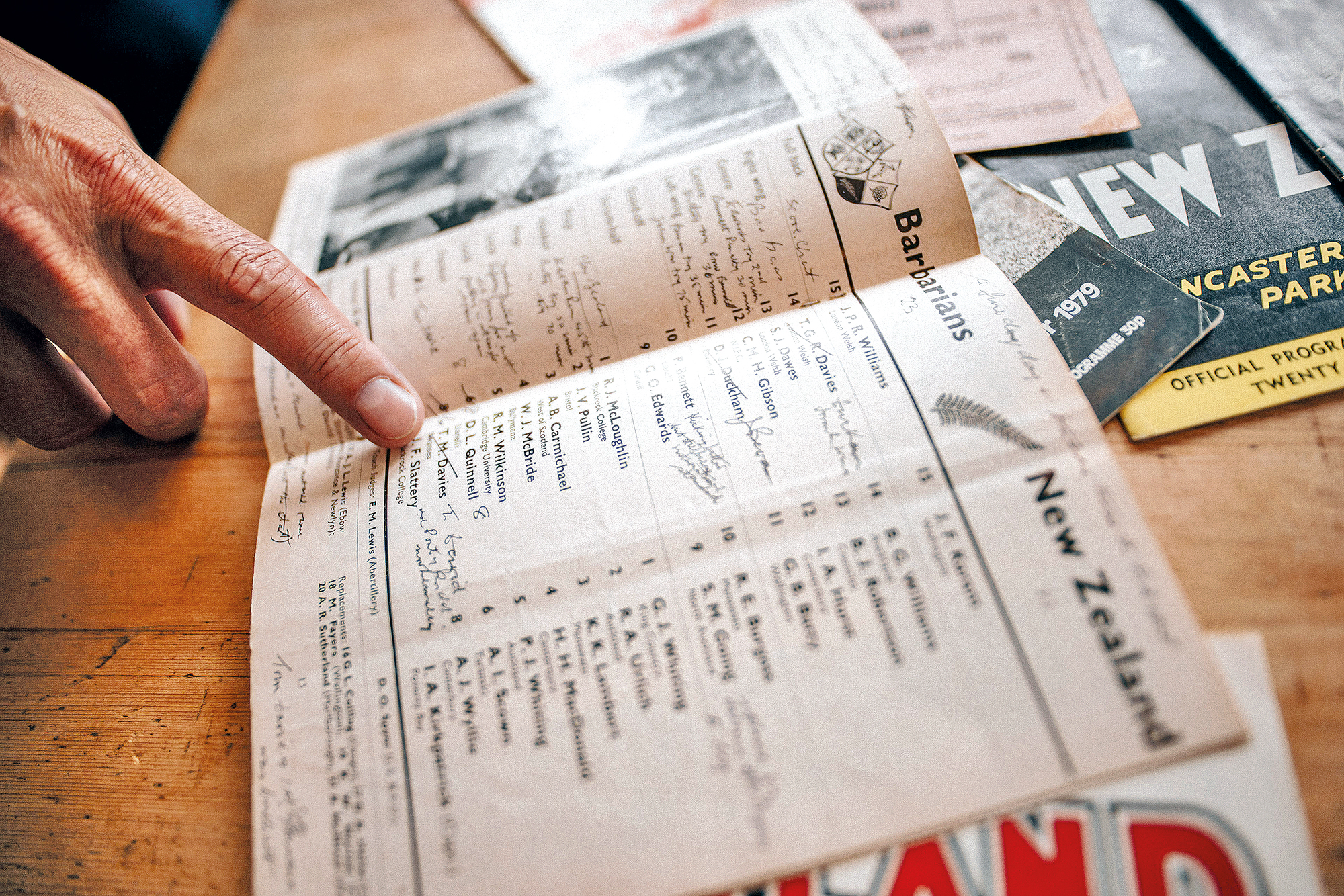
His collection features numerous unique anomalies, including a heavily annotated programme from the legendary 1973 Barbarians versus New Zealand fixture at Cardiff Arms Park. Purchased for five pounds, the publication contains contemporaneous handwritten notes detailing weather conditions, tactical shifts, and the late withdrawal of Welsh captain Mervyn Davies due to influenza.
Broader Impact and Cultural Implications
Historians and sports sociologists increasingly recognize physical ephemera like matchday programmes as vital primary sources that offer superior reliability compared to oral histories. By capturing real-time rosters, tactical notes, and contemporary societal attitudes, archives such as Lovell’s preserve the ephemeral culture of amateur rugby prior to the sport’s professionalization in 1995.
Moreover, Lovell actively utilizes his collection as a community resource rather than a private vault. He frequently responds to genealogical and historical inquiries from former players, relatives of match officials, and rugby researchers, occasionally gifting rare programmes to individuals for whom a specific match represented the pinnacle of their sporting lives.
When asked to identify the single most treasured item in his possession, Lovell bypasses high-value international test memorabilia in favor of the battered, oversized A3 publication that started it all: the 1983 Scotland versus Wales Five Nations programme. Retaining an estimated market value of barely two pounds, the document remains the irreplaceable cornerstone of a forty-six-year journey through the heart of rugby history.
Related posts: