Life, Larry and the Pursuit of Unhappiness Delivers Star-Studded Historical Sketch Comedy on HBO Max

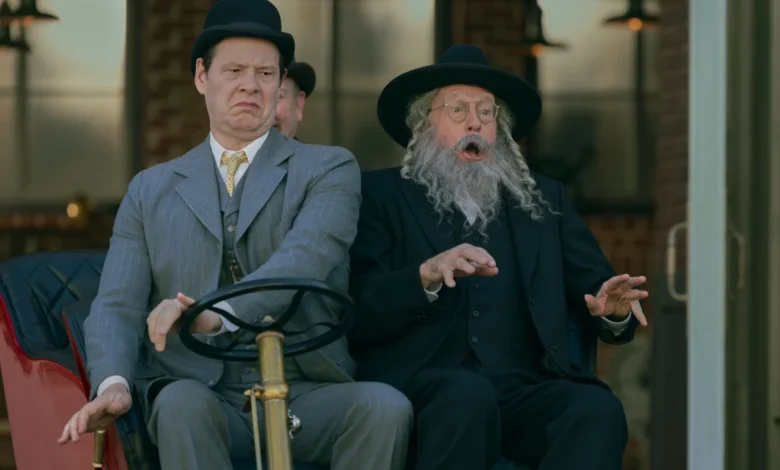
Larry David, the acclaimed creator and star behind the enduringly popular sitcom Curb Your Enthusiasm, has returned to HBO Max with a new sketch comedy series, Life, Larry and the Pursuit of Unhappiness. This ambitious project, executive produced by Barack and Michelle Obama through their Higher Ground Productions, reimagines American history through David’s signature comedic lens. Premiering in the wake of Curb Your Enthusiasm‘s finale, the show distinguishes itself not only with its premise but also with an astonishingly extensive roster of celebrity guest stars who embody iconic historical figures, creating a tapestry of American past viewed through a distinctly modern, and often absurd, sensibility.
The series, which airs new episodes Friday nights at 9 p.m. on HBO and streams on HBO Max, is a testament to the widespread appeal and comedic prowess of its lead. David, known for his incisive social commentary and masterful portrayal of awkwardness, takes on a diverse array of historical characters, from founding fathers to civil rights icons, often finding the inherent absurdity in their well-documented moments. The sheer breadth of talent involved suggests a significant investment in crafting a high-caliber production that aims to both educate and entertain, leveraging the star power of Hollywood’s elite to bring history to life in an unconventional manner.
A Stellar Ensemble Reinventing American History
What sets Life, Larry and the Pursuit of Unhappiness apart is its commitment to featuring a multitude of notable personalities in nearly every sketch. The guest list reads like a who’s who of contemporary entertainment, encompassing seasoned actors, celebrated musicians, and legendary comedians. This deliberate casting strategy ensures that each historical vignette is populated by recognizable faces, amplifying the comedic impact and creating unexpected juxtapositions.
Among the standout performers is Henry Winkler, who takes on the role of John Hancock in the premiere episode, a choice that resonates with his own status as a beloved television figure. Similarly, Chris Parnell and Alan Tudyk lend their distinct comedic talents to portray Benjamin Franklin and Thomas Jefferson, respectively, offering fresh interpretations of these foundational figures. The series also pays tribute to the late Rob Reiner, who delivered his final on-screen performance as George Washington in the second episode, a poignant inclusion given Reiner’s own significant contributions to television comedy, including his work on Curb Your Enthusiasm.
Major Hollywood figures such as Samuel L. Jackson, who serves as a recurring narrator, bringing his gravitas to the proceedings, and Lin-Manuel Miranda, whose Hamilton legacy makes his appearance as a participant in the Boston Tea Party particularly fitting, further elevate the show’s caliber. Television mainstays like Jerry Seinfeld, reuniting with David in a nod to their shared Seinfeld legacy, and Jon Hamm, showcasing his versatility, add further layers of comedic depth. The Hollywood Reporter has diligently tracked these appearances, recognizing the significant effort and talent each celebrity brings to David’s ambitious historical reimagining.
Episode Breakdown: A Journey Through Key Historical Moments
The series unfolds across several episodes, each delving into different eras and pivotal events in American history, often with a keen eye for the often-overlooked or mundane aspects that David excels at highlighting.
Episode 1: "Livingston"
The premiere episode immediately establishes the show’s ambitious scope and its unique blend of historical figures and contemporary humor. It opens with an introduction by executive producer Barack Obama, offering a personal touch and a hint of his own comedic timing, playfully engaging with David. Samuel L. Jackson’s narration sets a sophisticated yet accessible tone, guiding viewers through the historical reinterpretations.
The episode’s initial sketch features Winkler, Parnell, and Tudyk as the architects of American independence, humorously depicting Robert Livingston’s (played by David) attempts to insert his ideas into the Declaration of Independence. This segment cleverly satirizes the often-contentious process of nation-building. Following this, David embodies Alexander Graham Bell, facing the immediate, anachronistic demands of early adopters of the telephone, including a crowd featuring sitcom veterans Alison Becker, Mary Sohn, and Rodney J. Hobbs, who embody the impatience and evolving expectations of consumers.
A World War I trench warfare scenario presents David as a timid soldier under the command of Michael Chiklis’s gruff sergeant, with Mike Castle and Jake Reiner (son of the late Rob Reiner) as fellow soldiers. The episode concludes with a provocative sketch featuring David as an irritating bus passenger encountering Jurnee Smollett’s dignified portrayal of Rosa Parks, offering a stark and thought-provoking contrast between mundane annoyance and profound historical significance.
Episode 2: "Farewell"
This episode offers a highly anticipated reunion between Larry David and Jerry Seinfeld, two titans of American sitcom history. They portray explorers Lewis and Clark, embarking on their monumental expedition. The humor arises from their portrayal as somewhat casual drinking buddies, whose grand undertaking is viewed with a knowing eye by Rita Wilson as Meriwether Lewis’s long-suffering wife, Mavis.
David then tackles the contentious 1876 presidential election as Samuel Tilden, who, despite winning the popular vote, lost the Electoral College. The sketch highlights the frustrations and political machinations of the era, with Matthew Jones and Rich Fulcher as Tilden’s aides.
A Great Depression-era segment brings together Larry Wilmore and Colton Dunn as David navigates the scarcity of resources, humorously attempting to cut in line for bread, with Kaley Cuoco delivering a memorable performance as a grieving widow. The episode’s significant closing moment is Rob Reiner’s final screen appearance as George Washington, discussing presidential term limits. This segment subtly critiques contemporary political figures, with Jimmy Kimmel making a meta-commentary on his ongoing public disagreements.
Episode 3: "McCarthy"
The third installment begins with David inserting himself into the iconic Boston Tea Party. Lin-Manuel Miranda, leveraging his Hamilton expertise, shines as a ringleader, while comedian Lou DiMaggio also appears. The sketch highlights David’s character being excluded from the rebellion, a recurring theme of his comedic persona.
J.B. Smoove’s character, Jonesey, brings vibrant energy to a segment on the Underground Railroad, showcasing his demanding presence and the reactions of those around him. In another historical reimagining, David plays a less accomplished Wright sibling, feuding with his wife over his butter-churning skills, while Jon Hamm and Sean Hayes convincingly portray Orville and Wilbur Wright, preparing for their groundbreaking flight.
The episode culminates in a powerful and widely discussed sketch focusing on Senator Joseph McCarthy’s hearings. David takes on the role of McCarthy, with Michael McKean delivering the iconic "Have you no decency, sir?" rebuttal as Joseph Welch. Rob Huebel also features as a senator moderating the proceedings, recreating the intense atmosphere of the McCarthy era with a modern comedic sensibility.
Episode 4: "Deepthroat"
This episode turns its attention to the Watergate scandal. David portrays the anonymous informant "Deep Throat," but in a characteristic twist, his informant offers trivial, nonsensical information to Beck Bennett’s Bob Woodward, subverting expectations of a crucial leak.
The sketch then shifts to Ike Barinholtz as Henry Ford, who is confronted by David’s rabbi character, highlighting Ford’s controversial antisemitic views. David also plays President James Buchanan at a social gathering, attempting to flirt with women and experiencing the novelty of hors d’oeuvres, with Jordana Brewster and Katie Aselton among those encountering his awkward advances. Diallo Riddle appears as Buchanan’s assistant.
The episode’s most talked-about segment features David as Dora Salk, the overly proud mother of Jonas Salk, bragging about the polio vaccine. This sketch humorously parodies the politicization of public health, drawing parallels to contemporary debates surrounding vaccines, and includes a jab at HHS Secretary Robert F. Kennedy Jr. through David’s former co-star Cheryl Hines’s husband. Adam Lustick plays Jonas Salk and Gregg "Jeep" Perrie portrays a character expressing skepticism about the vaccine’s safety.
Episode 5: "Lincoln"
The penultimate episode of the initial run focuses on two significant historical moments. The first sketch transports viewers to the O.K. Corral, featuring Timothy Olyphant as Wyatt Earp and Don Johnson as Doc Holliday. David’s character injects his typical brand of obnoxious logistical commentary into the planning of the famed shootout, with Marc Menchaca, Johnno Wilson, and Maximo Salas rounding out the cowboy ensemble.
The second major segment revisits the strained relationship between Abraham Lincoln and his wife, Mary Todd Lincoln. Bill Hader delivers a nuanced performance as a beleaguered Lincoln, who, with his chief of staff Lawrence Butterfield, connives to orchestrate Mary’s departure from Ford’s Theatre during a performance of Our American Cousin. Kathryn Hahn portrays the mentally unstable Mary Todd Lincoln, and Lennon Parham plays Laura Keene. The sketch further explores the couple’s marital discord with an argument over a stolen sweater, echoing the domestic squabbles that often define Curb Your Enthusiasm. Jay Renshaw appears as John Wilkes Booth, and Seth Morris as Andrew Johnson.
A Broader Impact on Historical Comedy
Life, Larry and the Pursuit of Unhappiness represents a significant evolution in historical comedy. By blending David’s signature observational humor with meticulously crafted historical settings and an unparalleled ensemble cast, the series achieves a unique blend of entertainment and subtle social commentary. The involvement of the Obamas’ Higher Ground Productions signals a broader interest in using popular culture to engage with American history, potentially sparking renewed interest and discussion among viewers about the figures and events depicted.
The show’s success lies in its ability to find the universal aspects of human behavior – the pettiness, the ambition, the awkwardness – within grand historical narratives. By placing David’s character, often an outsider or an unwitting participant, into these pivotal moments, the series allows for a fresh perspective, demystifying historical figures and presenting them as complex individuals grappling with relatable, albeit historically significant, challenges. The extensive guest list not only provides comedic fodder but also underscores the show’s ambition to be a landmark comedic event, a veritable historical reunion on screen. As new episodes continue to be released, the series promises to be a talking point, offering a hilarious and insightful look at the American past through the inimitable lens of Larry David.