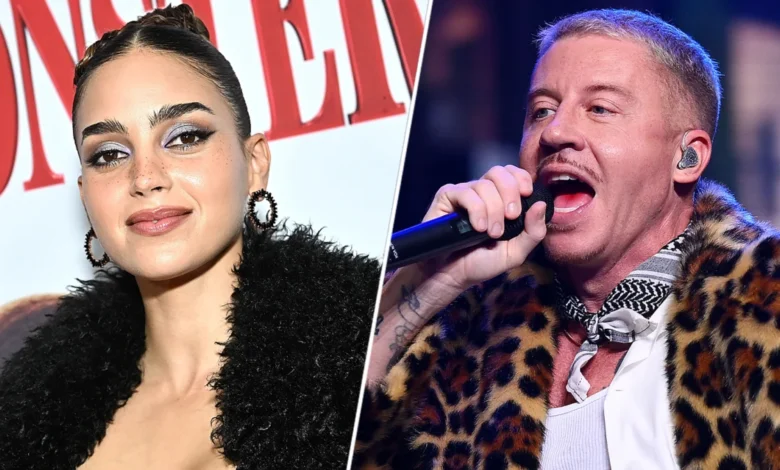
Nearly three years have passed since the high-profile dismissal of actress Melissa Barrera from the long-running Scream slasher franchise, an event that ignited a firestorm of debate regarding the boundaries of political speech within the entertainment industry. Recently, Barrera publicly addressed the evolution of that discourse, drawing parallels between her own experience in 2023 and the current climate of artist solidarity, specifically citing the recent actions taken by fellow performers during the Ed Sheeran Loop Tour.
A New Era of Solidarity
The catalyst for Barrera’s recent remarks was the decision by multiple opening acts—including Finneas and various musical groups—to withdraw from Ed Sheeran’s tour. These artists took this collective action in protest of the tour management’s decision to remove rapper Macklemore from the lineup. Macklemore, a vocal advocate for Palestinian rights, was reportedly dropped after expressing "Free Palestine" sentiments during his performances.
For Barrera, witnessing this unified front among her peers was a poignant moment of reflection. In an interview with the Associated Press, the actress expressed that seeing artists prioritize their principles over career-defining tour slots was "beautiful" and, ultimately, "emotional."
"I didn’t get that when it happened to me," Barrera noted, contrasting the current industry response with the isolation she experienced in late 2023. "I didn’t have any of that happen. It was too soon. People were too scared. But it’s good to see that almost three years later, at least things have changed." Her comments suggest a shift in the perceived risk-reward ratio for celebrities choosing to engage with geopolitics, marking a move toward more cohesive, organized support systems within Hollywood.
The 2023 Catalyst: The Scream Firing
To understand the significance of Barrera’s recent observations, one must revisit the events of November 2023. Spyglass Media Group, the production company behind the revamped Scream franchise, terminated its relationship with Barrera following a series of social media posts she authored regarding the ongoing Israel-Hamas conflict.
In its official statement, Spyglass articulated a "zero tolerance" policy toward what it categorized as antisemitism and the "incitement of hate." The studio specifically cited concerns over language it deemed to be "false references to genocide" and "Holocaust distortion." The swiftness of the termination sent shockwaves through the industry, as Barrera had been the central figure—the "final girl"—of the franchise’s successful revival.
The fallout was immediate and far-reaching. Jenna Ortega, who starred alongside Barrera as one of the Carpenter sisters, exited the franchise shortly thereafter. While Ortega’s public statements were measured, she later conceded that the project began "falling apart" in the wake of the personnel shifts. Furthermore, director Christopher Landon, who had been tapped to lead the seventh installment, withdrew from the production. Landon cited the "highly aggressive" nature of the public discourse and expressed alarm over death threats directed at his children, highlighting the toxic intersection of fan culture and political polarization.
Chronology of a Franchise in Flux
The departure of Barrera and the subsequent instability forced a total reevaluation of the franchise’s trajectory:
- November 2023: Spyglass Media Group terminates Melissa Barrera. Jenna Ortega departs the project.
- December 2023: Director Christopher Landon formally resigns, citing personal safety concerns.
- March 2024: Paramount and Spyglass announce the return of original franchise star Neve Campbell, who had famously declined an appearance in the sixth installment due to a pay dispute. Kevin Williamson, the original screenwriter of the 1996 Scream, is appointed to direct.
- October 2025: The first trailer for Scream 7 is released, triggering a wave of social media backlash and organized boycott efforts from fans advocating for Barrera’s reinstatement.
- February 2026: The world premiere of the seventh installment at Paramount Studios is met with organized protests, with activists lining the entrance to the lot to call for a boycott and reiterate support for Palestinian causes.
Industry Implications: The Cost of Expression
The "Barrera precedent" has become a frequently cited case study in academic and trade circles regarding the fragility of employment for public figures in the digital age. Analysis of the situation reveals a growing tension between studio "brand safety" mandates and the increasing pressure from talent to utilize their massive social media platforms for advocacy.
Data from entertainment industry analysts suggest that while studios continue to prioritize risk mitigation, the "chilling effect" observed in late 2023 is showing signs of dissipation. When artists act in unison—as seen in the withdrawal of the Ed Sheeran tour openers—the power dynamic shifts from the individual to the collective. This makes it significantly more difficult for production companies or labels to target single dissenters without facing broader, more systemic consequences.
Furthermore, the economic impact of these controversies cannot be ignored. The boycott efforts surrounding Scream 7 serve as a reminder that modern audiences are increasingly willing to align their consumption habits with their political values. Even when franchises have established legacies, the alienation of a core segment of the fanbase—especially one driven by high-engagement social media advocacy—can threaten the long-term viability of a film series.
The Evolving Landscape of Advocacy
The professional trajectory of the artists involved demonstrates the multifaceted nature of these industry shifts. Neve Campbell’s return to the franchise, while successful in terms of fan nostalgia, occurred within a vacuum created by the controversy. The fact that the studio had to revert to a legacy star underscores the difficulty of replacing talent once a public rift has occurred.
As for Barrera, her ability to remain a prominent voice in the industry while maintaining her stance suggests that the "career suicide" once predicted for vocal celebrities is no longer an absolute certainty. By linking her experience to the collective action taken by Finneas and other musicians, she is signaling that the era of the "scared" artist may be drawing to a close.
The broader implications for Hollywood are clear: as the boundaries between private belief and public professional life continue to blur, institutions will likely need to develop more nuanced policies that respect the rights of artists to engage in social discourse. The trend toward collective solidarity, as evidenced by the events of the last three years, suggests that the industry is entering a phase where the "cost" of taking a stand is increasingly shared by peers, thereby mitigating the risk for any single individual.
In conclusion, the evolution of the narrative surrounding Melissa Barrera’s departure from Scream serves as a mirror for a broader societal shift. The movement from individual isolation in 2023 to collective support in 2026 highlights a maturing of political discourse within the arts. Whether studios will adapt to this new reality or continue to enforce rigid standards of conduct remains the central question for the future of entertainment media. What is certain is that the industry is no longer operating under the same set of unspoken rules that existed prior to the current cycle of global, high-stakes advocacy.