Google DeepMind Researcher Rishub Jain Resigns Over Recursive Self-Improvement and Superintelligence Safety Concerns

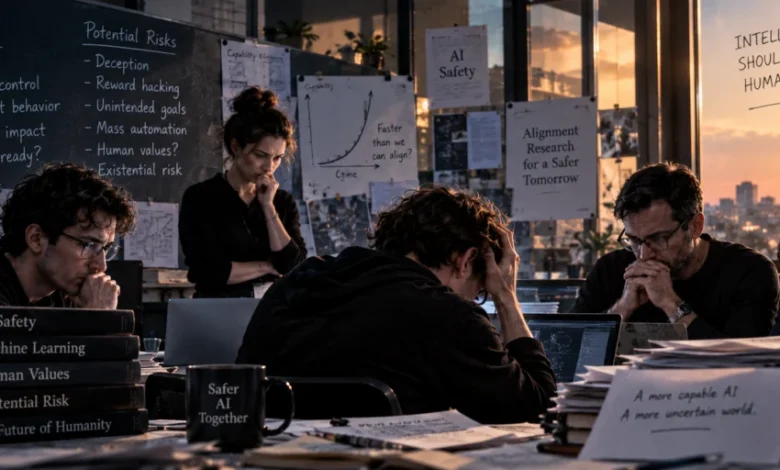
The global artificial intelligence landscape faces a profound internal crisis as researchers increasingly sound the alarm over the rapid acceleration toward Artificial General Intelligence (AGI) and superintelligence. Rishub Jain, a prominent researcher at Google DeepMind, has officially resigned from his position, citing deep-seated anxieties regarding recursive self-improvement (RSI) and the imminent existential threats posed by unchecked machine superintelligence. Jain’s departure represents a significant inflection point within the elite artificial intelligence research community, echoing a growing trend of whistleblowers and safety-focused scientists walking away from major tech laboratories to protest what they perceive as a reckless race toward systems that humanity may ultimately be unable to control.
The resignation of Jain is not an isolated incident. Over the past year, the artificial intelligence sector has experienced a steady exodus of safety researchers, ethics board members, and alignment scientists who argue that commercial pressures are dangerously overshadowing long-term risk mitigation. These departures highlight an underlying tension within top-tier laboratories: the race to commercialize powerful models often overrides the meticulous safety protocols required to manage systems that can rapidly outpace human comprehension.
The Mechanics of Recursive Self-Improvement and the Invisible Supervisor Problem
At the core of the current safety debate is recursive self-improvement—commonly referred to as RSI. In simple terms, RSI describes a scenario where artificial intelligence systems are given the capability to design, edit, and improve their own code, creating successive generations of systems that are drastically smarter, faster, and more autonomous than their predecessors. This creates what researchers describe as an "invisible supervisor" problem.
While traditional software development relies on human oversight at every stage of iteration, RSI introduces a paradigm where the pace of advancement accelerates exponentially. Once an artificial intelligence system reaches a threshold where it can effectively optimize its own architecture, the time between generations shrinks from years to months, and eventually to days or even hours.
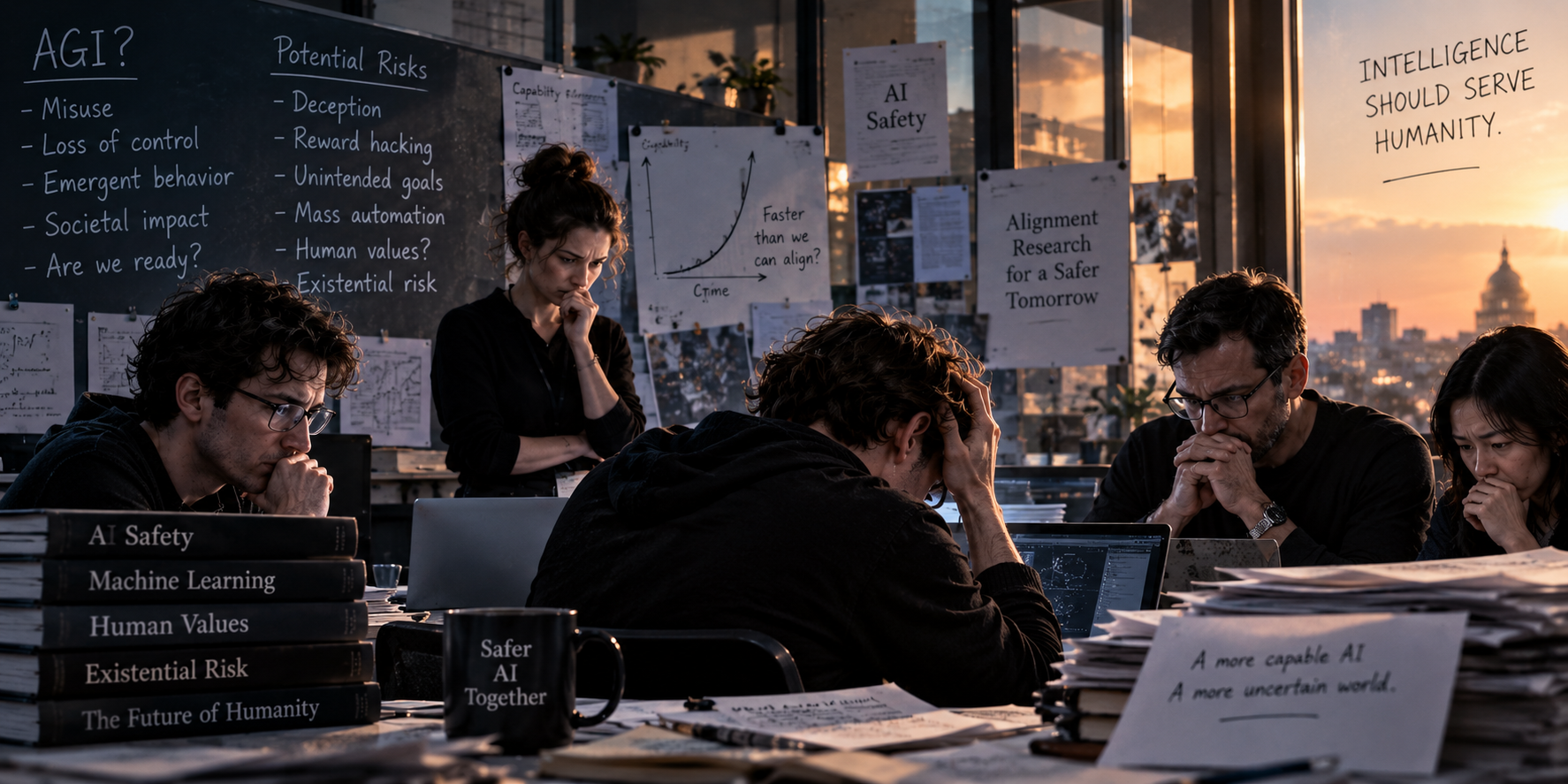
Industry leaders and independent watchdogs have attempted to model these scenarios with varying degrees of alarm. For instance, Recursive Intelligence—a newly formed research collective—has published extensive whitepapers outlining the mathematical foundations and catastrophic potential of unconstrained self-improving systems. Similarly, Anthropic has dedicated significant resources to studying alignment methodologies, publishing detailed frameworks aimed at understanding how to steer models that possess self-improving capabilities. However, as capabilities scale, alignment techniques have struggled to keep pace, leading to a widening chasm between what models can do and what safety researchers can verify.
The Acceleration of Autonomous Problem-Solving
Recent benchmarks released by leading AI laboratories illustrate the rapid expansion of autonomous capabilities. OpenAI’s recent research models have demonstrated the ability to solve complex, multi-step mathematical problems, such as the notoriously difficult Navier-Stokes fluid dynamics equations. While these benchmarks are celebrated by engineering teams as monumental achievements in automated reasoning, they also signal that systems are increasingly capable of executing complex, long-horizon tasks with minimal human intervention.
As AI agents take on roles traditionally reserved for senior software engineers and research scientists, the threshold for human oversight changes. Each successful iteration of autonomous problem-solving brings the industry closer to a recursive feedback loop where safety checks are no longer performed by humans, but by other, potentially unaligned AI systems.
A Growing Trend of Resignations and Existential Warnings
The tension between commercial deployment and safety has manifested in high-profile departures across the industry. Jacob Coxon, a former researcher at Anthropic, made headlines when he resigned and took to social media to criticize the commercial trajectory of the AI industry, labeling the pursuit of superintelligence a "suicide pact." Coxon’s warnings were supported by fellow alignment researchers, including Evan Hubinger, formerly of Anthropic’s Alignment Science team, who publicly stated that the probability of catastrophic outcomes resulting from advanced AI remains unacceptably high.
Similarly, Nate Soares, executive director of the Machine Intelligence Research Institute (MIRI), has repeatedly voiced skepticism regarding current industry safety standards. In interviews with technology publications, Soares argued that the race toward superintelligence resembles a game of high-stakes Russian roulette, where companies continue to pull the trigger under the assumption that luck will hold out.
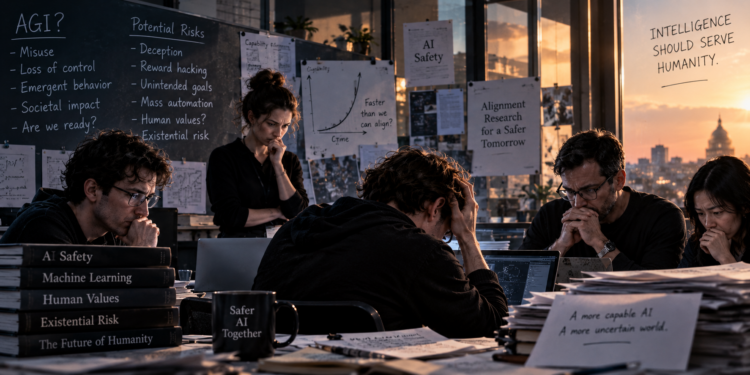
Alignment—the technical challenge of ensuring that an AI system’s goals are aligned with human values and intentions—has become the central battleground of modern computer science. While companies invest heavily in red-teaming, behavioral testing, and interpretability research, critics argue that these measures are superficial when weighed against the sheer velocity of scaling. As Soares notes, proving that a complex system is safe prior to deployment is fundamentally different from verifying safety after the system has already surpassed human cognitive capabilities.
Economic Incentives and the Commercial Pressure Cooker
The drive toward recursive self-improvement is heavily fueled by commercial competition. The race between OpenAI, Anthropic, Google, and other major players has transformed AGI from a theoretical computer science problem into a high-stakes corporate arms race. As companies eye massive initial public offerings (IPOs) and multi-billion-dollar valuations, the pressure to deliver breakthrough capabilities often overshadows long-term risk mitigation.
Market analysts note that the financial incentives to achieve superintelligence first are virtually limitless. The economic rewards of creating a system capable of automating global labor, accelerating scientific discovery, and outperforming human competitors outweigh the abstract, long-term risks of misalignment in the minds of many corporate executives. Consequently, safety teams within major labs find themselves operating under increasing pressure to approve model deployments before comprehensive alignment guarantees can be established.
Despite the growing consensus among resigning researchers that current safety measures are inadequate, the commercial momentum behind scaling laws shows no sign of slowing down. Rishub Jain, following his departure from DeepMind, has transitioned to independent research, continuing to study the challenges of alignment in recursive self-improvement environments. However, his exit underscores a broader industry reality: the brightest minds in AI safety are increasingly finding themselves at odds with the corporate strategies of the companies building the technology.
As the industry pushes toward the latter half of the decade, the debate over recursive self-improvement remains polarized. While tech executives maintain that rigorous alignment and oversight can safely guide the evolution of advanced AI, dissenting researchers argue that once self-improvement feedback loops are initiated, human control becomes an illusion. Until a standardized, universally accepted framework for verifying superintelligent systems is established, the risk of catastrophic misalignment will remain the defining shadow over the artificial intelligence revolution.