Trump’s World Cup Appearance Met with Boos as Controversy Swirls Around His Sporting Interventions

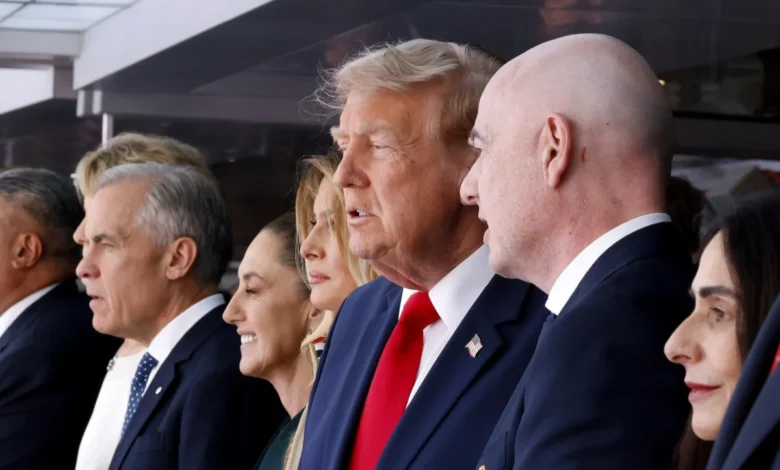
Spain may have emerged as the official winner of the 2026 FIFA World Cup, but the event was marked by a decidedly negative reception for a prominent American figure. Former U.S. President Donald Trump, who was slated to present the coveted trophy, found himself the target of widespread boos from fans at MetLife Stadium in New Jersey. The incident, which occurred shortly after Jennifer Hudson’s rendition of the national anthem, cast a shadow over the celebratory atmosphere and highlighted a recurring theme of public disapproval at major sporting events for the former president.
The jeers directed at Trump, who was shown on the stadium’s jumbotrons seated alongside his wife, Melania Trump, punctuated the final match between Argentina and Spain. This was not an isolated occurrence; Trump has a documented history of facing negative crowd reactions at various sporting spectacles. From the roar of the crowd at the World Series to the hushed disapproval at the U.S. Open, and even at UFC fights and PGA Tour events, hostile territory has become a familiar backdrop for his public appearances. The World Cup, as the pinnacle of global football, provided yet another stage for this phenomenon.
A Controversial Role in the USMNT’s World Cup Journey
Beyond the public reception, Trump’s alleged personal involvement in the U.S. Men’s National Team’s (USMNT) World Cup campaign has also come under scrutiny, with some suggesting it contributed to their eventual downfall. The controversy began during a crucial Round of 16 match against Belgium. After a red card was issued to the USMNT’s star striker, Folarin Balogun, which would have suspended him from a critical juncture of the game, Trump reportedly intervened. Sources indicate that he personally contacted FIFA President Gianni Infantino to discuss the decision.
The immediate aftermath of this alleged intervention was a swift overturning of Balogun’s red card. However, instead of galvanizing the U.S. team, this controversial turn of events appeared to create a palpable shift in the team’s morale. Reports from within the team and analyses of the match suggested a stressed and unsettled atmosphere, culminating in what many described as their weakest performance of the tournament. The U.S. was subsequently eliminated from the Round of 16, suffering a decisive 4-1 defeat to Belgium.
This episode drew immediate comparisons from fans and commentators to Trump’s appearance at Game 4 of the NBA Finals. In that instance, the New York Knicks, playing against the San Antonio Spurs, lost the only game in what would become their eventual 4-1 series defeat. Trump’s presence at that game was also met with significant booing, underscoring a pattern of public discontent at events he attends.
A History of Boos at Sporting Events
The 2026 World Cup final is merely the latest in a series of high-profile sporting events where Donald Trump has been met with audible disapproval. His attendance at a World Series game in 2019 saw him subjected to chants of "Lock him up!" This was preceded by a similar reception at the 2019 U.S. Open, where he was also booed by the crowd. Even at more niche sporting events, such as UFC fights and PGA Tour events, his presence has frequently elicited negative reactions.
- 2019 World Series: The former president attended Game 5, where he was met with loud boos and chants from the crowd.
- 2019 U.S. Open: During his appearance at the tennis tournament, Trump also experienced a wave of boos from spectators.
- NBA Finals: His attendance at Game 4 of the 2024 NBA Finals, where the New York Knicks were playing, resulted in significant booing from the audience.
- PGA Tour Events: Trump’s golf courses have hosted numerous PGA Tour events, and while his presence is often expected, it has not always been met with universal approval, with reports of mixed reactions.
- UFC Fights: Trump has attended several UFC events, often in prominent seating, where his appearances have been accompanied by boos from a segment of the audience.
These instances highlight a consistent trend of public dissent towards the former president at venues that are typically bastions of national pride and sporting enthusiasm. The reactions suggest a deep division within the public, with a significant portion of attendees at these events choosing to express their opposition to Trump through vocal disapproval.
The Trophy Presentation and Political Alliances
Despite the boos, Trump was still scheduled to perform the ceremonial duty of presenting the World Cup trophy to the winning team. This is not his first experience with such a role in international football. The previous summer, he presented the FIFA Club World Cup trophy to Chelsea FC. Reports from that event indicated that even members of the winning team, including star player Cole Palmer, appeared visibly confused by his presence and the ceremonial nature of his involvement. Players, often focused on the immediate elation of victory, have little control over who presents the trophy, and such appearances can sometimes feel like an imposition rather than a genuine part of the celebration.
The geopolitical context surrounding the trophy presentation also adds another layer of intrigue. Argentina’s President Javier Milei, who has openly aligned himself with Trump ideologically, has participated in various U.S. political events and even visited Trump’s Mar-a-Lago resort. This ideological kinship contrasts sharply with the relationship between Spain’s current government and Trump, which is described as less cordial. This divergence in political relationships between the potential winning nations and the former U.S. president could influence the dynamics of the trophy presentation and the broader reception Trump receives on the global stage. The symbolic act of handing over the World Cup trophy, a moment of immense global significance, is thus imbued with potential political undertones, further amplifying the scrutiny of Trump’s role.
Broader Implications and Analysis
The consistent booing of Donald Trump at major sporting events, culminating in his appearance at the 2026 World Cup final, speaks to a broader cultural and political polarization within the United States and, by extension, its global perception. Sporting events, often seen as apolitical arenas for shared national pride and entertainment, have increasingly become sites for the expression of political sentiment.
The alleged intervention in the USMNT’s World Cup campaign raises questions about the boundaries of political influence in international sports. While presidents and heads of state often engage in diplomatic efforts that can indirectly affect sporting outcomes, direct personal intervention, particularly if perceived as leveraging influence for a specific national team’s advantage, can be viewed as problematic. This incident highlights the delicate balance between national support and the integrity of international sporting regulations. FIFA, as the governing body, is expected to maintain impartiality, and any perceived undue influence can undermine public trust in its processes.
The confusion and apparent discomfort of athletes when figures like Trump are involved in trophy presentations also point to a disconnect between the world of politics and the purity of athletic achievement. For players who have dedicated years to reaching the pinnacle of their sport, the introduction of political figures, especially those with controversial public images, can detract from the significance of their victory.
As the World Cup concludes, the narrative surrounding Donald Trump’s participation will undoubtedly be a focal point, not just for football enthusiasts but for political observers as well. His continued appearances at high-profile sporting events, and the consistent public reactions they elicit, underscore the enduring impact of his presidency and his polarizing presence in American public life, even as he transitions out of office. The events of the 2026 World Cup serve as a potent reminder that in the modern era, the lines between sport, politics, and public opinion are increasingly blurred.