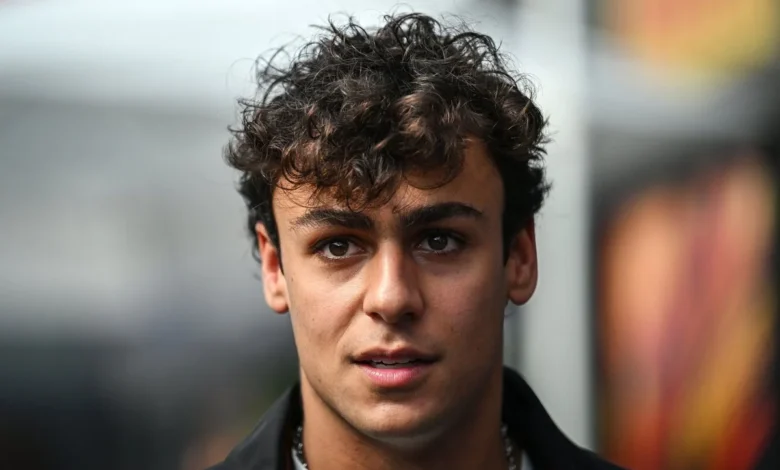
The incident occurred during the late stages of the race at the demanding Baku City Circuit, a track notorious for its narrow sections and high-speed complexity. While Lindblad managed to salvage a respectable seventh-place finish, netting six valuable points for the Racing Bulls outfit, the race was significantly compromised for his teammate. Liam Lawson, who had been positioning himself for a strong points finish, saw his afternoon derailed by the contact, eventually crossing the line in 12th position after the damage to his vehicle hampered his performance for the remainder of the event.
The Chronology of the Baku Collision
The chaos unfolded immediately following a safety car restart, which was triggered by a dramatic incident involving Williams driver Alex Albon. As the field bunched up for the green flag, the technical nature of the first sector of the Baku circuit—a series of tight, 90-degree corners—created a bottleneck.
According to track data and onboard telemetry, the restart saw a compact train of cars entering Turn 1. Arvid Lindblad, trailing both his teammate Lawson and Haas driver Esteban Ocon, attempted to capitalize on the slipstream effect. However, the braking zone proved to be a critical failure point. Lindblad applied his brakes marginally later than those ahead, finding himself in an untenable position. As Ocon and Lawson adjusted their lines for the corner, Lindblad was effectively squeezed into a vanishing gap. The resulting contact sent Lawson into a spin, causing significant aerodynamic damage to his floor.
The race stewards conducted a thorough post-race review of the incident, analyzing both telemetry and onboard footage. In their official statement, the stewards concluded that no further action was warranted against Lindblad. They cited the "restricted space available" as the primary mitigating factor, noting that the rookie driver had nowhere to go once the cars ahead began their braking sequence.
Reactions and Official Statements
In the immediate aftermath of the race, the frustration was palpable within the Racing Bulls garage. Liam Lawson, speaking to Sky Sports F1, expressed his disbelief regarding the maneuver. "I need to watch it, but I mean, we’re all coming into Turn 1 on the restart, and I just got smoked from my left, put a hole in my floor as well," Lawson noted. "So I don’t really know what gap he was looking for. In the middle of both of us going into Turn 1, I just don’t understand it."
The damage to Lawson’s floor was not merely cosmetic. Modern Formula 1 cars rely heavily on underfloor aerodynamics to generate downforce; a hole in this region leads to a loss of ground effect, causing instability in high-speed corners and a significant drop in tire efficiency. For the remainder of the Baku race, Lawson was essentially managing a wounded car, unable to defend or attack effectively.
Arvid Lindblad, recognizing the gravity of the situation, utilized his social media platforms to address the incident. His statement reflected both the professional satisfaction of his seventh-place finish and the personal remorse regarding his teammate’s misfortune.
"Strong race today, really happy to bring it home in P7," Lindblad stated. "It’s not been an easy week, and I’m frustrated with how I handled some of it. We’ve struggled as a team too, so I’m really happy with how we bounced back and maximized today on a difficult weekend. Big shoutout to the PU [Power Unit] boys – you gave me an absolute rocketship today. Gutted about what happened with Liam – sorry mate. Glad we were still able to bring some points home for the team."
Contextualizing the Racing Bulls Season
The 2024 season has been a testing period for the Racing Bulls team. Tasked with managing a young lineup, the team has faced the dual challenge of developing their car while fostering the growth of their drivers. The Baku event was a microcosm of these challenges. While the team’s power unit performance was highlighted by Lindblad as a major positive, the internal friction between teammates presents a management hurdle for team principal Laurent Mekies and the wider engineering group.

The Baku City Circuit is famously unforgiving. With an average speed that rivals some of the fastest tracks on the calendar, combined with the narrow walls of the old city section, any margin for error is razor-thin. For a rookie like Lindblad, the pressure of a safety car restart—where the field is tightly packed and tires are often at the edge of their operating window—is perhaps the most difficult test of race craft.
Statistically, the loss of points for Lawson is a blow to his championship standing. As the mid-field battle continues to intensify, every point is vital for the team’s constructor standings. The Racing Bulls currently find themselves in a tight group, fighting to secure a top-tier finish in the mid-field order. A 12th-place finish for a car that likely had the pace for the top eight represents a missed opportunity that the team will undoubtedly review during their post-race debriefs in Faenza.
Implications and Future Outlook
The collision between Lindblad and Lawson serves as a focal point for a broader discussion on teammate dynamics. In Formula 1, the teammate is the only driver with the exact same equipment, making them the primary benchmark for performance. When internal friction leads to on-track incidents, it often prompts teams to implement stricter internal protocols for race starts and defensive maneuvers.
For Arvid Lindblad, the incident is a formative moment. His public admission of fault demonstrates a level of maturity, yet it also highlights the aggressive nature of his driving style. Transitioning from junior categories to the pinnacle of motorsport requires a recalibration of aggression levels. The stewards’ decision not to penalize him does not absolve him of the necessity to improve his spatial awareness in traffic.
Looking ahead, the focus for the Racing Bulls will shift toward the next round of the championship. The team’s ability to provide a "rocketship" of a power unit, as noted by Lindblad, suggests that the underlying mechanical performance is strong. The challenge for the engineers will be to ensure that this performance is not wasted through avoidable contact.
Furthermore, the team management will likely engage in "air-clearing" sessions between the two drivers. Maintaining a harmonious working relationship is essential for data sharing and car development. If internal rivalries are allowed to fester, the team risks losing cohesion, which could be detrimental to their long-term development goals for the 2025 campaign.
Analytical Perspective: The Physics of the Incident
From a technical standpoint, the incident at Turn 1 in Baku illustrates the "dirty air" and visibility issues inherent in modern F1 cars. As the cars braked, the lead driver (Lawson) had the advantage of clear air and a predictable braking line. Lindblad, tucked in behind the pack, was subject to a rapidly changing environment.
The "sandwich" effect described by spectators occurs when a driver is caught between two cars moving toward the same apex. When the middle car (Lindblad) misses his braking point by even a fraction of a second, the kinetic energy involved in a collision at those speeds is substantial. The hole in Lawson’s floor was likely caused by the front wing endplate of Lindblad’s car making contact with the side pod or floor edge of Lawson’s vehicle.
In the fast-paced world of Formula 1, incidents are often analyzed through the lens of intent versus execution. There was no indication of malice or deliberate foul play; rather, this was a case of a rookie misjudging the complex physics of a restart. As the sport continues to evolve, with increasingly sophisticated telemetry and simulation tools, drivers are expected to have a near-perfect understanding of these variables. Lindblad’s apology is a sign of his recognition that, in the world of professional racing, the learning curve is often paved with such expensive, high-stakes errors.
As the season progresses, the eyes of the paddock will be on how Lindblad recovers from this incident. His performance in the remainder of the race—finishing seventh—suggests he possesses the speed and the temperament to recover from setbacks. The coming races will be a true test of whether he can integrate that speed with the tactical patience required to avoid contact with his teammate, ensuring that the Racing Bulls can maximize their potential in an increasingly competitive field.