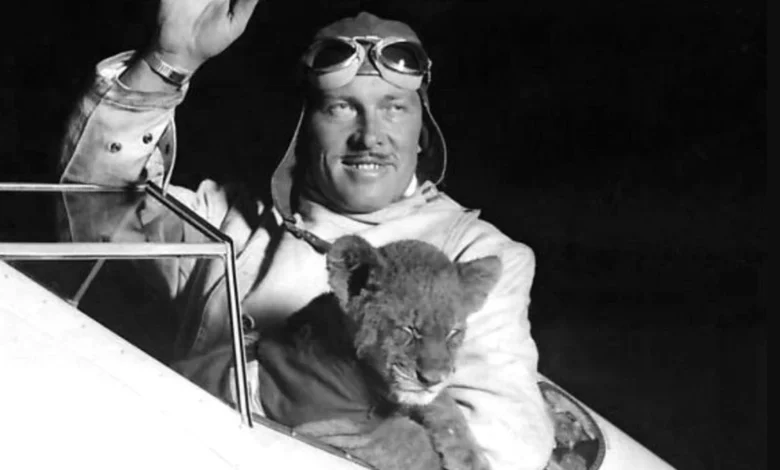
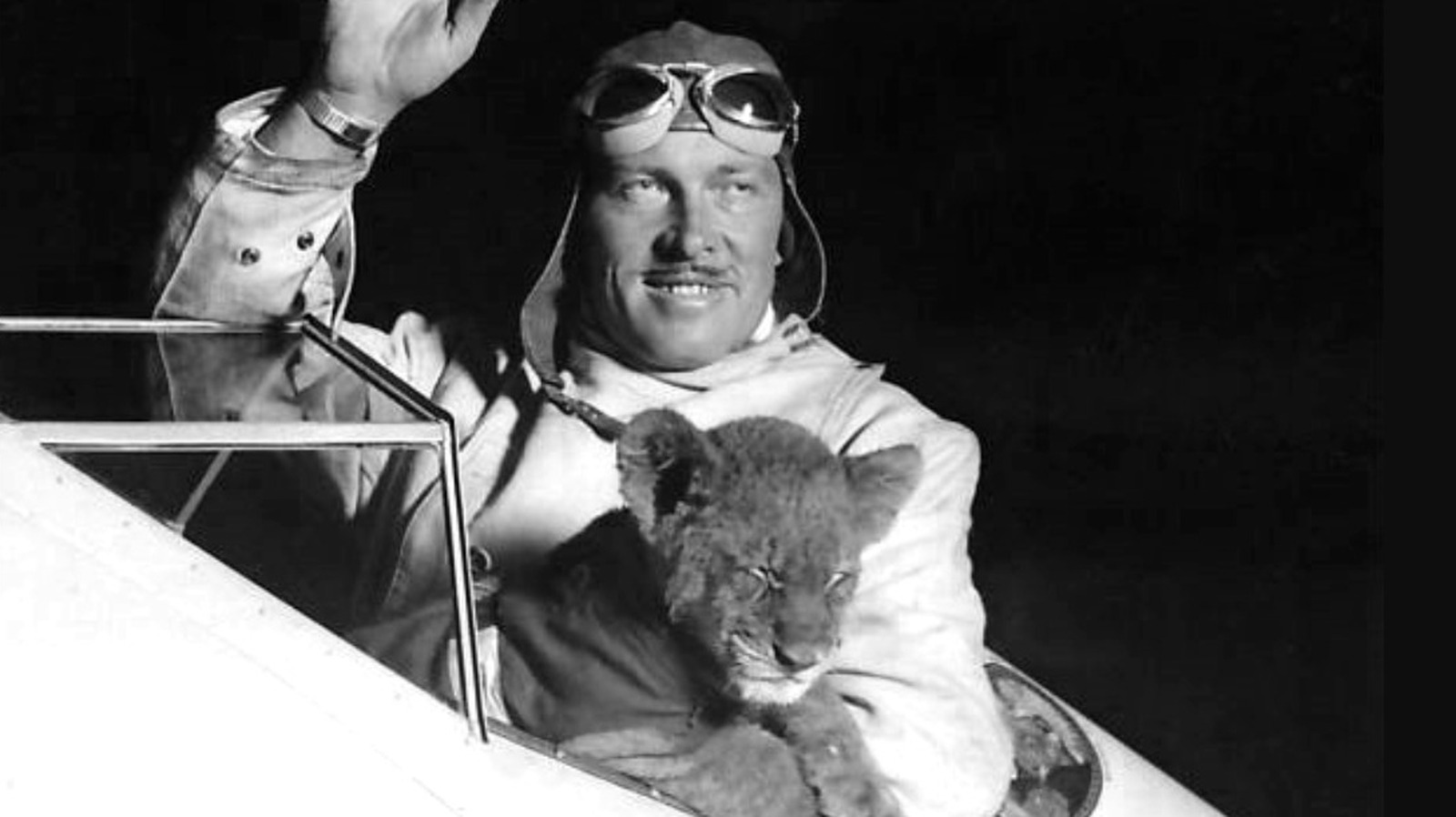
In the annals of early 20th-century aviation, few figures embodied the intersection of daring showmanship and corporate branding as vividly as Roscoe Turner. A veteran of the U.S. Army Air Service during the First World War and a pioneer of the barnstorming era, Turner became a household name not only for his aerobatic prowess but for his unconventional promotional tactics. Perhaps the most peculiar of these ventures occurred in 1930, when Turner, backed by the financial resources of Gilmore Oil, initiated a transcontinental flight campaign accompanied by a three-week-old lion cub named Gilmore. This partnership between man, machine, and predator redefined the boundaries of celebrity and corporate advertising during the Great Depression.
The Rise of the Flying Showman
Roscoe Turner was never a pilot who operated in the shadows. Born in Mississippi in 1895, he emerged from the chaos of World War I as a seasoned aviator with an appetite for the spectacular. During the 1920s, he transitioned into the world of barnstorming, a high-risk, high-reward profession that involved performing wing-walking stunts and meticulously choreographed parachute descents to dazzle rural crowds.
His career, however, was not without controversy. In 1922, Turner faced legal difficulties after purchasing a surplus Curtiss JN-4 aircraft that was later identified as stolen government property. Despite this setback, his charisma and piloting skill allowed him to rebound. He eventually founded the Roscoe Turner Flying Circus and served as a stunt pilot for early Hollywood motion pictures. As the Great Depression took hold of the American economy, traditional barnstorming became less profitable. Recognizing that survival in aviation required deep-pocketed sponsors, Turner pivoted toward speed racing, securing a lucrative sponsorship from Gilmore Oil, a company that marketed its fuel under the "Red Lion" brand—a name chosen to imply that their gasoline gave engines the "roar" of a beast.
The 1930 Transcontinental Record
In early 1930, Turner and Gilmore Oil sought to demonstrate the efficacy of their products on a national stage. Utilizing a Lockheed Express aircraft, Turner set out to shatter the transcontinental flight record. The journey from New York to Los Angeles was completed in a staggering 18 hours and 42 minutes, a feat that cemented Turner’s reputation as one of the elite speed flyers of his generation.
To ensure the publicity for the record-breaking run was impossible to ignore, Turner obtained a three-week-old lion cub from a local farm. Dubbed "Gilmore the Flying Lion," the cub was integrated into the promotional narrative. The cub did not merely sit in a crate; he was an active participant in Turner’s life, attending movie premieres, high-society events, and the renowned Cleveland National Air Races.
The Humane Society and Public Scrutiny
The spectacle of a lion in an open-cockpit plane eventually caught the attention of animal welfare advocates. The Humane Society, concerned about the welfare of the cub in high-altitude, high-speed conditions, voiced strong objections to Turner’s promotional stunts. In a move that displayed both his flair for drama and his willingness to adapt to criticism, Turner commissioned a custom-made static-line parachute for the 17-pound cub.
This accommodation allowed Turner to continue his tour with the lion, including a notable transit from Vancouver, Canada, to Aguascalientes, Mexico. During this period, the cub served as a living mascot for the petrochemical company, embodying the "Red Lion" branding. The association between the lion and the fuel was so potent that the public began to view the animal as a central figure in the expansion of American aviation culture.
The Professional Evolution of Roscoe Turner
By the time the lion cub reached ten months of age, he weighed 150 pounds and had logged more than 25,000 miles in the air. Recognizing that the animal was becoming too large for the cockpit, Turner retired Gilmore from flying duties. However, the pilot’s career trajectory continued to ascend. Working alongside engineers Jimmy Wedell and Harry Williams, Turner helped develop advanced low-wing monoplanes that were essentially a seat, a tiller, and a powerful Pratt & Whitney nine-cylinder radial engine.
Turner’s personal style remained a subject of fascination for his contemporaries. Fellow pilot Jimmy Doolittle famously noted Turner’s penchant for theatricality, describing his polished riding boots, powder-blue military jacket adorned with diamond-studded wings, and his signature waxed mustache. Doolittle remarked that one could always sense Turner’s presence before seeing him, noting that his magnetic personality and gregarious nature made him a central figure in the social life of the aviation community.
Turner’s racing record confirms his skill: he won the prestigious Bendix Trophy in 1933 and the Thompson Trophy in 1934, solidifying his status as a titan of the golden age of air racing.
The Later Life of Gilmore the Lion
The post-aviation life of Gilmore the lion serves as a sobering postscript to his brief moment of fame. After his retirement from the air, he was moved between various enclosures, eventually being held at a display cage at a Gilmore gas station in Beverly Hills. What was once a symbol of the untamed sky was reduced to a stationary attraction for motorists.
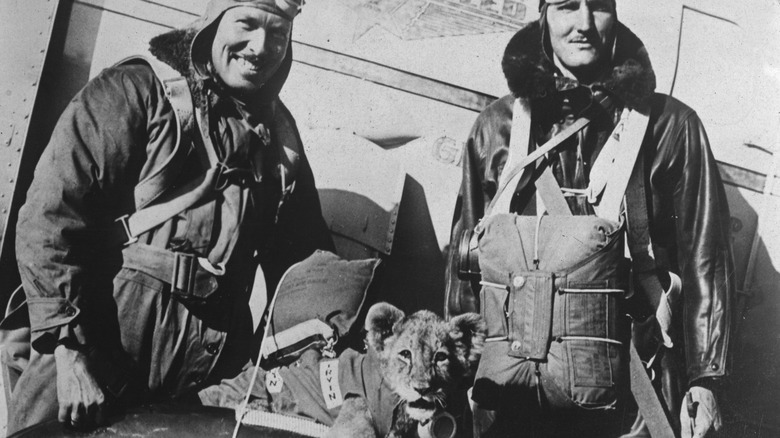
In 1940, the lion was returned to the Louis Goebel Lion Farm in Agoura, California, where he had been born. He lived there until his death on December 17, 1950, at the age of 20. Throughout those years, Turner remained a benefactor, providing financial support for the lion’s care and making periodic visits.
Following his death, the lion was taxidermied and became part of the Roscoe Turner Museum in Indianapolis upon its opening in 1970. When the museum closed two years later, the specimen was transferred to the Smithsonian Institution’s National Air and Space Museum. Today, the stuffed lion, weighing in at approximately 328 pounds, serves as a historical artifact, representing a unique, albeit ethically complex, era of American corporate marketing and aviation history.
Historical Context and Legacy
The story of Roscoe Turner and his flying lion highlights the transition of aviation from a dangerous, experimental pursuit into a form of mass-market entertainment. The 1930s were characterized by a desperate need for public distraction, and the sight of a lion in a cockpit provided a compelling, if bizarre, narrative that helped keep the aviation industry in the headlines during a period of economic instability.
From a marketing perspective, the campaign was highly effective. It utilized the "humanization" of a predator to associate the qualities of strength, speed, and ferocity with a consumer product. While modern sensibilities regarding animal welfare have rendered such promotional tactics obsolete, the legacy of Gilmore the Flying Lion remains a cornerstone of early 20th-century American pop culture. The merger of the Gilmore Oil company into the firm that would eventually become Mobil closed the chapter on the corporation, but the imagery of the roaring lion persists in historical archives as a testament to the era’s relentless pursuit of publicity and progress.
Ultimately, the partnership between Turner and the cub was a product of its time—a time when the sky was the final frontier, and any means, no matter how unusual, was considered justifiable to capture the public imagination. Through his races, his uniforms, and his companion, Roscoe Turner ensured that he would not merely be remembered as a pilot, but as one of the most distinctive showmen of the century.