Cellular Glue Repurposed: How Epithelial Tissues Orchestrate Cleanup to Maintain Biological Integrity

A protein complex long celebrated for its role as the mortar holding the human body’s structural integrity together has been found to possess a sophisticated, previously unknown secondary function: acting as a biological scavenger. Researchers have discovered that the E-cadherin complex, which anchors epithelial cells in skin, lungs, and the digestive tract, is fundamentally involved in the engulfment and disposal of dying cells. This revelation, published in the journal Nature Communications, fundamentally alters our understanding of how tissues maintain homeostasis and provides a potential new frontier for addressing chronic inflammation and autoimmune disorders.
The Role of E-cadherin in Tissue Architecture
Epithelial cells serve as the body’s primary barrier, forming continuous, sealed layers that protect internal organs from external pathogens and environmental stress. For decades, the E-cadherin complex—a molecular assembly consisting of the protein E-cadherin and three specialized partners—has been identified as the "cellular glue" responsible for this structural strength. By facilitating direct adhesion between neighboring cells, this complex ensures that tissues remain intact, effectively creating a sophisticated biological seal.
However, the maintenance of these barriers is not a static process. Tissues are dynamic environments where individual cells frequently reach the end of their lifecycle. The efficient removal of these apoptotic cells is critical; if left to linger, dead cells can rupture, leaking toxic intracellular contents into the surrounding environment, which in turn triggers inflammatory responses. Chronic inflammation is a hallmark of numerous diseases, including cardiovascular conditions, neurodegenerative disorders, and cancer, making the mechanism of cellular cleanup a subject of intense scientific scrutiny.
Investigating the Cleanup Mechanism
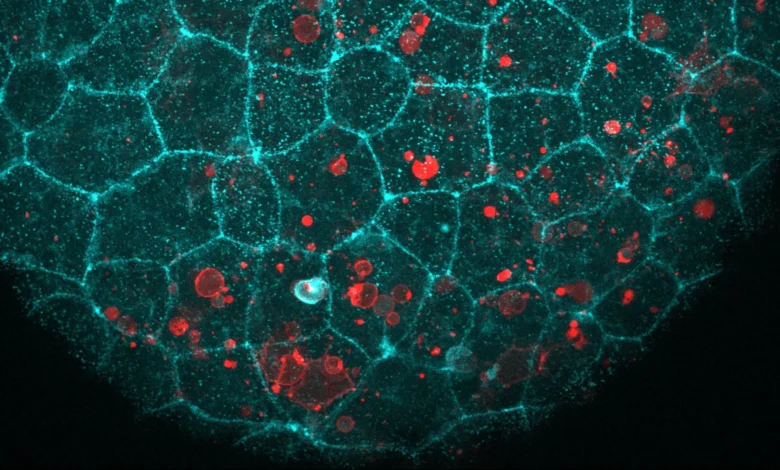
The study, led by ICREA Research Professor Verena Ruprecht, sought to understand the mechanics behind this cleanup process. By utilizing high-resolution, live-imaging techniques in zebrafish and mouse embryos, the research team observed a striking phenomenon: the same E-cadherin molecular machinery used to bond living cells together migrates to the specific contact points where a dying cell touches the epithelial layer.
To determine if this was a standard adhesion process, the team conducted a series of rigorous experiments. When they presented the epithelial tissue with dying cells that had been intentionally stripped of E-cadherin, the tissue continued to engulf the debris with high efficiency. Further, when the researchers introduced synthetic fat droplets—devoid of proteins but coated with "eat-me" signals normally found on dying cells—the epithelial cells still moved to consume them. This suggested that E-cadherin was not merely "sticking" to a neighbor, but was actively facilitating a complex, physical remodeling process to ingest unwanted material.
The Biomechanics of Cellular Consumption
One of the most significant challenges for an epithelial cell is to engulf a large mass—often roughly the size of the cell itself—without compromising the integrity of the tissue barrier. The researchers discovered that this is achieved through a specialized, asymmetrical cellular response.
The process mirrors a sophisticated choreography. While the upper surface of the cell, which faces the external environment or a lumen, remains rigid and stable to maintain the barrier, the lower surface undergoes extensive deformation. It stretches and bends around the dying cell, effectively "swallowing" the debris from underneath. Ruprecht likens this behavior to a group of dancers holding hands; while their arms and upper bodies remain locked in a steady formation to keep the line intact, their feet move in complex patterns to navigate obstacles.
The study further identified the mechanical components enabling this movement:
- The Molecular Rope: A specific protein within the E-cadherin complex acts as a tether, connecting the assembly to the cell’s internal skeleton. This provides the force transmission necessary to pull the dying cell into the epithelial layer. Without this tether, or the specific protein region that attaches it to the cytoskeleton, the cleanup process halts entirely.
- The Molecular Brake: Another component serves as a regulator for the cell’s contractile machinery. Interestingly, the study found that this component acts as a brake; however, removing this brake did not accelerate the process. Instead, it rendered the cell too rigid to perform the necessary, delicate remodeling, highlighting that the cleanup process requires a precise balance of fluidity and tension.
Chronology and Evolutionary Context
The research builds upon a decade of study into innate immune defense mechanisms. Previous work by the Ruprecht lab demonstrated that early-stage embryos utilize epithelial tissues to cooperatively remove dying cells, a behavior categorized as a form of "primitive" or innate immunity. Because embryos are transparent, they have served as the ideal model for this study, allowing researchers to observe these cellular mechanics in real-time—a feat currently impossible in adult human tissues.
The discovery that this mechanism is shared between zebrafish and mice suggests that the process is evolutionary conserved. The persistence of the E-cadherin structure across diverse vertebrate species underscores its critical importance to survival. While the study has not yet been confirmed in adult human tissue, the presence of E-cadherin in the human retina, colon, airways, and mammary glands makes it a high-probability candidate for a universal cleanup mechanism in adults as well.
Clinical Implications and Future Research
The implications for human health are profound. If researchers can determine how to stimulate or repair this cleanup mechanism, it could offer a novel approach to managing chronic inflammation. Currently, many inflammatory conditions are treated by targeting the chemical signals that trigger immune responses. However, if the root cause of the inflammation is a failure in the mechanical "cleanup" process of dead cells, then pharmacological interventions targeting the E-cadherin complex or its associated cytoskeletal tethers could prove far more effective.
"Studying the mechanisms of how dying cells can be removed efficiently from tissues is of very high relevance to human health," Ruprecht noted. The potential for this research to influence therapeutic strategies for degenerative diseases is significant. If, for instance, the cleanup process in the retina or the gut fails as a result of aging or disease, restoring the "rope-and-brake" mechanical balance of these cells could theoretically prevent the chronic inflammation that exacerbates these conditions.
Collaborative Efforts and Funding
The study was the result of a multi-year collaborative effort led by joint first authors Hanna-Maria Häkkinen, Marta Batet Palau, and Laura F. Bianchi. The research was made possible through extensive institutional support and international funding, including grants from the Spanish Ministry of Science and Innovation, the Human Frontier Science Program, the European Union’s Horizon Europe program, and the "la Caixa" Foundation. Additional technical support was provided by the CRG Core Facilities for Advanced Light Microscopy, Tissue Engineering, and Protein Technologies.
Analysis: A New Paradigm for Cellular Health
The transition from viewing E-cadherin strictly as a "structural glue" to seeing it as a dynamic "scavenger" marks a shift in cell biology. For years, the scientific consensus focused on the chemical signaling pathways that alert the body to apoptosis. This study emphasizes that the physical capacity for cells to reshape themselves—the biomechanics of the act—is just as vital as the chemical trigger.
As the scientific community moves toward validating these findings in adult human models, the focus will likely shift to whether environmental factors, such as toxins or chronic stress, can disrupt this mechanical cleanup process. If the "choreography" of the epithelial cells is disrupted, the consequences for the organism are likely to be severe, potentially providing new answers to why some tissues are more prone to inflammatory decay than others. The work of Ruprecht and her colleagues provides the necessary framework to begin asking these questions, opening a new window into the microscopic cleanup operations that protect our bodies every day.
Related posts: