The Emergence and Devastation of SCTLD
Stony Coral Tissue Loss Disease first appeared near Miami in 2014, and its rapid expansion has been described by marine biologists as one of the most lethal coral disease outbreaks ever recorded. Unlike localized bleaching events or previous disease outbreaks, SCTLD is characterized by its aggressive progression, often stripping the living tissue from a coral colony in a matter of weeks. The disease primarily targets "reef-building" species, including the Great Star Coral (Montastraea cavernosa), which provide the structural complexity necessary for diverse marine ecosystems to thrive.
The economic and ecological stakes are immense. The Florida Reef Tract is the only barrier reef system in the continental United States, supporting thousands of jobs in tourism and fishing while acting as a natural buffer against storm surges. As the disease spread throughout the Caribbean—reaching as far as the U.S. Virgin Islands, Mexico, and Jamaica—the scientific community scrambled to find interventions that could scale beyond the laboratory.
The Discovery of the MCH1-7 Probiotic
The breakthrough arrived following a period of rigorous observation. In 2018, Smithsonian scientists identified a coral colony that had mysteriously survived an SCTLD outbreak despite being surrounded by decaying, infected neighbors. Upon analysis, researchers discovered that this specific colony hosted a unique bacterial strain, later designated MCH1-7.
This bacterium produces a potent compound known as tetrabromopyrrole (TBP). In the natural world, TBP acts as a chemical cue that influences the settlement of coral larvae. The hypothesis formed by researchers was two-fold: not only does TBP potentially aid in the healthy development and recruitment of new coral, but it also serves as a protective chemical shield against the pathogens driving SCTLD. This evolutionary "defense-recruitment" mechanism became the foundation for the current study published in Frontiers in Marine Science.
Experimental Methodology: Bagging vs. Topical Treatment
To assess the efficacy of MCH1-7, the research team conducted a long-term field study using Montastraea cavernosa. They employed two distinct delivery methods. The first involved a topical paste application directly onto lesions—a method commonly used in earlier coral restoration efforts. However, the study found that this approach had limited success, as it failed to address the systemic nature of the infection within the colony.
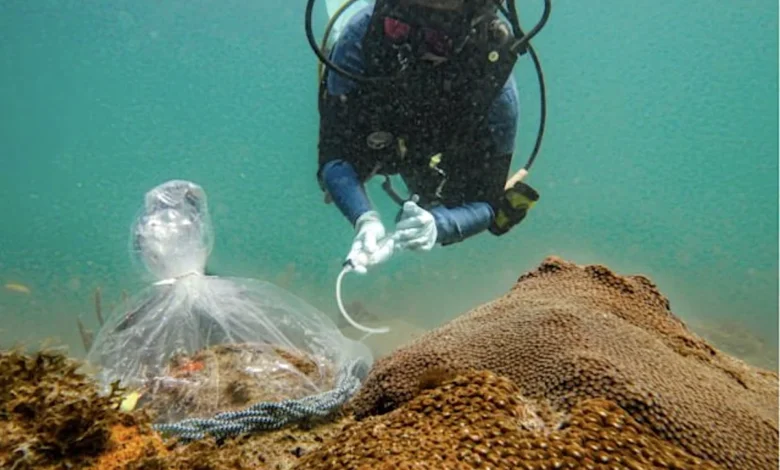
The second, more innovative approach involved "whole-colony bagging." Researchers submerged the corals in specialized, weighted bags filled with seawater enriched with the MCH1-7 probiotic. By isolating the colony within this treated environment, the researchers allowed the beneficial bacteria to colonize the coral’s surface tissues and mucus layers effectively.
The monitoring phase was exceptionally long by marine biology standards. The team tracked the health of the treated corals for 2.5 years, a duration essential for proving that the probiotic was not merely a temporary fix but a durable intervention. The results were stark: while untreated control colonies lost an average of 35% of their tissue to the disease, those subjected to the whole-colony bagging treatment lost only 7%.

Chronology of the Research
- 2014: Initial identification of SCTLD off the coast of Miami, Florida.
- 2018: Smithsonian Marine Station researchers identify the disease-resistant Montastraea cavernosa colony and isolate the MCH1-7 bacterial strain.
- 2021–2022: Field deployment of the whole-colony bagging technique begins in the Florida Reef Tract.
- 2023: Mid-study assessments confirm that the probiotic treatment continues to suppress lesion expansion.
- 2025: Publication of the findings in Frontiers in Marine Science, confirming a 2.5-year success window.
Analysis of Implications and Operational Challenges
The study highlights a critical shift in coral restoration philosophy. Previously, much of the effort was focused on genetic banking and laboratory propagation. While these remain vital, the ability to treat existing, mature reefs in situ using probiotic intervention provides a "stop-gap" that preserves the architectural complexity of the reef.
However, the "bagging" method is not without logistical hurdles. As noted by the lead author, Kelly Pitts, and her colleagues, the process requires significant human capital. Divers must transport equipment, set up the containment bags, and carefully monitor the probiotic concentration. This is a labor-intensive, time-consuming process compared to simpler, spray-on treatments. Yet, the authors argue that the long-term survival rates justify the investment of resources.
Furthermore, the study addressed safety concerns. A major fear with introducing biological agents into an open ocean environment is the potential for ecological disruption. The research team confirmed that the application of MCH1-7 did not negatively impact the surrounding Caribbean coral community, suggesting that the treatment is host-specific and environmentally benign.
Perspectives from the Scientific Community
The findings have been received with cautious optimism by the broader marine science community. While no single intervention is considered a "silver bullet," the use of microbial therapies is increasingly viewed as the most promising frontier in coral conservation.
"This is definitely not a cure-all, but we’re definitely moving in the right direction," stated Kelly Pitts. Her sentiment reflects the broader consensus that human-induced climate change and water quality issues remain the primary stressors for reefs. Probiotics offer a way to buy time, allowing reefs to survive long enough for larger-scale climate mitigation strategies to take effect.
Biologist Jennifer Sneed noted the ecological elegance of the discovery: "If TBP is a natural settlement cue, and if bacteria that also produce this compound protect corals from disease, it makes sense that larvae would settle where those compounds are being produced." This suggests that the use of MCH1-7 might eventually facilitate natural reef regeneration, as healthier, treated colonies become more attractive to drifting coral larvae.
Future Directions for Research
Despite the success of the 2.5-year study, the researchers acknowledge that the path to widespread application is still under construction. Future studies are expected to focus on:
- Scaling Logistics: Developing faster, less labor-intensive ways to deploy the probiotic in high-current or deep-water environments.
- Cross-Species Efficacy: Determining if MCH1-7 can be adapted for other highly susceptible species, such as the pillar coral (Dendrogyra cylindrus), which has been nearly wiped out by SCTLD.
- Environmental Resilience: Testing whether the treated corals exhibit enhanced resilience to secondary stressors, such as temperature-induced bleaching.
The work led by the Smithsonian Marine Station underscores the necessity of interdisciplinary approaches to environmental crises. By combining microbiology, ecological field observation, and specialized diving techniques, researchers are proving that even the most dire environmental catastrophes can be mitigated through scientific innovation. As the Florida Reef Tract continues to face the dual threats of disease and warming oceans, the success of the MCH1-7 probiotic stands as a vital development in the race to preserve these essential marine habitats. For now, the focus remains on scaling the treatment and ensuring that the interventions are sustainable for the long-term health of the ecosystem.