Hidden Beneath Our Feet: The Urgent Global Campaign to Map and Protect Earth’s Vital Fungal Networks

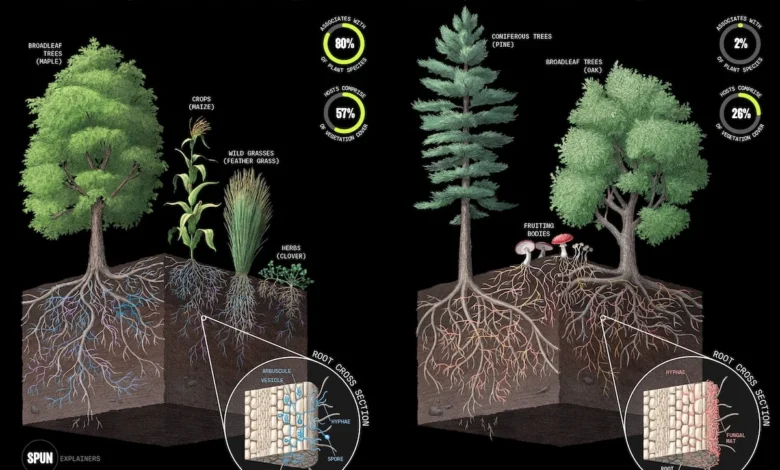
For centuries, humanity has focused its conservation efforts on the charismatic megafauna and towering forests visible to the naked eye, while the true architects of terrestrial life have remained largely invisible. New research published in the journal Nature has brought the planet’s "underground circulatory system" into the light, revealing that 90 percent of the world’s most critical mycorrhizal fungi biodiversity hotspots currently exist outside of protected areas. This groundbreaking study, spearheaded by the Society for the Protection of Underground Networks (SPUN), utilizes a massive dataset of 2.8 billion fungal sequences to map, for the first time, the subterranean communities that sustain global plant life, regulate soil health, and sequester massive amounts of atmospheric carbon.
The Foundation of Terrestrial Life
Mycorrhizal fungi, which include arbuscular and ectomycorrhizal varieties, are ancient biological partners that have co-evolved with plants for approximately 450 million years. These fungi form intricate, microscopic filaments known as mycelium that attach to plant roots, creating a symbiotic exchange: the fungi provide essential nutrients like phosphorus and nitrogen to the host, while the plants provide the fungi with carbon-rich sugars.
Beyond this individual partnership, these networks act as planetary engineers. By drawing more than 13 billion tons of carbon annually into the soil—a figure equivalent to nearly one-third of global fossil fuel emissions—these fungi are instrumental in mitigating the impacts of climate change. When these networks are disrupted by industrial agriculture, deforestation, or urbanization, the downstream effects are severe: diminished crop productivity, increased vulnerability to pathogens, and a breakdown in the soil’s ability to store carbon.
A Chronology of Discovery and Mapping
The effort to quantify and visualize this "dark" biodiversity began in earnest with the founding of SPUN in 2021, an initiative born from the recognition that fungal conservation was fundamentally absent from global climate agendas. The path to the recent Nature publication involved a multi-year, large-scale scientific synthesis:
- 2021: The launch of SPUN marks the first organized attempt to map fungal biodiversity on a global scale, gathering data from researchers, citizen scientists, and field explorers.
- 2022–2024: An international network of 96 "Underground Explorers" conducts sampling in remote and highly diverse ecosystems, including the Guinean forests of West Africa, the temperate rainforests of Tasmania, and the Brazilian Cerrado savanna.
- July 2025: SPUN releases its high-resolution predictive maps. By analyzing 2.8 billion sequences across 130 countries, researchers identify specific biodiversity hotspots that have previously been ignored by environmental policy.
- July 2025: The findings are published in Nature, confirming that only 9.5 percent of these identified fungal hotspots currently fall within the boundaries of existing global protected areas.
Data-Driven Insights and the "Fungus Blindness" Problem
The sheer scale of the SPUN dataset—covering over 40,000 specimens representing 95,000 mycorrhizal taxa—has finally allowed scientists to address what Dr. Merlin Sheldrake, SPUN’s impact director, calls "fungus blindness." This term refers to the systematic failure of conservationists to recognize that terrestrial health is fundamentally rooted in the soil.

The data reveals a stark discrepancy: while the global community has spent decades designating national parks and marine reserves based on visible plant and animal species, the primary engines of those very ecosystems—the fungi—have been left unprotected. Dr. Michael Van Nuland, the study’s lead author and a data scientist at SPUN, emphasizes that these maps are not merely academic exercises. They provide quantitative benchmarks that allow restoration managers to understand the ideal fungal composition of a healthy, functioning ecosystem. By identifying areas of high endemism, the tools enable policymakers to designate "underground conservation corridors," ensuring that subterranean networks remain intact even as surface land usage shifts.
Official Responses and the Scientific Community
The publication has sent ripples through the environmental policy sector, with prominent figures in the conservation world aligning behind the call for a shift in strategy. The project is backed by a prestigious advisory board, including conservationist Jane Goodall and authors Michael Pollan and Paul Hawken.
Dr. Toby Kiers, Executive Director of SPUN, has been vocal about the implications of the findings. "If we have healthy fungal networks, then we will have greater agricultural productivity, bigger and beautiful flowers, and can protect plants against pathogens," Kiers stated. The sentiment is echoed by Dr. Alex Wegmann of The Nature Conservancy, who noted that restoration practices have historically been "dangerously incomplete" because they ignored the below-ground reality. By incorporating these maps into restoration frameworks, organizations can now prioritize areas where fungal reintroduction or preservation would yield the highest ecological return on investment.
The Broader Economic and Climate Implications
The implications of these findings extend far beyond biology; they reach into the heart of global economic stability and food security. As extreme climate events—ranging from prolonged droughts to catastrophic flooding—become more frequent, the resilience of the soil has become a primary concern for international agricultural organizations.
Mycorrhizal networks act as a natural defense system for crops. Fungi improve soil structure, enhancing water retention and nutrient cycling, which makes plants more robust in the face of environmental stress. By ignoring these networks, current agricultural models often rely on synthetic fertilizers to compensate for "dead" soil—a practice that, ironically, further destroys the very fungi that could provide these services for free.
Furthermore, the role of fungi in the global carbon budget cannot be overstated. With 13 billion tons of carbon sequestered annually, the preservation of these networks is effectively a climate mitigation strategy that requires minimal technological intervention. Integrating this data into the decision-making processes of international policy bodies, such as the UN Convention on Biological Diversity, could fundamentally alter how carbon credits and land-use subsidies are allocated in the future.

Moving Toward a New Era of Conservation
As the world grapples with the dual crises of biodiversity loss and climate change, the work of SPUN provides a rare, actionable path forward. The goal is to elevate underground biodiversity to the same level of importance as satellite imagery in environmental planning.
The next phase of the project involves training local stakeholders, land managers, and governments on how to interpret these predictive maps. By using the maps to identify which ecosystems are most at risk of losing their fungal connectivity, SPUN hopes to assist in the creation of new protected areas that are designed from the ground up—literally.
For the "Underground Explorers" still working in the field, the mission remains urgent. Despite the 40,000 specimens already cataloged, this represents a fraction of a percent of the planet’s surface. The maps released today are the first, high-resolution attempt to visualize the invisible, but they are also a warning. As the data shows, we are operating in a state of high uncertainty, with 90 percent of the world’s most critical fungal hotspots lacking any form of formal protection.
The transition from a "surface-only" conservation mindset to one that accounts for the complex subterranean webs supporting all life on Earth will be a major challenge for the remainder of the decade. However, with these new, evidence-based tools, the scientific community now possesses the capability to make decisions that reflect the true complexity of our planet’s life-support systems. Safeguarding the underground is no longer a peripheral concern; it is now recognized as a fundamental pillar of global food security, climate resilience, and ecosystem stability. As we look to the future of conservation, the message from the research is clear: to save the forest, we must first save the soil.