
The scientific community has long grappled with a phenomenon known as publication bias, where negative results—studies that fail to confirm a hypothesis or reveal a lack of correlation—are frequently relegated to obscurity or left unpublished. This tendency creates a distorted view of scientific progress, emphasizing successful interventions while ignoring the null findings that are equally vital for mapping the contours of human psychology. However, a major study published this week in the journal Nature has defied this convention, offering a rigorous, large-scale investigation that suggests our current methods for measuring emotional regulation are fundamentally misaligned.
The research, led by an international consortium of scientists, casts doubt on the validity of three foundational pillars used to measure "cognitive reappraisal," a cornerstone of Cognitive Behavioral Therapy (CBT). By examining the intersection of self-reported questionnaires, behavioral task ratings, and functional MRI (fMRI) brain imaging, the study concludes that these disparate tools are not, in fact, measuring the same psychological capacity.
The Foundation of Cognitive Reappraisal
Cognitive reappraisal is a widely practiced technique in psychotherapy, particularly within the framework of CBT. It involves an individual’s ability to consciously re-evaluate a negative stimulus or a distressing life event to alter its emotional impact. By shifting one’s perspective, an individual can theoretically dampen a physiological stress response, thereby fostering greater emotional resilience and mental well-being.
Because of its therapeutic efficacy, cognitive reappraisal has been the subject of thousands of academic papers over the last two decades. Researchers have consistently sought to pinpoint the neural signatures of this process, often focusing on the amygdala—the brain’s "alarm center"—which plays a primary role in processing emotional threats. The prevailing hypothesis has been that when a person successfully engages in reappraisal, they are actively down-regulating the amygdala, effectively "turning down the volume" on their emotional response.

Chronology of the Investigation
The international research team recognized a growing disparity in the literature. While many small-scale studies reported finding links between personality traits (measured via questionnaires), task performance, and amygdala activity, these results were often inconsistent and difficult to replicate.
The study’s methodology was designed to overcome the limitations of previous, smaller-scale inquiries. The team compiled a massive dataset comprising 40 functional MRI data sets. This aggregate approach provided the statistical power necessary to detect even subtle correlations, a feat rarely achieved in traditional neuroimaging studies, which often suffer from small sample sizes that lead to inflated effect sizes and false positives.
"The effect size was comparatively small," the researchers noted in their report. "To detect this effect size with a statistical power of 80 percent, a single study would need to test 1,105 participants." Given that few, if any, individual fMRI studies have access to such a large participant pool, the team’s decision to aggregate existing data was a critical methodological shift.
Statistical Inconsistencies and Neural Disconnects
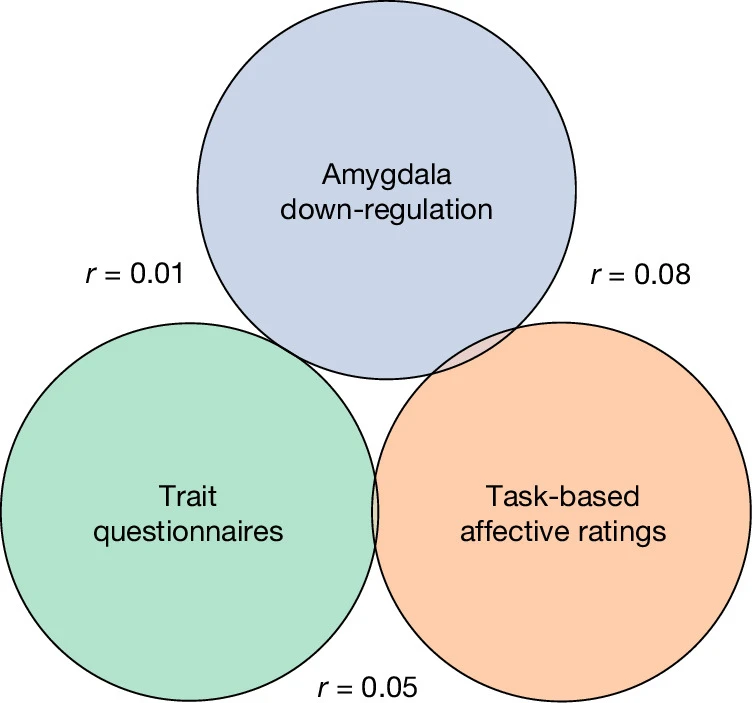
The results of the analysis were stark. When the researchers compared the data across the three measurement categories—trait questionnaires, task-based affective ratings, and amygdala down-regulation—they found almost no correlation. The variance in one measure did not predict the variance in another.
A central figure in the paper visually demonstrates this disconnect: a Venn diagram where the three circles—representing the different methods of measuring regulation—barely overlap. This lack of convergence suggests that if a person performs well on a questionnaire, it provides no reliable information about their neural activity during an actual task, nor does it predict their behavioral response in a controlled experiment.
Further complicating the picture was the observed activity in the brain’s high-level decision-making centers, specifically the prefrontal cortex. Traditional models suggest that the prefrontal cortex should exert "top-down" control to suppress the amygdala. However, the data revealed a different pattern: the activity in the prefrontal cortex appeared to track with the activity of the amygdala rather than suppressing it. When the amygdala was highly active, the reasoning centers were also active; when the amygdala was quiet, the reasoning centers were likewise subdued. This suggests a more complex, integrated neural circuit than the simple "brake-pedal" model of emotional regulation currently taught in many clinical settings.
Implications for Clinical Practice
The implications for psychiatry and clinical psychology are profound. If the tools used to diagnose and treat patients are not measuring the same underlying biological or psychological processes, the efficacy of targeted interventions may be overestimated.
"These findings call for a fundamental reassessment of how reappraisal capacity is measured and interpreted across behavioural and neural levels of analysis," the authors stated. The study suggests that the "gold standard" of measuring emotion regulation is currently broken. Questionnaires, for instance, capture broad personality traits over long periods, while fMRI experiments capture transient, "in-the-moment" responses under the highly artificial and stressful conditions of an MRI scanner. It is, therefore, perhaps unsurprising that these distinct metrics fail to align.
The researchers caution against using specific brain regions, such as the amygdala, as a definitive biomarker for a patient’s emotional health. "Strong claims about a person’s emotion regulation capacity based on any specific brain region should be made with considerable caution," the report warns.
The Need for New Methodologies
The study does not necessarily suggest that cognitive reappraisal is ineffective as a therapeutic tool; rather, it highlights that the scientific community currently lacks the precision instruments required to quantify it. The field may need to move toward more ecologically valid measures—methods that assess how individuals regulate their emotions in real-world settings rather than in laboratory environments or through subjective, memory-based surveys.

This research highlights a growing movement toward "open science" and the publication of null findings. By validating the lack of correlation between these metrics, the study provides a "reset" button for the field. Future research will likely focus on developing multi-modal assessments that can bridge the gap between biological markers and behavioral outcomes.
Broader Scientific Context
The publication of this study in a journal as prestigious as Nature signals a shifting tide in the scientific establishment. Historically, journals have favored "positive" findings that imply a discovery has been made. However, as the field of psychology faces a "replication crisis," there is an increasing demand for studies that rigorously test the validity of existing paradigms.
This study joins a growing body of work that challenges the "neuro-essentialism" that has dominated the last two decades—the idea that mental states can be easily read or localized within specific brain regions. As neuroscientists continue to map the brain, they are increasingly finding that mental functions are distributed across complex, dynamic networks that do not always behave according to simplistic, linear models.
Ultimately, this study serves as a call for humility in neuroscience and clinical psychology. While cognitive reappraisal remains a vital component of mental health treatment, our understanding of how it functions at a neurological level is still in its infancy. By acknowledging that current methods are misaligned, researchers can now begin the work of developing more robust, accurate tools to help patients manage the complexities of human emotion.