WHO and African Union Forge New Health Pact in Geneva to Combat Aid Cuts and Achieve Health Sovereignty

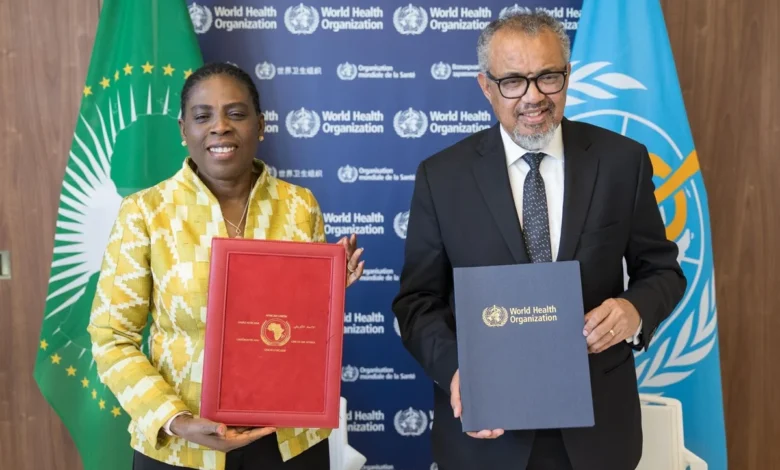
GENEVA — In a definitive move aimed at reshaping the trajectory of healthcare delivery across the African continent, the World Health Organization (WHO) and the African Union (AU) Commission officially renewed their longstanding strategic partnership today. The signing of an updated Memorandum of Understanding (MoU) took place on the sidelines of the 78th World Health Assembly in Geneva, Switzerland. This high-profile agreement arrives at a critical juncture for international public health, characterized by unprecedented financial headwinds, shrinking bilateral development assistance, and an urgent imperative for regional self-reliance.
The newly minted framework agreement reinforces a shared, long-term commitment to advancing comprehensive health security, accelerating universal health coverage (UHC), and driving sustainable development across all 55 African Union member states. Furthermore, the pact elevates the institutional role of the African Union’s Department of Health, Humanitarian Affairs, and Social Development, positioning it firmly at the operational core of regional health policy formulation, coordination, and execution.
High-Level Signatories and Institutional Leadership
The formal signing ceremony brought together key leaders from both multilateral organizations. Her Excellency Ambassador Amma Adomaa Twum-Amoah, Commissioner for Health, Humanitarian Affairs, and Social Development, signed the document on behalf of His Excellency Mahmoud Ali Youssouf, Chairperson of the African Union Commission. They were joined by Dr. Tedros Adhanom Ghebreyesus, Director-General of the World Health Organization.
The event served as a powerful reminder of the evolving dynamics in global health governance. By strengthening institutional ties, the WHO and the AU are attempting to construct a more resilient, predictable, and nationally owned public health architecture capable of withstanding external shocks, economic downturns, and geopolitical shifts.
Ambassador Twum-Amoah underscored the profound strategic significance of the updated agreement during her address in Geneva, highlighting the necessity of moving beyond traditional paradigms of international aid.
"This Agreement marks a new chapter in AU-WHO cooperation," Commissioner Twum-Amoah stated. "By working together more closely, we can better respond to the health needs of our populations and ensure that no one is left behind. The African Union values WHO’s central and leading role in global health and looks forward to deepening this strategic partnership in support of our shared goals. We need to move from budgeting for survival to planning for health sovereignty."
Background Context: Evolving Partnership and Financial Pressures
The newly signed MoU builds directly upon the foundational framework established by the previous agreement signed in 2019. Over the past five years, the landscape of global health has undergone seismic shifts, driven primarily by the COVID-19 pandemic, subsequent supply chain vulnerabilities, emerging and re-emerging infectious disease outbreaks across the African continent, and a sharp contraction in traditional donor funding.
In recent months, major donor nations have announced substantial cuts to bilateral health aid, driven by domestic fiscal pressures, shifting political priorities, and economic readjustments following the pandemic recovery period. These reductions have left gaping holes in national health budgets across developing nations, threatening decades of hard-fought progress against preventable diseases such as HIV/AIDS, tuberculosis, and malaria, as well as undermining immunization campaigns and maternal health programs.
It is against this precarious backdrop that the WHO-AU partnership has been revitalized. The updated accord is specifically designed to streamline operational hurdles, eliminate administrative redundancies, and optimize resource allocation across all AU entities. By aligning regional health priorities with WHO’s normative guidance and technical expertise, the agreement creates a cohesive united front to address systemic vulnerabilities.
Dr. Tedros Adhanom Ghebreyesus did not mince words regarding the urgency of the moment, pointing directly to the dangers posed by eroding international financial support.
"This renewed agreement comes at a critical time, as cuts to bilateral aid imperil the health of millions in Africa," Dr. Tedros remarked. "It reflects our determination to translate our partnership into tangible results for the people of Africa, and support countries to leave behind the era of aid dependency and transition to sustainable self-reliance. We are proud to stand with the African Union in driving forward the health priorities of the continent."
Chronology of Cooperation: From 2019 to the 78th World Health Assembly
To fully understand the weight of today’s agreement, it is instructive to examine the institutional timeline of collaboration between the two bodies:
- January 2020: The onset of the COVID-19 pandemic tests the resilience of African health systems, prompting unprecedented cooperation between the WHO Regional Office for Africa (WHO AFRO) and the Africa Centres for Disease Control and Prevention (Africa CDC).
- February 2022: African Union heads of state endorse the New Public Health Order for Africa, a strategic framework calling for local manufacturing of vaccines, therapeutics, and diagnostics, alongside stronger public health institutions.
- September 2023: The African Union is formally admitted as a permanent member of the G20 during the New Delhi summit, instantly elevating the continent’s geopolitical leverage and voice in global economic and financial governance.
- May 2024 (77th WHA): Preliminary discussions commence in Geneva regarding the structural modernization of the 2019 WHO-AU MoU to reflect post-pandemic realities and the G20 integration.
- May 2025 (78th World Health Assembly): Ambassador Twum-Amoah and Dr. Tedros officially sign the updated MoU in Geneva, establishing a streamlined five-pillar collaborative framework focused on health security, universal health coverage, and sustainable financing.
Strategic Implications: The Push for Health Sovereignty
The timing of this renewed partnership coincides with a historic elevation of Africa’s standing in international diplomacy. With the African Union’s recent inclusion as a permanent member of the G20, the continent commands a much louder and more influential voice in global governance. This newfound diplomatic weight allows African leaders to advocate more effectively for systemic reforms in international financial institutions, debt relief, and equitable access to medical countermeasures.
Analysts point out that the concept of "health sovereignty"—a term explicitly highlighted by Commissioner Twum-Amoah—represents a fundamental ideological departure from past decades. Rather than relying indefinitely on vertical disease programs funded by foreign donors, the current strategy emphasizes domestic resource mobilization, regional pooled procurement mechanisms, regulatory harmonization through the African Medicines Agency (AMA), and the domestic production of essential medical supplies.
The WHO’s role in this transition is primarily technical and normative. By anchoring its operations within the AU’s broader developmental agenda, the WHO ensures that its global guidelines are effectively tailored to regional realities, epidemiological profiles, and institutional capacities. This includes providing critical technical support for health system strengthening, emergency preparedness, workforce development, and data systems integration.
Broader Economic and Social Impacts
The implications of the updated MoU extend far beyond the clinical definition of healthcare. A robust, self-reliant health sector is increasingly recognized as a fundamental prerequisite for macroeconomic stability, workforce productivity, and sustainable economic growth across Africa.
When preventable diseases strike populations without adequate health coverage, entire households are pushed into poverty through catastrophic out-of-pocket health expenditures. Furthermore, recurrent health crises disrupt trade, tourism, and foreign direct investment. By building regional resilience through the WHO-AU partnership, member states aim to insulate their economies against future shocks.
The agreement also places a strong emphasis on primary health care (PHC) as the most cost-effective and equitable path toward universal health coverage. Shifting resources and political will toward community-level prevention, early diagnosis, and robust primary care networks will alleviate the strain on tertiary hospitals and ensure that marginalized and rural populations receive continuous care.
Looking Ahead: Implementation and Accountability
As the ink dries on the Geneva agreement, attention will quickly pivot from high-level diplomacy to operational implementation. Success will ultimately be measured by tangible improvements on the ground: stronger disease surveillance systems, shorter response times during outbreaks, increased domestic budgetary allocations for health under the Abuja Declaration targets, and measurable progress toward the health-related Sustainable Development Goals (SDGs).
Both the African Union Commission and the World Health Organization have committed to establishing robust monitoring and evaluation mechanisms to track the progress of the five core collaborative areas outlined in the MoU. Regular joint steering committee meetings will ensure transparency, accountability, and the agile adjustment of strategies as new public health challenges emerge.
In a global health landscape increasingly fractured by geopolitical competition and financial constraints, the renewed alliance between the WHO and the African Union offers a compelling model of multilateral solidarity—one grounded not in perpetual dependency, but in mutual respect, shared accountability, and the unyielding pursuit of health sovereignty for the African continent.
For further information and media inquiries, please contact:
- Professor Julio Rakotonirina | Director | Department of Health, Humanitarian Affairs and Social Development | African Union Commission | Email: [email protected]
- Ms Stéphanie Seydoux | Director | DG Envoy for Multilateral Affairs | World Health Organization | Email: [email protected]
- WHO Media Team | World Health Organization
- Mr. King David Cartey | African Union Commission