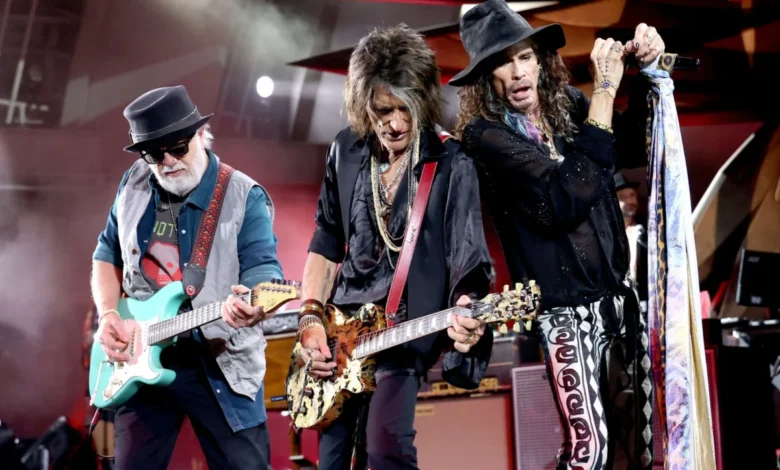
The legendary rock outfit Aerosmith, often hailed as "America’s Greatest Rock and Roll Band," made a thunderous return to the stage this week, ending a three-year live performance hiatus with a pair of star-studded events at the iconic Hollywood Bowl in Los Angeles. Billed as California, Dream On: Aerosmith & Friends, the concerts held on October 29 and November 1 served as both a celebration of the band’s storied catalog and a bittersweet reminder of the physical realities facing aging rock icons in the modern era.
The events arrived in the wake of the band’s difficult 2024 decision to permanently retire from large-scale touring. That announcement followed the catastrophic vocal cord injury sustained by frontman Steven Tyler, an ailment that forced the cancellation of their long-planned farewell tour. While the band has effectively transitioned away from the grueling schedule of global road travel, these Hollywood Bowl performances offered a rare, high-profile opportunity for fans to witness the quintet—and their musical peers—revisit the classics that defined the American hard rock sound for over five decades.
A Star-Studded Retrospective
The production was designed as a sprawling, multi-act homage to the Aerosmith legacy, featuring an eclectic lineup of rock royalty who have been influenced by Tyler, Joe Perry, and their bandmates. The first night set a high bar, with performances from Eric Church, Heart, Billy Idol, Sammy Hagar, and Godsmack’s Sully Erna. Backing these legends were seasoned musicians, including virtuoso guitarist Nuno Bettencourt, providing a high-fidelity musical foundation for the night’s proceedings.
The Black Crowes delivered a four-song tribute set, while Guns N’ Roses served as direct support, showcasing the deep-seated respect between the two generations of hard rock titans. The GN’R set included gritty renditions of "Nobody’s Fault," "Last Child," and "Seasons of Wither," demonstrating the enduring technical complexity of the Aerosmith songbook.
The anticipation reached a crescendo when Liv Tyler and Alicia Silverstone—the iconic stars of the band’s 1994 "Crazy" music video—took to the stage to introduce the main event. Their presence served as a bridge between the band’s MTV-era cultural dominance and the current moment, framing the evening as a retrospective on a massive pop-culture footprint.
The Grohl Factor and the Setlist
For the October 29 performance, the band’s rhythm section received a high-profile injection of energy: Foo Fighters frontman and world-renowned drummer Dave Grohl sat behind the kit for the majority of the set. Grohl, known for his relentless work ethic and deep reverence for classic rock, provided a driving, percussive force that matched the intensity of Aerosmith’s biggest anthems.
The setlist for the first night was a "greatest hits" masterclass, featuring "Toys in the Attic," "Back in the Saddle," "Sweet Emotion," and "The Train Kept A-Rollin’." The latter featured a surprise appearance by actor and musician Johnny Depp, who joined the band on guitar for a high-octane jam session. To close the evening, original Aerosmith drummer Joey Kramer made a poignant return to his stool, reuniting with his longtime bandmates for a climactic performance of "Walk This Way."
The second night, held on November 1, shifted the musical landscape slightly. The support bill included further appearances from Billy Idol, Train’s Pat Monahan, Grace Potter, and the powerhouse duo of Ann and Nancy Wilson of Heart. Musical highlights included a cross-genre collaboration between Rage Against The Machine’s Tom Morello and Halestorm’s Lzzy Hale, who tackled "Kings and Queens" and "Round and Round." Additionally, Alice in Chains’ Jerry Cantrell and Mike Inez teamed up with Richie Kotzen to deliver heavy, nuanced takes on "Draw The Line" and "Nobody’s Fault." During this show, the band opted for a slight variation in the setlist, incorporating a cover of The Beatles’ "Come Together," a staple of their live repertoire since the late 1970s. For this second evening, the band utilized their regular touring drummer, John Douglas, rather than Grohl.
The "Final" Controversy
Comedian Bill Burr served as the master of ceremonies for both evenings. During the first show, Burr addressed the audience with a blunt assertion, claiming that the night represented the "final two shows in Aerosmith’s history." The remark rippled through the crowd and dominated post-show discourse, sparking immediate speculation regarding the band’s future viability.
However, Steven Tyler took the opportunity on the second night to forcefully refute the narrative of a definitive end. "So Bill Burr said these are our final shows, huh?" Tyler asked the crowd. "Doesn’t he know that you can’t get rid of Aerosmith? In fact, at the end of the fucking world, there will only be cockroaches, Aerosmith, and, I guess, Bill Burr."
While Tyler’s rhetoric was defiant, industry analysts note the distinction between "touring" and "performing." Since the 2024 tour cancellation, Tyler has maintained a sporadic but active schedule. His performance at the 2025 "Back To The Beginning" concert honoring Ozzy Osbourne and Black Sabbath, alongside his collaborative work with the artist Yungblud, suggests a pivot toward one-off events, residencies, or collaborative projects rather than traditional, months-long tour cycles.
Context and Broader Implications
The success of the Hollywood Bowl events highlights the immense commercial and cultural demand for heritage rock acts. Despite the band’s formal retirement from touring, their ability to sell out the Hollywood Bowl—and draw high-profile guests like Dave Grohl and Tom Morello—demonstrates that the Aerosmith brand remains a potent force in the music industry.
The logistical complexity of these two shows, which required the coordination of over a dozen high-profile guest artists and two distinct lineups, underscores the logistical shift in how aging rock bands are now interacting with their audiences. By moving away from the "farewell tour" model—which often creates immense pressure on the artist to maintain a grueling pace—Aerosmith appears to be pioneering a "curated event" model. This approach allows the band to perform on their own terms, at venues of their choosing, while mitigating the vocal and physical strain that caused their touring retirement.
Data and Performance Metrics
The choice of the Hollywood Bowl is significant. With a capacity of approximately 17,500, the venue provides an intimate yet grand setting for a band that has spent decades playing stadiums. According to industry reports, the secondary market demand for the November 1 show saw ticket prices surge, reflecting the perceived scarcity of these performances.
Furthermore, the band’s recent pivot into digital collaborations—such as their work with Lainey Wilson and Steve Martin—shows an attempt to diversify their sound for a streaming-first audience. These efforts, combined with the successful execution of the Hollywood Bowl concerts, indicate that Aerosmith is not merely "fading away" but is instead repositioning itself as a legacy act capable of leveraging its history to reach new demographics.
Looking Ahead
The Hollywood Bowl shows serve as a blueprint for how rock legends can navigate the transition into their later years. By embracing the role of a "celebrated icon" rather than a "working musician," Aerosmith has successfully kept their legacy front and center without subjecting the band members to the risks associated with international travel and rigorous performance schedules.
Whether or not these truly are the final shows remains a matter of ongoing debate, but the sentiment expressed by Tyler suggests that the band is not yet ready to cede their place in the cultural zeitgeist. As long as there is an appetite for the raw, blues-infused hard rock that Aerosmith pioneered in the early 1970s, the band will likely continue to find ways to occupy the stage, even if those appearances remain rare, deliberate, and undeniably iconic. The "California, Dream On" events have proven that, for Aerosmith, the music is not just a career—it is a perpetual, evolving enterprise that refuses to be constrained by the traditional boundaries of retirement.