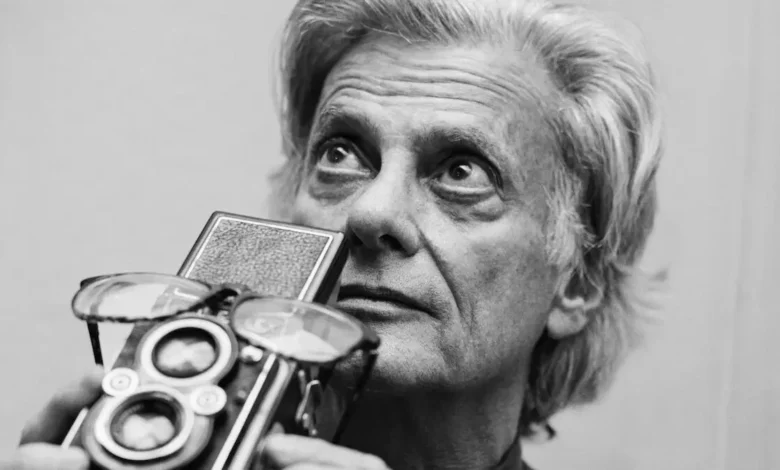
The cinematic landscape of biographical documentaries has welcomed a defining new entry with the release of Avedon, acclaimed director Ron Howard’s meticulous exploration into the life and career of legendary American photographer Richard Avedon. Distributed to critical praise, the film stands out as a high-water mark in Howard’s non-fiction filmography—surpassing even his celebrated 2016 venture, The Beatles: Eight Days a Week. Guided by the supple, rhythmically sophisticated editing of Andrew Morreale, the documentary weaves together hundreds of iconic photographs. The result is a nearly musical visual essay that examines how a single artist fundamentally altered the metaphysics of photography and reshaped the global visual consciousness of the twentieth century.
The central paradox of Avedon’s career forms the core narrative of Howard’s film: how an undisputed titan of high fashion and impossible glamour could simultaneously operate as a deeply democratic humanist. To unpack this duality, Howard employs a rich tapestry of archival footage, historic outtakes, and illuminating contemporary interviews. Prominent cultural figures—including media executive Tina Brown, art dealer Larry Gagosian, author John Lahr, cultural critic Adam Gopnik, writer Hilton Als, fashion designer Calvin Klein, and pioneering model Twiggy—offer critical context. Furthermore, the documentary gains unprecedented access through interviews with John Avedon, the photographer’s son, and James Martin, executive director of the Richard Avedon Foundation. Martin guides viewers through the labyrinthine archives preserving the output of roughly 16,000 portrait sittings conducted between 1944 and 2004.
A Chronological Journey: From Wartime Mug Shots to Global Iconography
The chronology of Richard Avedon’s life is deeply intertwined with the evolution of modern American visual culture. Born in New York City in 1923, a young Avedon developed an early, instinctual method of visual composition, famously recalling how he would momentarily blink and keep his eyes closed on city streets to preserve images in his mind before he ever held a camera.
His formal entry into professional photography began during World War II. At the age of 19, Avedon enlisted in the U.S. Merchant Marine Corps, where he was assigned to the photographic department. Tasked with shooting approximately 100,000 identification portraits of enlisted men and defense workers, Avedon faced what might have been considered tedious military redundancy. Instead, he treated the assignment as a profound psychological study. Stationing his subjects against a stark, flat white background, he observed thousands of unfiltered, baffled faces looking directly into the lens. This austere setting became the foundation of his signature minimalist style. By stripping away extraneous backdrops and props, the white background served as an egalitarian equalizer, allowing the raw individuality of each subject to emerge without interference.
Following his military service, Avedon transitioned rapidly into the commercial and fashion spheres, capturing the cultural zeitgeist of post-war America. By the late 1950s, his cultural footprint was so pronounced that it inspired the 1957 Hollywood musical Funny Face, in which Fred Astaire portrayed a fashion photographer explicitly modeled after Avedon. Throughout the decades that followed, Avedon maintained a relentless creative output, maintaining an average of one portrait session per working day across a sixty-year professional timeline.
The Mechanics of Intimacy and Spontaneity
Despite his immense technical proficiency, Avedon famously dismissed the mechanical intricacies of photography. In archival clips featured in the documentary, he declares, “I can say very little about photography. I follow no rules, no laws, and no advice.” Rather than obsessing over f-stops, shutter speeds, or lighting equipment, Avedon focused entirely on interpersonal dynamics during a shoot.
Collaborators and subjects interviewed in the film, including model and actress Isabella Rossellini, shed light on his unconventional working methods. While commercial photographers often exhausted their subjects with endless rapid-fire shooting, Avedon deliberately paced his sessions. He would engage in conversation, share coffee for the first half-hour of a scheduled booking, and wait until the final moments to approach the white paper backdrop. This psychological disarmament frequently resulted in profound moments of spontaneity.
Notable historical examples highlight this methodology. During a 1953 session, a playful Charlie Chaplin spontaneously held improvised devil horns over his head, an unrehearsed gesture that Avedon instantly captured to create one of the twentieth century’s most enduring images. Similarly, a 1957 portrait session with Marilyn Monroe—pegged to the promotion of The Prince and the Showgirl—stretched across an entire day. While the session produced numerous vibrant, high-energy glamour shots, the definitive image emerged in the final ten seconds, when Monroe momentarily dropped her carefully constructed public facade, revealing a poignant, introspective vulnerability.
Broadening the Lens: Beyond Glamour and Commerce
While Avedon’s name became synonymous with the elite pages of Harper’s Bazaar and Vogue, Howard’s documentary takes care to emphasize the breadth of his documentary projects. Avedon consistently turned his penetrating gaze toward ordinary citizens and sociopolitical upheaval.
His expansive portfolio included documentation of Oklahoma oil field workers in 1980, a grueling seven-week assignment photographing American military generals during the Vietnam War, and stark portraits of the Chicago Seven trial participants. Furthermore, his seminal late-career project, In the American West (1985), captured drifters, coal miners, and blue-collar laborers with such unflinching, unromanticized realism that initial museum exhibitions faced considerable institutional resistance. In addition to his fine art and editorial work, Avedon maintained a lucrative commercial practice, designing surrealist, cinematic television commercials such as the iconic Obsession perfume spots.
Implications and Cultural Legacy
The release of Avedon offers a timely reevaluation of photographic authorship in an era saturated with digital imagery and AI-generated content. By examining Avedon’s unwavering commitment to the direct, unmediated human encounter, the documentary highlights the enduring power of the photographic medium to communicate psychological truth.
Industry analysts and art historians note that Howard’s film successfully bridges the artificial divide often placed between commercial and fine art photography. Over a career spanning six decades, Avedon proved that fashion imagery, advertising, and high-art portraiture could share the exact same aesthetic and philosophical DNA. Every frame he captured, whether of a celebrated icon like John Lennon, Marilyn Monroe, and J. Robert Oppenheimer, or an anonymous laborer, was driven by a singular objective: to confront the viewer with the unvarnished reality of another human being.
Through its rigorous structure, comprehensive archival research, and insightful commentary from those who knew him best, Avedon cements the photographer’s legacy not merely as a master of style, but as a defining chronicler of the modern human condition.
Related posts: