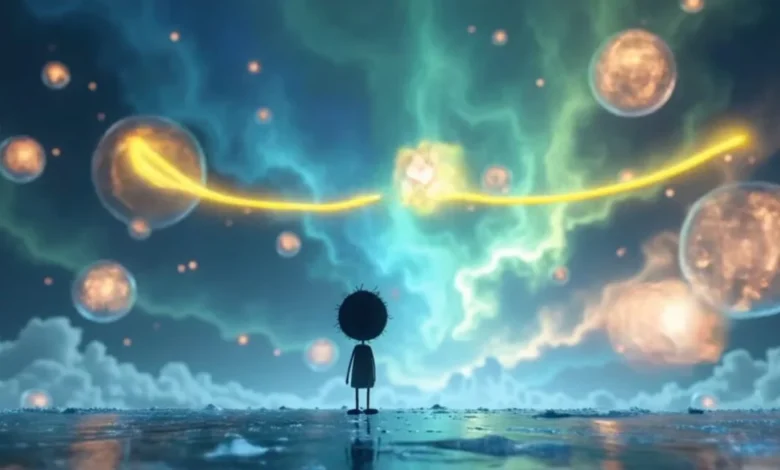
Scientists are frequently encouraged to translate their intricate research into terms comprehensible to a broad audience, often colloquially framed as "explain it to a child." This endeavor proves particularly formidable when confronting subjects as profoundly complex as quantum mechanics, a field that challenges even seasoned academics in its counter-intuitive principles and abstract mathematical foundations. Yet, this formidable task has been embraced and masterfully executed by an unlikely duo: nine-year-old Kai, affectionately known as the Quantum Kid, and his mother, Dr. Katia Moskvitch, a distinguished theoretical physicist and accomplished science communicator. Their collaborative venture, "The Quantum Kid" podcast, has not only captivated a global audience, recently surpassing an impressive milestone of 100,000 subscribers, but has also garnered critical acclaim, culminating in a prestigious nomination for a Webby Award. The ongoing public voting phase for the Webby Awards, a crucial determinant in some categories, is nearing its conclusion, underscoring the immediate relevance and impact of this innovative educational platform in the realm of science communication.
The Genesis of a Quantum Curiosity
Dr. Katia Moskvitch, an established theoretical physicist with a robust background in science communication, found herself at the confluence of professional expertise and maternal instinct when her son, Kai, began to exhibit an insatiable curiosity about the universe’s most profound mysteries. From a remarkably young age, Kai demonstrated a precocious intellect, spending countless hours engrossed in scientific videos on YouTube. By the tender age of six, he had already embarked on programming in Python, a testament to his early aptitude for logical reasoning and problem-solving. It was these foundational interests that fueled a relentless barrage of "big questions" directed at his mother, inquiries spanning the origins of life, the vastness of the cosmos, and, inevitably, the perplexing domain of quantum physics.
Despite her extensive training and deep understanding of these subjects, Dr. Moskvitch candidly admits to finding it challenging to distill such intricate concepts into answers that fully satisfied Kai’s burgeoning intellect without oversimplifying or losing accuracy. This recurring pedagogical dilemma sparked an innovative idea: what if Kai could seek these deeper answers directly from the experts, facilitated by his unique perspective as a child? When presented with the proposition of launching his own platform—initially conceived as a YouTube channel—Kai responded with an enthusiastic affirmation, signaling the birth of what would soon become "The Quantum Kid" podcast. The initiative was a natural extension of Moskvitch’s lifelong commitment to making science accessible, but with a novel twist: the interviewer himself would be the primary target demographic.
A Unique Pedagogical Approach: The Child as Interlocutor
"The Quantum Kid" podcast officially launched in the summer of 2025, adopting a consistent production schedule of approximately one episode per month. The format is deceptively simple yet profoundly effective: Kai, with his innocent yet incisive questions, engages leading figures in quantum physics and related fields. This unique dynamic leverages the inherent curiosity of a child to cut through jargon and expose the fundamental concepts of complex scientific theories. Experts, often accustomed to academic discourse, find themselves compelled to articulate their work in a manner accessible to a nine-year-old, inadvertently simplifying it for a much wider, non-specialist audience.
One of the undeniable strengths of the podcast lies in Dr. Moskvitch’s extensive professional network. Her years as a theoretical physicist and science communicator have cultivated invaluable connections within both academic institutions and the burgeoning quantum industry. This robust network has enabled the podcast to attract an impressive roster of high-profile guests, individuals whose contributions have shaped the very landscape of modern physics. For instance, Kai notably interviewed Dr. Peter Shor, the renowned applied mathematician and computer scientist at MIT, about his seminal quantum algorithm, a cornerstone of quantum computing theory. Another landmark episode featured Dr. Scott Aaronson, a distinguished physicist at the University of Texas, Austin, engaging in a fascinating discussion about the theoretical underpinnings of time travel. These interviews not only provide invaluable insights but also demonstrate the willingness of top-tier scientists to engage with and support innovative science communication efforts.
The Webby Nomination and Growing Acclaim
The podcast’s innovative approach and educational impact did not go unnoticed. "The Quantum Kid" recently garnered a nomination for a Webby Award in the highly competitive "Podcasts – Features – Experimental & Innovation" category. The Webby Awards, often hailed as the "Oscars of the Internet," recognize excellence across digital platforms, celebrating innovation, creativity, and impact in online content. A nomination alone is a significant achievement, placing "The Quantum Kid" among an elite group of digital projects pushing the boundaries of their respective mediums. The public voting component, which concludes shortly after the announcement of the nomination, adds another layer of community engagement and recognition, highlighting the podcast’s broad appeal.
Beyond critical acclaim, "The Quantum Kid" has achieved a significant quantitative milestone, crossing the 100,000 subscriber mark. In the increasingly crowded podcasting landscape, where millions of podcasts vie for listener attention, reaching six-figure subscriber numbers is a testament to sustained engagement and a compelling value proposition. This milestone underscores the podcast’s effectiveness in reaching and retaining an audience interested in science, particularly complex topics like quantum mechanics. The rapid growth since its launch in the summer of 2025 further illustrates the resonance of its unique format and the pressing demand for accessible scientific content.
Audience Demographics and Educational Impact
While the podcast is explicitly designed to appeal to children, Dr. Moskvitch’s insights into its actual listenership reveal a fascinating demographic truth. According to YouTube analytics, the primary age group engaging with "The Quantum Kid" falls between 25 and 45 years old. This data supports Moskvitch’s observation that the intended audience isn’t necessarily children listening independently, but rather parents watching, ideally with their children. "This is the intended audience," Moskvitch told Ars. "It’s parents watching, ideally with their children. I don’t think many kids are watching it on their own."
This dynamic highlights a powerful "trickle-down" effect in science education. Parents, often seeking engaging and educational content for their children, discover the podcast and find themselves equally captivated by the simplified explanations and the charming interviewer. The shared viewing experience then sparks conversations, follow-up questions, and a collective exploration of scientific concepts within the family unit. Dr. Aaronson’s reaction after his interview further exemplifies this: he watched the episode with his own two children, who subsequently bombarded him with follow-up questions, proving the podcast’s efficacy in stimulating curiosity across generations. This model positions "The Quantum Kid" not just as an educational tool for children, but as a facilitator of family-based STEM learning, strengthening the bond between parents and children through shared intellectual discovery.
Demystifying Quantum Mechanics: A Grand Challenge in Science Communication
Quantum mechanics, the fundamental theory describing nature at the smallest scales of energy levels of atoms and subatomic particles, is notoriously challenging to explain to a lay audience. Its core principles—such as superposition (a particle existing in multiple states simultaneously), entanglement (two particles linked regardless of distance), and quantum tunneling—defy classical intuition and everyday experience. The mathematical formalism underpinning quantum theory is abstract and often requires years of specialized study to master. For decades, scientists and educators have grappled with the best methods to convey these complex ideas without sacrificing accuracy or overwhelming the audience.
Historically, figures like Carl Sagan, with his groundbreaking television series "Cosmos," and later popularizers like Neil deGrasse Tyson and Bill Nye, have championed the cause of science literacy, making astronomy, physics, and biology accessible to millions. However, quantum mechanics has largely remained an elusive frontier for mass popularization, often relegated to dense textbooks or overly simplistic metaphors. "The Quantum Kid" addresses this gap by leveraging the power of direct, uninhibited inquiry. A child’s question, free from preconceived notions or the burden of disciplinary expertise, often cuts directly to the heart of a concept, forcing experts to articulate fundamental truths in refreshingly clear ways. This approach not only demystifies the subject but also humanizes the scientists themselves, making the field seem less intimidating and more approachable.
The Broader Landscape of STEM Education and Future Implications
The success of "The Quantum Kid" podcast holds significant implications for the broader landscape of STEM (Science, Technology, Engineering, and Mathematics) education. Early exposure to scientific concepts, especially through engaging and interactive formats, has been consistently linked to increased interest and eventual pursuit of STEM careers. Studies by organizations like the National Science Foundation and various educational psychology journals consistently highlight the critical role of parental involvement and early-childhood experiences in fostering a lifelong love for learning and scientific inquiry. "The Quantum Kid" provides a valuable resource for parents who wish to cultivate this interest in their children but may lack the specialized knowledge or communication tools themselves.
Moreover, as quantum technologies—including quantum computing, quantum cryptography, and quantum sensing—move from theoretical research to practical applications, a quantum-literate populace will become increasingly vital. Understanding the basic principles of quantum mechanics will be crucial not only for future scientists and engineers but also for policymakers, business leaders, and an informed citizenry navigating a world transformed by these technologies. "The Quantum Kid" is therefore not just an entertainment or educational product; it is a foundational effort in building future quantum literacy, preparing a generation to engage with and contribute to the quantum revolution.
Chronology of Quantum Curiosity and Success
The journey of "The Quantum Kid" is marked by several key milestones:
- Early Childhood (Pre-6 years old): Kai develops a profound interest in science, consuming educational YouTube videos on various scientific topics.
- Age 6: Kai begins to learn Python programming, demonstrating an early aptitude for logical and computational thinking.
- Late 2024 / Early 2025: Dr. Katia Moskvitch faces persistent "big questions" from Kai regarding the universe and quantum physics, leading to the conceptualization of a platform for deeper answers.
- Summer 2025: "The Quantum Kid" podcast officially launches, initially envisioned as a YouTube channel, with a commitment to producing approximately one episode per month.
- Throughout 2025-2026: Key interviews are conducted, including those with Dr. Peter Shor (on quantum algorithms) and Dr. Scott Aaronson (on time travel), attracting significant attention within the scientific community and beyond.
- Early 2026: The podcast crosses the significant milestone of 100,000 subscribers, signaling a rapidly growing and engaged audience.
- April 2026: "The Quantum Kid" receives a prestigious Webby Award nomination in the "Experimental & Innovation" category, recognizing its groundbreaking approach to science communication. Public voting commences, underscoring the podcast’s immediate impact and popularity.
Inferred Reactions and Future Outlook
The enthusiastic reception of "The Quantum Kid" suggests a broad consensus on its value. Dr. Peter Shor and Dr. Scott Aaronson, luminaries in their respective fields, likely found the unique interview format refreshing and an effective means to disseminate their complex work. Their willingness to participate underscores a shared commitment within the scientific community to public engagement and inspiring the next generation. The Webby Award nomination itself speaks volumes about the podcast’s innovation, with judges recognizing its novel blend of education and entertainment. Parents, as evidenced by the YouTube analytics, have found a valuable resource that not only educates their children but also fosters shared family learning experiences, leading to positive feedback and a growing demand for more content.
Looking ahead, "The Quantum Kid" serves as a powerful model for future science communication initiatives. Its success demonstrates that even the most abstract scientific fields can be made accessible and engaging through creative pedagogical approaches. One could foresee similar child-led interview series emerging for other complex disciplines like neuroscience, artificial intelligence, or astrophysics. For Kai and Dr. Moskvitch, the future likely holds continued exploration of quantum frontiers, perhaps expanding into new formats or tackling even more ambitious topics. The lasting legacy of "The Quantum Kid" will undoubtedly be its pioneering role in demystifying quantum mechanics, inspiring countless young minds, and proving that with the right approach, even a nine-year-old can unravel the universe’s most profound secrets.
In conclusion, "The Quantum Kid" podcast stands as a beacon of innovative science communication. Through the collaborative genius of a curious nine-year-old and his theoretically brilliant mother, it has transformed the daunting subject of quantum mechanics into an approachable and captivating journey of discovery. Its Webby nomination and impressive subscriber count are not merely accolades but powerful affirmations of its profound impact on fostering scientific literacy and inspiring the next generation of thinkers, one quantum question at a time.