Global Climate Extremes Redefine the New Normal as Wildfires Surge and Heat Related Mortality Rises Across the Northern Hemisphere


The intensification of the global climate crisis reached a critical inflection point this week as a series of "firewaves" and record-breaking heatwaves converged across Europe and North America, signaling what scientists now describe as a permanent shift in the planet’s meteorological baseline. From the ancient forests of France to the urban centers of the United Kingdom and the vast wilderness of Canada, the tangible impacts of rising atmospheric carbon concentrations are manifesting in increasingly volatile and deadly ways. This convergence of extreme weather events, documented by major meteorological agencies and international research bodies, underscores a transition from sporadic climate anomalies to a sustained state of environmental emergency.
The Emergence of the Firewave: Europe and North America Under Siege
A "firewave"—a term increasingly used to describe the intersection of prolonged heatwaves and rapid-onset wildfire activity—has placed unprecedented pressure on emergency services across the Northern Hemisphere. In France, the historic Fontainebleau forest, located just south of Paris, became the site of a desperate containment effort. To combat the blaze, French authorities deployed specialized water-dumping aircraft that were forced to collect water directly from the River Seine, a logistical feat that highlighted the severity of the local drought conditions.
Simultaneously, the United Kingdom has grappled with a rare and persistent heat event. Data from the Financial Times indicates that the UK has endured 25 non-consecutive days with temperatures exceeding 30°C, including a grueling nine-day stretch where mercury levels surpassed 34°C. This sustained heat has transformed the British landscape into a tinderbox, leading to a surge in grass fires and heat-related infrastructure failures.
Across the Atlantic, the scale of the Canadian wildfire season continues to have transboundary consequences. An "orange haze" caused by smoke from intense wildfires in Ontario and Quebec has drifted southward, blanketing the northern United States in hazardous particulate matter. BBC News reported that air quality alerts were issued for several major metropolitan areas, echoing the severe smoke events of the previous year and demonstrating that the ecological health of the boreal forests is inextricably linked to the public health of urban populations thousands of miles away.
The Met Office and the UK’s New Meteorological Reality
The UK Met Office recently released a definitive report on the nation’s climate, concluding that events previously categorized as "extreme" are now the "new normal." While the preceding year was the hottest on record for the UK, meteorologists warn that this record is unlikely to stand for long. Current climate models suggest that the 2023 and 2024 temperature peaks will likely be surpassed within the next few years as the warming trend accelerates.

Liz Bentley, the head of the Royal Meteorological Society, emphasized that the theoretical predictions made by climate scientists for decades are no longer abstract projections. Speaking to the Guardian, Bentley noted that climate change is now being felt directly by the UK population within their own homes and communities. This sentiment is backed by a shift in the frequency of temperature extremes; the UK is now seeing a significant increase in the number of days exceeding 30°C, a threshold that was historically rare in the British Isles.
Conservation Progress: A Significant Downturn in Amazon Deforestation
Amidst the reports of climatic instability, data from South America provided a rare glimmer of environmental progress. In the first half of 2026, deforestation in the Brazilian Amazon fell by 38% compared to the same period in the previous year. This decline, reported by Al Jazeera, is widely attributed to the aggressive environmental policies and enforcement measures reinstated under the administration of President Luiz Inácio Lula da Silva.
The Amazon rainforest serves as one of the world’s most critical carbon sinks, and the reduction in land clearing is vital for global efforts to stay within the 1.5°C warming limit established by the Paris Agreement. However, experts warn that while the decrease in deforestation is a significant victory for policy-driven conservation, the biome remains under threat from regional climate shifts, including localized droughts that can trigger forest dieback even in the absence of human-led clearing.
Quantifying the Human Cost: Heat-Related Mortality and Attribution Science
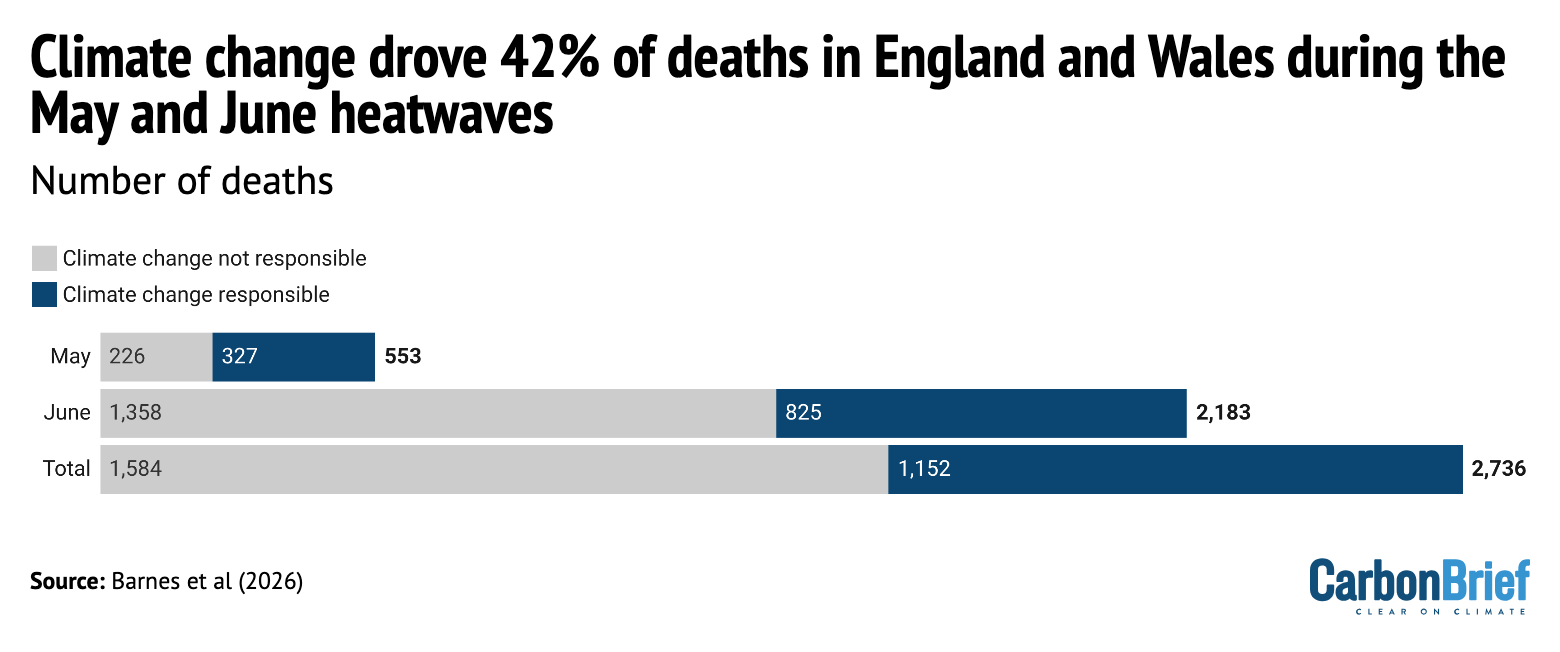
The human toll of the current climate trajectory is becoming easier to quantify through the advancement of attribution science. A recent analysis by Carbon Brief focused on the mortality rates in England and Wales during the heatwaves of May and June. The study concluded that climate change was a primary driver in approximately 42% of all heat-related deaths during those months.
In total, over 1,000 heat-related fatalities in England and Wales were attributed directly to the additional warming caused by human-induced greenhouse gas emissions. This research highlights a grim reality: nearly half of the people who died from heat exhaustion or related complications would likely have survived had the climate remained at pre-industrial levels. Globally, the figures are even more staggering, with some estimates suggesting that heatwaves have contributed to upwards of 10,000 deaths across Europe in the early summer months alone. These statistics are driving a renewed focus on urban cooling strategies and the protection of vulnerable populations, such as the elderly and those with underlying health conditions.
Institutional Advocacy: The Natural History Museum’s Call to Action
As the physical impacts of climate change intensify, cultural and scientific institutions are pivoting toward more direct public engagement. London’s Natural History Museum (NHM) has launched its first permanent climate-themed exhibition, titled "Fixing Our Broken Planet." Meaghan Macdonald, the museum’s senior project and programme manager, explained that the initiative is designed to transform the museum from a repository of the past into a "convener of conversations" about the planetary emergency.
The exhibition aims to empower visitors by weaving scientific data with a sense of "stubborn hope." It features "conversation starters" on complex ethical issues, such as whether the deep sea should be mined to provide the minerals necessary for a green energy transition. By highlighting the work of its own scientists—who remain among the most trusted figures in public life—the NHM is attempting to create "advocates for the planet." This strategy extends beyond London, with graphic panel versions of the display appearing in international hubs like Bangalore, India, and through initiatives like the National Education Nature Park in the UK.
Historical Accountability and the Path Forward
The current crisis is framed by a growing body of evidence regarding historical accountability. Research from the Center for International Environmental Law (CIEL) has revealed that major emitting countries and fossil fuel interests were aware of the catastrophic risks of climate change decades earlier than previously acknowledged. This "legacy of knowledge" suggests that the current "firewaves" and mortality rates are the result of deliberate delays in policy implementation and transition planning.
Looking ahead, the scientific community is urging a more transparent discussion about "worst-case scenarios." Professor Peter Stott, a leading climate scientist, argued in a recent essay for The Conversation that researchers must be more vocal about the possibility of extreme tipping points, such as a "Godzilla" El Niño event. Such an event would see a massive release of heat from the Pacific Ocean, potentially pushing global temperatures well beyond the 1.5°C threshold on a semi-permanent basis.
Analysis of Implications
The developments of this week illustrate a three-pronged challenge for global society: mitigation, adaptation, and accountability. The success in the Amazon proves that political will can yield immediate results in carbon sequestration and habitat preservation. Conversely, the "firewaves" in Europe and the mortality data from the UK demonstrate that adaptation measures are currently lagging behind the pace of warming.
Furthermore, the "new normal" described by the Met Office necessitates a fundamental redesign of national infrastructures. From the way homes are cooled to the way forests are managed and emergency services are funded, the baseline assumptions of the 20th century are no longer applicable. The orange haze over North America and the smoke-filled skies of Paris serve as a visual reminder that the climate crisis is not a future threat, but a present reality that ignores national borders and requires a unified, science-driven response.
As the world prepares for the next cycle of international climate negotiations, the data from this week serves as both a warning and a roadmap. The integration of scientific trust, public advocacy, and aggressive policy enforcement remains the only viable path toward "fixing our broken planet" and ensuring that the "new normal" does not descend into a permanent state of unmanageable catastrophe.