Earth Overshoot Day 2025 Arrives on July 24 Marking the Earliest Depletion of Annual Natural Resources in Human History

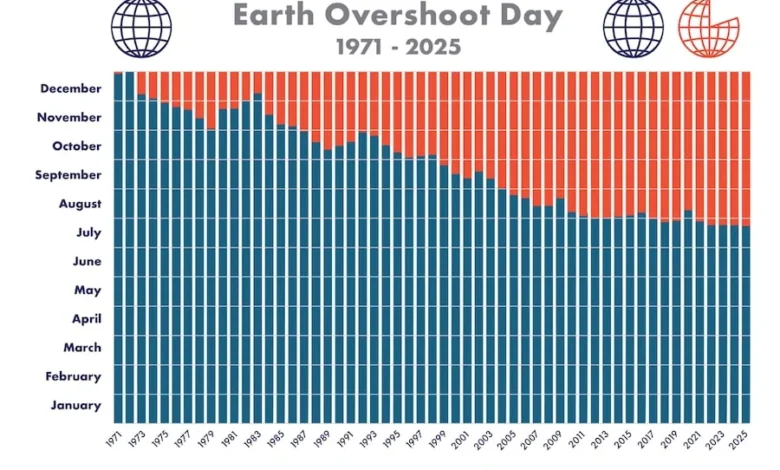
On July 24, 2025, humanity officially exhausted the planet’s biological budget for the entire year, marking the earliest Earth Overshoot Day since records began. This milestone signifies that in less than seven months, human demand for ecological resources and services has exceeded what Earth can regenerate in the entirety of 2024. According to data compiled by the Global Footprint Network, the world is currently operating as if it had 1.8 Earths at its disposal, creating a precarious ecological deficit that threatens the long-term stability of global ecosystems and economies.
Earth Overshoot Day is calculated by dividing the planet’s biocapacity—the amount of ecological resources Earth is able to generate that year—by humanity’s Ecological Footprint, which represents human demand for that year. The result is then multiplied by 365, the number of days in a year. The 2025 date of July 24 represents a continued and alarming trend of acceleration in resource consumption, driven largely by carbon emissions, intensive agriculture, and the rapid depletion of fisheries and forests.
The Evolution of Ecological Debt: A Historical Timeline
The concept of Earth Overshoot Day was first conceived by Andrew Simms of the UK think tank New Economics Foundation, who partnered with the Global Footprint Network in 2006 to launch the first global campaign. However, the Global Footprint Network maintains a comprehensive database that allows for the retrospective calculation of overshoot dates back to the 1960s, providing a stark visual of how rapidly industrialization and population growth have strained the biosphere.
In the early 1970s, humanity’s total ecological footprint was nearly in balance with the Earth’s regenerative capacity. In 1971, Earth Overshoot Day fell on December 25, meaning the world was using resources at a rate only slightly higher than what the planet could provide. By 1979, the date had crept forward to November 3. Throughout the 1980s, the date fluctuated but generally trended earlier, reaching October 12 by 1989.
The 1990s and early 2000s saw a significant acceleration. By 1999, the date moved into September for the first time, landing on September 25. When the campaign was officially launched in 2006, the recalculated date was August 22. The 2010s saw the threshold cross into July, with 2018 marking July 29. While 2020 saw a brief reprieve due to the global lockdowns associated with the COVID-19 pandemic—which pushed the date back to August 22—the rebound was immediate. The previous records for the earliest overshoot occurred in 2022 and 2023, both falling on July 25. The shift to July 24 in 2025 confirms that the global trajectory toward resource exhaustion remains unchecked.
Understanding the Methodology: Biocapacity vs. Footprint
The Global Footprint Network utilizes National Footprint and Biocapacity Accounts (NFA) to determine these dates. These accounts track the use of six categories of biologically productive surface areas: cropland, grazing land, fishing grounds, built-up land, forest area, and carbon demand on land.
Biocapacity represents the productivity of these areas, including their ability to absorb waste, particularly carbon dioxide emissions from burning fossil fuels. The Ecological Footprint, conversely, measures the biologically productive land and sea area required to provide the resources a person or population consumes and to absorb the corresponding waste.

Currently, the primary driver of the widening gap is carbon emissions. The "carbon footprint" now makes up 60% of humanity’s total ecological footprint. If the global community is to "Move the Date" back toward the end of the year, addressing the carbon intensity of the global economy is considered the most critical lever.
The Cumulative Impact of Persistent Overshoot
The danger of Earth Overshoot Day does not lie solely in the date itself, but in the cumulative "ecological debt" that humanity accrues year after year. By consuming 1.8 times more than the Earth can provide, humanity is not merely using interest; it is liquidating the planet’s natural capital.
The consequences of this liquidation are manifest in various forms of environmental degradation. These include large-scale deforestation, soil erosion, the collapse of biodiversity, and the buildup of carbon dioxide in the atmosphere, which leads to more frequent and severe extreme weather events. Scientists have identified nine "planetary boundaries" that define a safe operating space for humanity. Recent research indicates that we have already breached seven of these nine boundaries, including those related to climate change, biosphere integrity, and land-system change.
Lewis Akenji, a board member of the Global Footprint Network, emphasized the gravity of the situation in a recent statement. "We are stretching the limits of how much ecological damage we can get away with," Akenji noted. "It is now a quarter into the 21st century and we owe the planet at least 22 years of ecological regeneration, even if we stop any further damage now. If we still want to call this planet home, this level of overshoot calls for a scale of ambition in adaptation and mitigation that should dwarf any previous historical investments we have made."
Strategic Solutions: The Power of Possibility
Despite the grim milestone, the Global Footprint Network maintains that it is technically and economically possible to reverse the trend through targeted systemic changes. Their "Power of Possibility" campaign outlines several high-impact interventions that could significantly delay Earth Overshoot Day.
One of the most effective measures would be a 50% reduction in global carbon emissions. According to GFN modeling, such a reduction would move Earth Overshoot Day back by 93 days, or roughly three months. This would require a massive transition in the global energy sector. Currently, the campaign estimates that generating 75% of the world’s electricity from renewable sources—such as wind, solar, and hydro—would move the date by 26 days.
Food systems also present a major opportunity for change. Global food production currently occupies roughly half of the Earth’s biocapacity. If the world were to reduce food waste by 50%, it would move the date by 13 days. Furthermore, a shift toward more plant-based diets and regenerative agricultural practices could further alleviate the pressure on land and water resources.
The implementation of a global "Green New Deal"—a massive public investment in green infrastructure and jobs—is estimated to have the potential to move the date by 42 days. These interventions suggest that while the current situation is dire, the tools for correction are within reach if political and economic will can be mobilized.

Global Disparities in Resource Consumption
While July 24 is the global average, the date varies wildly when calculated for individual nations. "Country Overshoot Days" illustrate the deep inequality in global resource consumption. For instance, if the entire world lived like the residents of Qatar or the United Arab Emirates, Earth Overshoot Day would fall in February. If the world lived like the United States, the date would fall in mid-March.
Conversely, many developing nations in the Global South maintain footprints that fall within the Earth’s biocapacity. However, these nations are often the most vulnerable to the consequences of global overshoot, such as rising sea levels, droughts, and resource scarcity driven by the overconsumption of wealthier industrialized nations. This disparity highlights the need for a "just transition" that accounts for ecological limits while ensuring equitable development.
Expert Analysis and Future Implications
The continued advancement of Earth Overshoot Day suggests that current international climate agreements, such as the Paris Agreement, have yet to translate into the systemic shifts necessary to bring human demand in line with the planet’s biological reality.
Mathis Wackernagel, co-founder of the Global Footprint Network and one of the creators of the Ecological Footprint concept, warns that the current path is unsustainable by the very laws of physics. "Because of the nature of physics, overshoot cannot last," Wackernagel stated. "It will end either by deliberate design or dumped-on disaster. It should not be too hard to choose which one is preferable, particularly in light of so many possible choices."
The economic implications of overshoot are also becoming increasingly apparent. As natural resources become scarcer and ecosystems fail, the costs of raw materials, food, and disaster recovery are expected to rise, potentially leading to global economic instability. Investors and credit rating agencies are beginning to incorporate ecological risks into their assessments, recognizing that countries with high biocapacity deficits are more vulnerable to "resource shocks."
As the world looks toward 2026, the arrival of Earth Overshoot Day on July 24 serves as a definitive call to action. The data suggests that incremental changes are no longer sufficient to bridge the gap. Instead, the focus must shift toward fundamental transformations in how humanity produces energy, consumes food, and structures its urban environments. The "Power of Possibility" remains, but the window for deliberate design is closing, replaced by the increasing likelihood of ecological and economic disruptions that will define the remainder of the century.