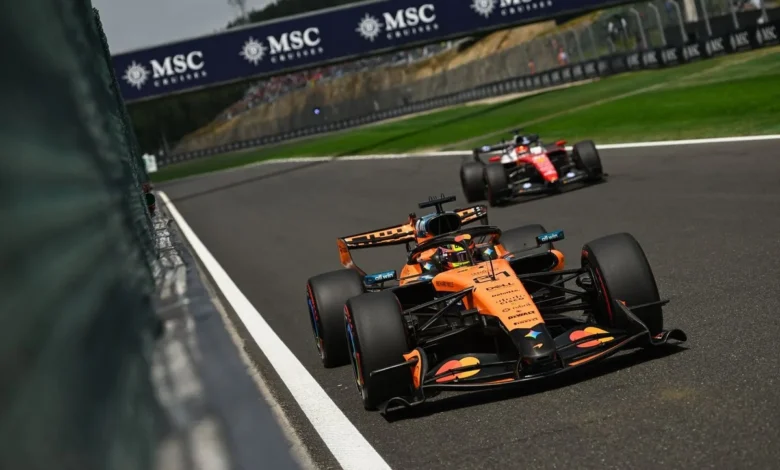
The McLaren Formula 1 team is grappling with a perplexing performance gap observed between its drivers, Oscar Piastri and Lando Norris, particularly evident during the recent qualifying session at Spa-Francorchamps. Team Principal Andrea Stella has indicated that this deficit, which manifests predominantly on straight-line sections of the track, is not attributable to Piastri’s driving ability but rather to the intricate algorithms governing the team’s Formula 1 power unit. This observation has sparked wider discussion about the complexities of energy management and its impact on driver performance in the current era of Formula 1.
The Spa-Francorchamps Enigma: Straight-Line Speed and Power Unit Dynamics
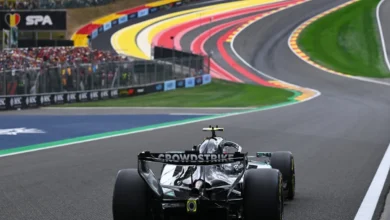
At the iconic Spa-Francorchamps circuit, a track renowned for its demanding nature and significant emphasis on straight-line speed, Piastri found himself approximately two tenths of a second adrift of his teammate Norris in qualifying. Analysis of the data revealed that this entire margin was lost on the long straights, specifically between the Stavelot corner and the Bus Stop Chicane. This section of the track coincides with a critical phase where the cars’ power units experience ‘derating’ – a controlled reduction in electrical energy deployment as the system conserves energy or manages thermal loads.
Traditionally, such discrepancies are often attributed to a driver’s ability to optimize energy harvesting from the hybrid system. The current Formula 1 regulations allow for energy to be recaptured during braking zones and through specific cornering sequences, with sections like Pouhon and Fagnes often referred to as ‘charging stations’. The prevailing assumption would be that Piastri might not have been as adept as Norris in maximizing this energy capture through the preceding sectors, thereby entering the crucial derating phase with less available electrical boost.
However, Stella’s assessment suggests a more nuanced and potentially systemic issue. "When you come to a circuit like this, which is inherently highly power-sensitive, then these sensitivities to driving input, to how much you deploy before a certain corner, were even more visible," Stella explained. "And across team-mates, if I compare Lando and Oscar in their best lap in Q3, Oscar is losing time in the final straight and Blanchimont for reasons that have nothing to do with Oscar’s driving. They are just a minor deviation in how the power unit was operated."

This statement shifts the focus away from individual driver error and points towards the complex interplay between the car’s software, the power unit’s operational parameters, and the driver’s inputs. The implication is that even subtle variations in how the power unit manages its energy reserves and deployment strategies can translate into significant performance differences on track, particularly on circuits that amplify these effects.
A Widespread Phenomenon: Mercedes Analogy and Customer Team Challenges
Intriguingly, McLaren’s observations at Spa resonate with a similar dynamic observed within the works Mercedes team. Stella drew a parallel between the performance differential between Norris and Piastri and that experienced by Mercedes drivers George Russell and their highly-touted junior driver Kimi Antonelli. Antonelli, in his recent impressive outings, has notably outperformed his more experienced teammate Russell on occasion, a situation that has left the Brackley-based squad searching for answers.
"I think this seems to be pretty much the same across the two Mercedes cars. When you overlay Antonelli and Russell, it looks like Lando and Oscar," Stella remarked. He further elaborated on the challenges faced by customer teams in fully understanding and optimizing these complex systems. "We do so much work in offline simulation. And now as a customer team, we are at race 10 and we are finally getting the tools to actually simulate before the event. I would say that most of the conversation this weekend has been about power unit and optimisation. But it’s not like it only [varies] works team to customer team. Because, like I said before, it looks like there are deviations even for the works team between one driver and the other."
This suggests that the issue is not confined to McLaren as a customer of Mercedes power units, but rather points to a broader challenge within the sport concerning the management of these sophisticated hybrid power units. The ability of a team to fully replicate the performance characteristics of the power unit, especially its adaptive software, in simulations prior to race weekends is crucial. The fact that McLaren is only now receiving the necessary tools to conduct pre-event simulations highlights the steep learning curve associated with these advanced technologies. The observation that even the works Mercedes team exhibits similar intra-team performance variations underscores the inherent complexity and the unpredictable nature of these systems.
Stella’s candid assessment suggests that Piastri could have potentially gained a significant chunk of time – "one to two tenths faster" – had the power unit behaved precisely as anticipated. This underscores the fine margins at play in Formula 1 and how a seemingly minor anomaly in power unit operation can have a disproportionate impact on lap times.

The Adaptive Nature of Modern Power Units: A Steep Learning Curve
The complexity of the current Formula 1 power units, particularly their adaptive and predictive capabilities, is a significant contributing factor to these performance variations. Unlike traditional engines, these hybrid systems are not static entities. They are designed to learn and adapt on the fly, building an extensive information bank based on real-time data gathered during practice, qualifying, and races. This learning process allows the power unit to optimize energy deployment and predict future energy needs on a corner-by-corner basis.
This "learning on the fly" aspect, while intended to enhance efficiency and performance over a season, can also introduce unpredictability. As Stella explained, "You don’t operate these power units in an open-loop way, whereby I would be able to have an offline simulation and say, oh, that’s how the electrical power will be deployed, and it will always be identical to itself. There’s a large component that happens with live calculations, and the power unit kind of forward thinks, forward calculates what it has to do based on some [parameters]. This is why it’s not so easy to understand what kind of calculations have been made as the car was going."
This dynamic, adaptive behaviour means that the power unit’s response can vary even from one lap to the next, making it challenging for engineers and drivers to achieve absolute consistency. The very algorithms designed to optimize performance are constantly evolving based on the car’s performance, creating a moving target for both car and driver.
Impact on Driver Strategy and Reference Points
The intricacies of power unit management are not merely an engineering challenge; they profoundly impact the drivers’ approach to racing. The need to constantly monitor and optimize energy harvesting and deployment often detracts from other critical aspects of driving, such as raw pace and aggressive cornering.
"It is especially difficult to understand for the drivers, which is one of the reasons why they have been so vocal about the 2026 rules," the article notes, referencing the ongoing discussions about the future of the sport’s technical regulations. Instead of focusing on pushing the car to its absolute limits through demanding corners like those at Spa, drivers are increasingly occupied with mastering braking and harvesting techniques to ensure their batteries are optimally charged.
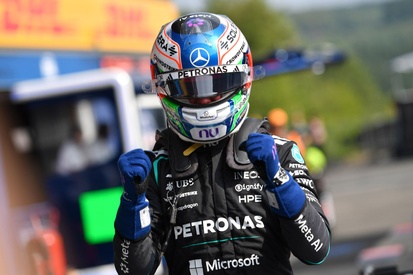
George Russell’s comments after qualifying at Spa perfectly encapsulated this shift in focus: "My whole focus for the last 36 hours has been on straightline speed. It hasn’t been focusing on the set-up, the tyres or anything, because we’re all trying to solve what is going on." This indicates a significant departure from traditional racing priorities, where setup and tire management are usually paramount.
Furthermore, the fluctuating nature of power unit deployment can disrupt a driver’s reference points for braking and corner entry. Stella elaborated on this critical aspect: "This is not only for the influence it has on the straights, but also because it affects the braking points, because if you have an additional amount of [energy] harvesting before braking, then you are approaching the braking zone 10km/h slower and your braking point changes."
This creates a complex feedback loop. The power unit’s unpredictable behaviour alters the car’s speed and braking characteristics, which in turn necessitates constant adjustments from the driver. This can lead to a situation where drivers feel they are not only competing against their rivals but also battling against their own car’s internal systems. "This is quite difficult to master for the drivers. It’s not only about getting the most out of the power unit, but also because the variations of the power unit affect your references as you approach a corner," Stella added. The article concludes by suggesting that drivers are increasingly feeling like they are engaged in a battle against their power unit’s machine learning algorithms, a far cry from the traditional physical and strategic duels of the past.
The Spa-Francorchamps Context: A Magnifying Glass for Power Unit Issues
The specific characteristics of the Spa-Francorchamps circuit, with its long straights and relatively fewer heavy braking zones, serve to amplify the challenges associated with managing modern F1 power units. Unlike circuits with numerous hard braking events that offer natural opportunities for energy harvesting, Spa demands a more strategic and sustained approach to energy deployment and regeneration. This places a greater emphasis on the software’s ability to balance energy usage over extended periods, making any inefficiencies or unpredictable behaviours more pronounced.
The article notes that the "relative lack of braking zones as natural harvesting opportunities has brought out the most extreme version of the 2026 rules." This has led some drivers to express a preference for circuits like the Hungaroring, with its stop-start nature that offers more consistent opportunities for energy management, over traditional fan-favourite, high-speed venues. The implication is that the current technical regulations, while pushing the boundaries of efficiency and performance, may be better suited to certain track layouts than others, leading to a divergence in driver experience and potentially competitive balance.

Piastri’s Friday Setback: A Potential Contributing Factor
The incident involving Oscar Piastri on Friday at Spa-Francorchamps, where he lost significant track time due to a hydraulic leak, is also highlighted as a potential contributing factor to his qualifying performance. This lost track time would have limited his opportunities to fine-tune his power unit software and gather crucial data for optimization.
"Piastri missed a lot of track time on Friday with a hydraulic leak, which would have likely set him and his power unit software on the back foot," the article states. Furthermore, a subsequent mistake in Q3, where Piastri went wide and encountered gravel, could have had a cascading effect. Not only did this ruin his initial flying lap, but it may have also influenced how his power unit behaved on his subsequent run. Such an incident, even if minor, could have triggered adaptive responses within the power unit’s learning algorithms, potentially penalizing him across different runs and contributing to his deficit.
Broader Implications and Future Outlook
The current situation with McLaren and the wider performance variations within the Mercedes family underscore a critical challenge facing Formula 1: the increasing complexity of its technological components and their impact on driver performance and team strategy. As teams and drivers continue to adapt to these sophisticated hybrid systems, the line between human input and machine learning becomes increasingly blurred.
The ongoing debate around the 2026 regulations, which will see further evolution of power unit technology, suggests that these challenges are likely to persist. The need for greater transparency and predictability in power unit behaviour, or conversely, the development of more intuitive control systems for drivers, will be crucial for maintaining the sport’s appeal and competitive integrity.
The article’s assertion that drivers are "fighting their own power unit’s machine learning algorithms" paints a vivid picture of the new frontier in motorsport. It suggests that success in modern Formula 1 is not solely about mechanical grip or aerodynamic prowess, but also about mastering the intricate dance between human skill and artificial intelligence, a challenge that is proving to be as demanding as any on the racetrack. The coming races will undoubtedly see teams and drivers continuing their relentless pursuit of understanding and harnessing these complex power unit dynamics, hoping to unlock the secrets that lie within the algorithms.
Related posts: