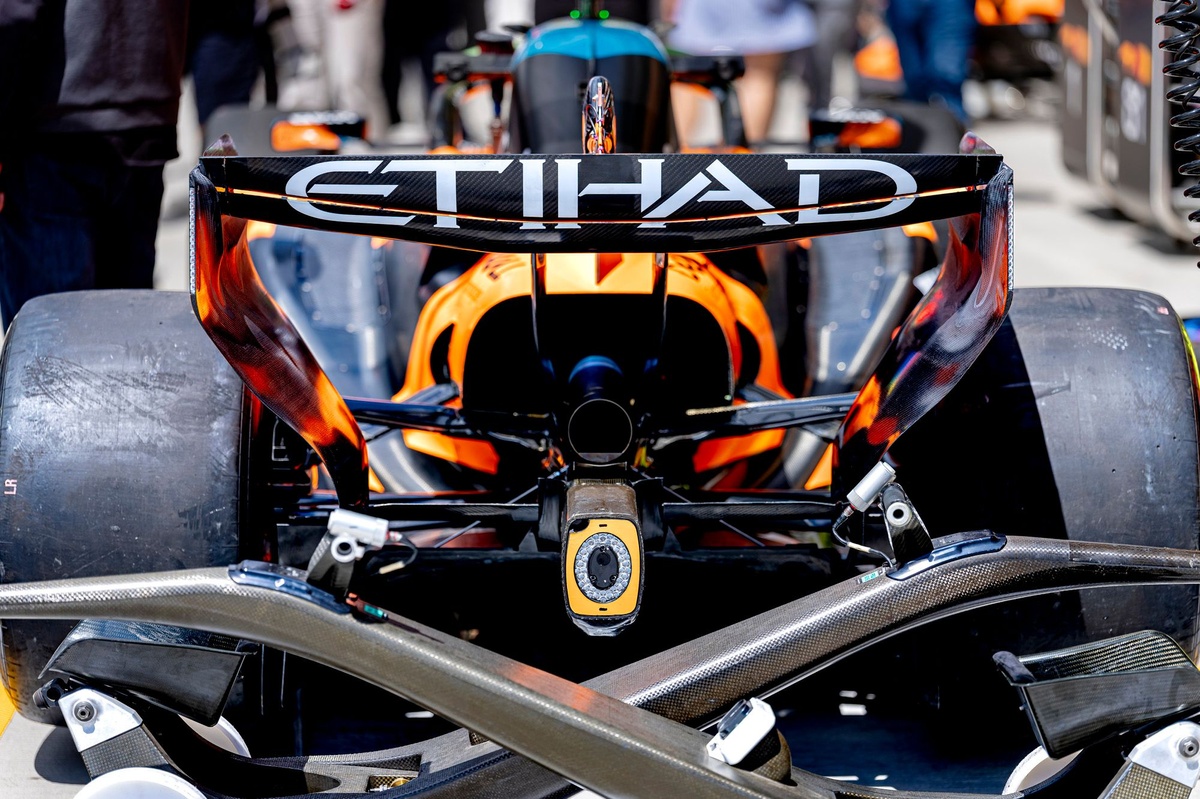
McLaren has finally unleashed its highly anticipated, experimental pivoting rear wing, a sophisticated piece of aerodynamic machinery that has been in development since its initial concept was set aside in Austria for further refinement. While this iteration is primarily a data-gathering prototype, with a finalized version slated for the latter half of the Formula 1 season, its intricate design signals a significant evolution in the team’s pursuit of aerodynamic advantage. This innovative solution marks a departure from previous approaches seen from rivals, showcasing McLaren’s unique engineering philosophy and its commitment to pushing the boundaries of what’s possible within the sport’s regulations.
The genesis of this complex system lies in McLaren’s strategic decision to diverge from the solutions pioneered by competitors. While Ferrari’s pivoting wing, affectionately nicknamed the "Macarena" wing, and Red Bull’s comparable innovation share the fundamental goal of aerodynamic adjustment, their implementation differs significantly. Ferrari opted to integrate the actuator directly into the endplate, a compact yet potentially less flexible approach. Red Bull, on the other hand, developed its own unique rotational system. McLaren, in a testament to its engineering prowess, has managed to synthesize elements from both, while forging its own distinct and highly refined path.
A Novel Actuation System: The Heart of McLaren’s Innovation
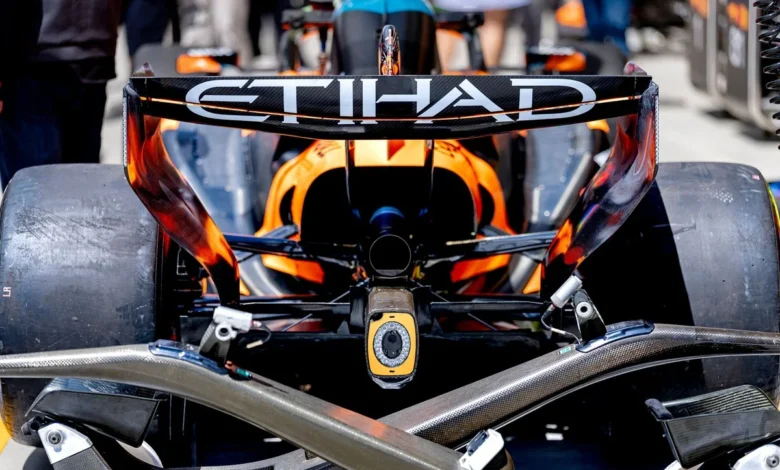
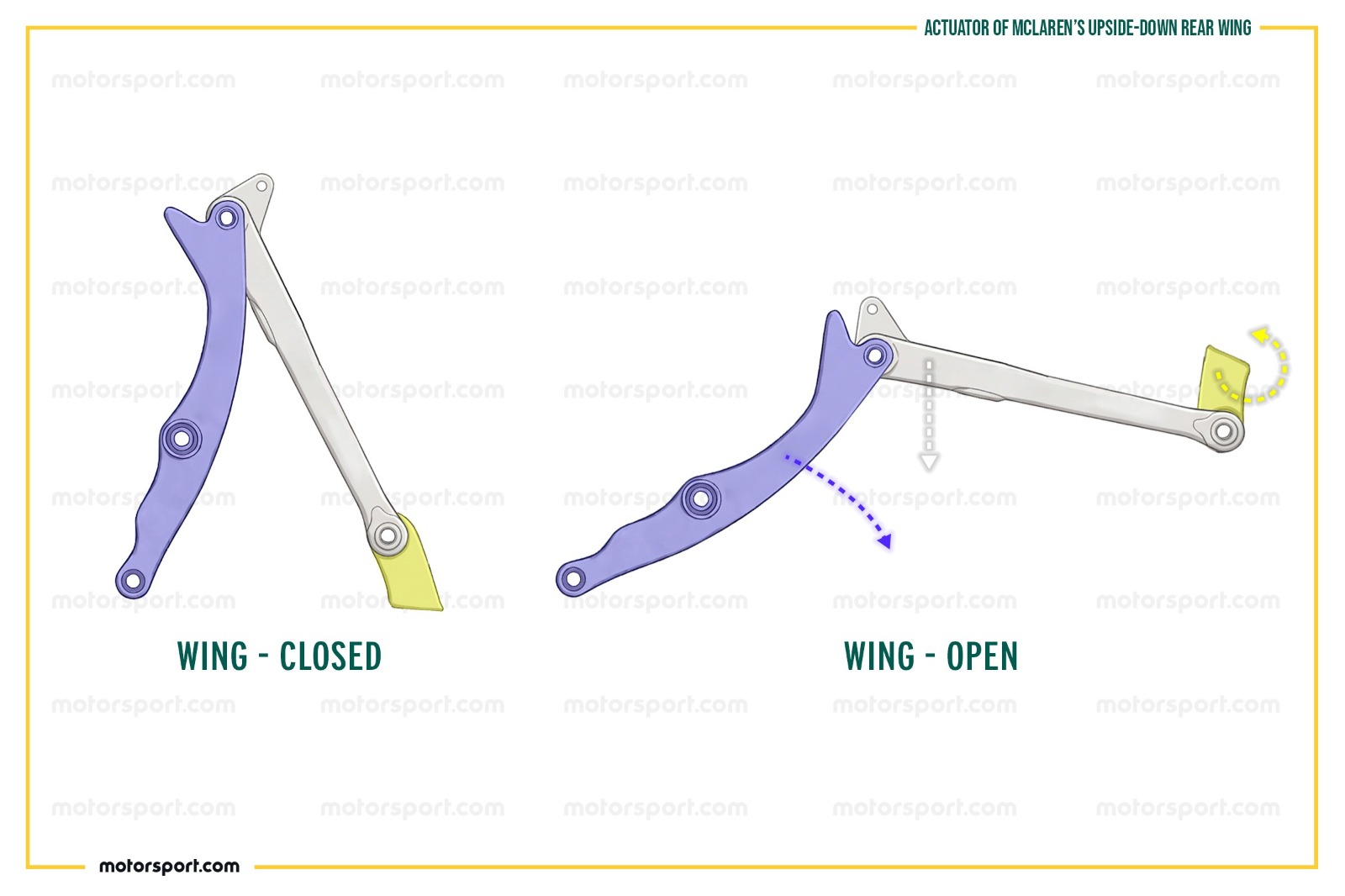
The core of McLaren’s innovation lies in its ingenious actuation mechanism, a stark contrast to the methods employed by its rivals. Instead of embedding the actuator within the endplate, as Ferrari has done, McLaren has retained a centrally mounted actuator. This unit, through an exceptionally clever three-link mechanism, orchestrates the simultaneous rotation of both main wing flaps into their deployed position. This approach allows for a more distributed and potentially more robust deployment system.
The Three-Link Kinematic Dance
The operation of McLaren’s three-link system is a masterclass in kinematic engineering. When the movable wing is activated, a piston within the central actuator extends. This piston engages the first link (visually represented in blue in available imagery), pushing it to an angle of approximately 45 degrees. This initial movement triggers a cascading effect. The second link (depicted in white) responds by extending into a nearly horizontal orientation. Finally, the third link (illustrated in yellow), which is directly connected to the lower of the two movable wing flaps, rotates upwards. This rotation continues until the yellow link forms an angle close to 90 degrees with the second link, effectively becoming perpendicular.
The ultimate role of this yellow link is crucial: it is the component that physically lifts and supports the wing flaps, ultimately achieving a near-vertical position. This design is notable for its departure from fixed support structures. Unlike the Red Bull system, which necessitates a rigid "cage" to house its actuator and connect to the rotating pivot, McLaren’s links themselves form the load-bearing structure. This not only simplifies the overall architecture but also offers a significant potential advantage in terms of weight reduction, a critical factor in the performance-driven world of Formula 1. The complexity of this arrangement belies its elegance, presenting a highly intricate yet exceptionally clever engineering solution.
Minimizing Turbulence: A Key Design Consideration
Beyond the actuation mechanism, McLaren’s design also addresses a critical aerodynamic challenge: minimizing turbulence generated during the wing’s deployment. In essence, the wing rotates backward as it pivots open, a characteristic shared with the Red Bull RB22 design. However, McLaren’s engineers have implemented a particularly astute design choice: they deliberately avoid lifting the outer edge of the wing when it opens.
This strategic decision is aimed at reducing the disruptive airflow that arises when the outer corners of the wing become exposed. In contrast, Red Bull’s solution, which utilizes a complex system of lateral pivots that themselves rotate during deployment, can potentially exacerbate this issue. McLaren’s approach, by keeping the wing tips in close proximity to the endplates, significantly limits the formation of unwanted turbulence that would typically increase as the outer sections of the wing are exposed.

The lateral pivot points on the McLaren wing are, therefore, more conventional. Two free-moving pivot elements are strategically positioned at the extremities of the upper flap. These elements allow the movable wing sections to rotate while seamlessly following the precise movements dictated by the hydraulic actuator. This meticulous engineering ensures that the wing’s aerodynamic profile remains as controlled and efficient as possible, even during its dynamic transition between open and closed states.
Background and Context: The Evolution of Active Aerodynamics
The introduction of pivoting rear wings by multiple teams signifies a broader trend within Formula 1 towards more sophisticated and dynamically adjustable aerodynamic devices. While DRS (Drag Reduction System) has been a staple for years, providing drivers with a temporary straight-line speed advantage, these new pivoting wings represent a more fundamental integration of active aerodynamics.
The 2022 Formula 1 season saw the introduction of a radical new aerodynamic formula designed to promote closer racing. This included a significant emphasis on ground effect aerodynamics, with sculpted undertrays and complex diffuser designs. However, teams have continually sought ways to optimize performance further, leading to innovations in areas such as front and rear wing adjustability.
Ferrari was among the first to publicly test a pivoting rear wing concept, showcasing its "Macarena" wing at various circuits. This prompted other teams, including Red Bull and McLaren, to investigate similar avenues. The development timelines suggest that these concepts have been under intense scrutiny and refinement for a considerable period. McLaren’s decision to initially withhold its version, choosing to dedicate time to "further refine the concept," highlights the meticulous approach taken by the Woking-based outfit. This period of refinement was likely dedicated to understanding the intricate balance between aerodynamic performance, structural integrity, and regulatory compliance.
Data Collection and Future Implications
The primary objective of McLaren’s current deployment of the pivoting rear wing is data collection. The team is keen to gather real-world performance metrics and correlate them with their extensive simulations. This data will be invaluable in understanding the wing’s behavior under various track conditions, speeds, and G-forces. The insights gained will directly inform the development of the final, race-ready version, which is expected to be introduced in the second half of the season.
The implications of such a device are significant. A fully functional pivoting rear wing could offer teams a substantial competitive advantage. It allows for on-the-fly adjustments to downforce levels, enabling drivers to optimize their car’s performance for different sections of a circuit. For instance, a driver could deploy the wing to generate more downforce in high-speed corners, improving cornering grip and stability, and then retract it on straights to minimize drag and maximize top speed. This level of dynamic aerodynamic control was previously unattainable within the strict regulations of Formula 1, outside of the DRS system.
The successful implementation and performance of McLaren’s pivoting wing could also influence the design philosophies of other teams. If McLaren can demonstrate a tangible performance benefit, it is highly likely that other constructors will intensify their own research and development into similar technologies. This could lead to an arms race in active aerodynamics, further pushing the boundaries of engineering innovation within the sport.
Official Responses and Team Perspectives (Inferred)
While direct quotes from McLaren officials regarding this specific prototype may be limited due to its experimental nature, their past statements on aerodynamic development provide context. The team has consistently emphasized its commitment to innovation and its pursuit of marginal gains. The investment in developing such a complex system underscores their belief in the potential of advanced aerodynamic solutions.

Competitors, such as Ferrari and Red Bull, are undoubtedly monitoring McLaren’s progress closely. Their own advancements in pivoting wing technology suggest an acknowledgment of its potential. It is reasonable to infer that these teams will be analyzing McLaren’s solution to understand its strengths and weaknesses, and to potentially adapt their own strategies accordingly. The cat-and-mouse game of aerodynamic development is a constant feature of Formula 1, and the introduction of such novel technology only intensifies this dynamic.
Broader Impact on Formula 1
The development of pivoting rear wings by multiple top-tier teams is a testament to the evolving nature of Formula 1. It signals a shift towards more intelligent and adaptable car designs that can actively respond to changing race conditions. This could lead to:
- More Dynamic Racing: Drivers may have more tools at their disposal to manage tire wear, optimize strategy, and attack or defend more effectively.
- Increased Engineering Complexity: The demands on aerodynamicists, engineers, and simulation teams will increase, requiring even more sophisticated tools and methodologies.
- Regulatory Scrutiny: As these technologies become more prevalent and impactful, the FIA (Fédération Internationale de l’Automobile) will likely increase its scrutiny to ensure fair play and maintain the sport’s core principles.
McLaren’s intricate three-link pivoting rear wing represents a significant step forward in this ongoing evolution. Its sophisticated design, focused on both performance and turbulence mitigation, showcases the team’s engineering acumen and its relentless drive to innovate. As the season progresses, all eyes will be on McLaren to see how this groundbreaking technology translates into on-track performance, potentially reshaping the aerodynamic landscape of Formula 1.