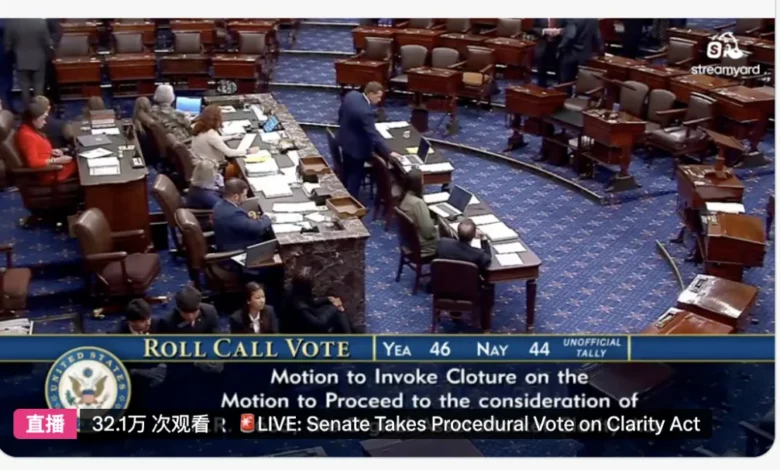
The United States Senate has taken a decisive step forward in the ongoing debate over digital asset regulation, moving closer to establishing a comprehensive federal framework for the cryptocurrency industry. On September 15, the Senate voted to advance the "Guiding and Establishing Market Certainty Act" (commonly referred to as the CLARITY Act, designated as H.R. 3633), clearing a procedural hurdle known as a cloture vote. This legislative milestone brings the broader financial sector one step closer to achieving the crucial 60-vote threshold required to officially break the filibuster and advance the bill toward a final floor vote.
The legislative momentum reflects years of intense negotiations between lawmakers, regulatory bodies, and industry stakeholders. As decentralized finance (DeFi) continues to expand its footprint within the global financial ecosystem, policymakers face increasing pressure to clarify regulatory jurisdictions and provide legal certainty for market participants, investors, and innovators alike.
Legislative Overview and Core Objectives
The CLARITY Act represents one of the most ambitious legislative efforts in the history of U.S. cryptocurrency regulation. For years, the digital asset industry has operated under a patchwork of regulatory interpretations, often characterized by jurisdictional turf wars between the Commodity Futures Trading Commission (CFTC) and the Securities and Exchange Commission (SEC). Market participants have frequently criticized the SEC’s enforcement-heavy approach, arguing that traditional securities laws are poorly suited for decentralized, borderless blockchain technologies.
The primary objective of the CLARITY Act is to establish a clear statutory division of labor between the two primary financial regulators. Under the proposed framework, the CFTC would gain primary oversight over digital asset commodities and spot markets, while the SEC would retain jurisdiction over digital assets that function as securities. Furthermore, the legislation introduces tailored registration pathways for decentralized finance protocols, addressing a long-standing regulatory grey area that has deterred institutional participation and innovation within the DeFi sector.
The bill’s journey through Congress has been marked by significant bipartisan compromise. Following initial legislative successes in the House of Representatives, where the bill passed by a decisive 294 to 134 vote, the legislation moved to the Senate for consideration. However, the path through the upper chamber has proven challenging, requiring delicate negotiations to secure the necessary support across party lines.
Political Dynamics and Legislative Chronology
The recent cloture vote reflects a hard-fought compromise among key senators, though the path forward remains politically sensitive. Key figures in the Senate, including Senators Cynthia Lummis and other prominent crypto advocates, have pushed aggressively for the legislation, emphasizing that the rapidly evolving financial landscape demands immediate congressional action.
However, the bill has faced opposition from various factions within the Senate. Some progressive lawmakers have expressed concerns that the legislation might weaken investor protections or limit the enforcement powers of regulatory agencies against bad actors. Conversely, libertarian-leaning senators and fiscal conservatives have scrutinized certain provisions related to compliance burdens and anti-money laundering (AML) reporting requirements, arguing that overly stringent rules could stifle innovation and privacy rights.
Despite these divisions, the urgency surrounding digital asset regulation has intensified due to broader macroeconomic factors and shifting political dynamics. The White House and Treasury Department have increasingly emphasized the need for clear guardrails to prevent illicit finance while fostering responsible innovation. Financial stability concerns, coupled with the rapid adoption of tokenized real-world assets and stablecoins, have created a narrow window of opportunity for lawmakers to enact meaningful reform before the upcoming 2026 midterm elections.
Regulatory Implications for DeFi and Traditional Markets
The advancement of the CLARITY Act carries profound implications for both traditional financial institutions and native cryptocurrency enterprises. For years, institutional investors have cited regulatory uncertainty as a primary barrier to entry. By delineating clear rules of the road, the legislation is expected to unlock substantial institutional capital, paving the way for broader integration of blockchain technology into mainstream financial markets.
In particular, the bill’s provisions regarding decentralized finance (DeFi) mark a significant departure from traditional regulatory frameworks. Recognizing that decentralized protocols do not fit neatly into traditional corporate structures, the CLARITY Act introduces novel registration concepts that attempt to balance systemic risk mitigation with the preservation of open-source innovation. This includes pragmatic approaches to node operators, liquidity providers, and governance tokens, aiming to hold malicious actors accountable without dismantling the foundational architecture of decentralized networks.
At the same time, the legislation strengthens enforcement mechanisms against fraud, market manipulation, and illicit financing. Regulators will be equipped with enhanced statutory tools to investigate and prosecute bad actors, helping to restore consumer trust and clean up bad elements within the ecosystem. Industry analysts note that while compliance costs will undoubtedly rise for market participants, the overarching benefit of legal clarity will ultimately outweigh the short-term friction of regulatory adjustment.
Outlook and the Road Ahead
As the CLARITY Act enters the final stages of the legislative process, all eyes remain on the Senate floor. Securing the necessary 60 votes to overcome the filibuster represents a major milestone, but finalizing the statutory language and passing the bill through both chambers into law will require continued bipartisan cooperation.
Market participants and advocacy groups are closely monitoring developments, recognizing that the outcome of this legislative push will shape the trajectory of the U.S. digital asset economy for decades to come. Whether the Senate can maintain momentum and deliver a finalized regulatory framework in 2026 will depend heavily on the willingness of lawmakers to compromise on remaining contentious issues, including specific compliance thresholds and agency funding allocations.
Ultimately, the advancement of the CLARITY Act underscores a growing bipartisan consensus that the era of regulation by enforcement is reaching its limits. As digital assets continue to weave themselves into the fabric of global finance, the establishment of a comprehensive, transparent, and balanced regulatory framework is no longer just an industry preference—it has become an economic necessity.
Related posts: