NASA Selects SpaceX Falcon 9 to Launch StarBurst Mission Exploring Neutron Star Collisions and Gamma-Ray Bursts

The National Aeronautics and Space Administration has officially tapped commercial aerospace leader SpaceX to provide launch services for the agency’s highly anticipated StarBurst mission. Designed as a specialized small satellite, StarBurst will venture into orbit to investigate the cataclysmic merging of neutron stars and unravel the fundamental origins of short gamma-ray bursts—some of the most energetic and violent electromagnetic events in the known universe.
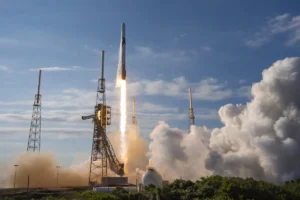
According to mission parameters released by the space agency, the StarBurst spacecraft will lift off aboard a SpaceX Falcon 9 rocket configured for a Bandwagon rideshare mission. The launch is scheduled to take place from Space Launch Complex 40 at the Cape Canaveral Space Force Station in the state of Florida. Agency officials have confirmed that the targeted launch window will open no earlier than 2028, providing engineers and scientists ample time to complete final integration, payload testing, and orbital alignment schedules.
This prestigious launch assignment has been awarded as a firm-fixed-price task order operating under NASA’s Venture-Class Acquisition of Dedicated and Rideshare contract mechanism, widely recognized within the aerospace community by the acronym VADR. The VADR framework functions as an indefinite-delivery/indefinite-quantity contracting vehicle engineered to grant NASA streamlined access to commercial launch capabilities. Operating across a robust 10-year ordering period, the VADR contract vehicle boasts a maximum cumulative ordering ceiling of $1 billion distributed across all participating commercial providers, empowering the agency to procure cost-effective, reliable rideshare and dedicated flight opportunities for a wide variety of scientific payloads.
Unlocking the Secrets of Gamma-Ray Bursts
At its core, the StarBurst mission has been meticulously engineered to observe the entire expanse of the celestial sphere that remains unblocked by the physical presence of Earth. By maintaining this continuous, unobstructed sky-viewing capability, the compact satellite will systematically hunt for brief, incredibly powerful flashes of high-energy radiation known as gamma-ray bursts.
Scientific focus will be heavily concentrated on detecting the initial high-energy emission phase characteristic of short gamma-ray bursts. Astounding theoretical and observational models indicate that these fleeting, intense phenomena are triggered when two ultra-dense stellar remnants—specifically, neutron stars orbiting one another in a decaying binary system—spiral inward and ultimately collide. These titanic cosmic crashes generate shockwaves across spacetime itself while unleashing torrents of gamma-ray photons across the cosmos.
By operating in low-Earth orbit, StarBurst will act as an unblinkering celestial sentinel. Because short gamma-ray bursts typically last for only a fraction of a second to a few seconds, capturing their initial high-energy signatures requires specialized instrumentation capable of rapid response times and wide-field surveillance. StarBurst meets these stringent observational demands, positioning it to become a cornerstone asset in high-energy astrophysics.
A Leap Forward for Multimessenger Astronomy
The true scientific value of the StarBurst mission extends far beyond its standalone observations, resting heavily on its integration into the rapidly evolving field of multimessenger astronomy. In modern astrophysics, multimessenger astronomy refers to the coordinated study of cosmic events using multiple distinct types of observable signals—most notably electromagnetic radiation, gravitational waves, neutrinos, and cosmic rays.
When a pair of neutron stars merges, the event propagates ripples through the fabric of space and time known as gravitational waves, which are detected by ground-based observatories such as the Laser Interferometer Gravitational-Wave Observatory (LIGO) in the United States, Virgo in Italy, and KAGRA in Japan. However, while gravitational wave detectors can pinpoint the general vicinity of a cosmic collision, they often lack the precise directional resolution required to identify the specific host galaxy.
This is where observatories like StarBurst play an indispensable role. By detecting the prompt gamma-ray emission associated with the gravitational wave signal, StarBurst can provide critical directional data. When researchers combine StarBurst’s high-energy space-based observations with ground-based gravitational-wave measurements and follow-up optical, infrared, and radio observations from other telescopes around the globe, they can construct a complete, multidimensional picture of the event. This synergistic approach allows scientists to probe the physics of extreme gravity, test the limits of general relativity, and determine the nucleosynthesis pathways responsible for heavy elements in the universe, such as gold and platinum.
The Astrophysics Pioneers Program Framework
StarBurst occupies a vital niche within NASA’s broader scientific portfolio as a selected payload under the Astrophysics Pioneers Program. Managed by the Astrophysics Division within the Science Mission Directorate at NASA Headquarters in Washington, the Pioneers Program was established to foster innovative, lower-cost scientific investigations that address high-priority astrophysical questions.
Traditionally, flagship space telescopes require multi-billion-dollar investments and decades of development, limiting the frequency at which new scientific questions can be explored. The Astrophysics Pioneers Program deliberately disrupts this paradigm by encouraging smaller spacecraft, balloon-borne experiments, and payloads hosted on commercial or international missions. By capping costs and streamlining bureaucratic oversight, the program enables frequent access to space for targeted, high-reward missions. StarBurst perfectly exemplifies this philosophy, leveraging commercial rideshare opportunities to maximize scientific return on investment while empowering emerging scientific instrumentation methodologies.
Operational Oversight and Launch Management
The complex task of managing the VADR contract and overseeing the commercial launch arrangements for StarBurst falls under the purview of NASA’s esteemed Launch Services Program Office. Headquartered at the agency’s Kennedy Space Center along the space-faring coast of Florida, the LSP team is globally recognized for its expertise in certifying commercial launch vehicles, managing mission integration, and ensuring that delicate scientific payloads are safely delivered to their designated orbital trajectories.
The Launch Services Program acts as the critical bridge between NASA science missions and commercial aerospace launch providers. Through rigorous engineering reviews, risk assessments, and mission assurance protocols, the office ensures that vehicles like SpaceX’s Falcon 9 meet all mandatory safety and performance criteria before granting final flight clearance. The synergy between NASA’s Kennedy Space Center launch managers and SpaceX engineering teams at Cape Canaveral Space Force Station creates a robust operational environment well-suited to handle the technical demands of the 2028 StarBurst lift-off.
Chronology of the VADR Initiative and StarBurst Selection
The journey toward the 2028 StarBurst launch is part of an ongoing strategic evolution in how NASA procures and executes space science missions.
The foundation for this launch contract was laid years prior with the establishment and continuous expansion of the VADR contracting mechanism. Recognizing the explosive growth of the commercial launch sector—particularly the emergence of reliable, frequent rideshare options driven by mega-constellation deployments—NASA designed VADR to capitalize on these market efficiencies. By establishing pre-competed contract pools with fixed pricing structures, the agency eliminated lengthy, bespoke procurement cycles for individual small-satellite missions.
Following the formal proposal and peer-review process within the Astrophysics Pioneers Program, StarBurst was selected for flight development. Engineers and instrument designers at lead academic and research institutions began fabricating the satellite’s specialized gamma-ray detection sensors and power systems.
With the recent announcement selecting SpaceX as the designated launch provider for the mission, project managers have solidified the critical path toward flight readiness. Over the next several years, the StarBurst payload will undergo comprehensive environmental testing—including thermal vacuum exposure, acoustic vibration analysis, and electromagnetic compatibility checks—to ensure it can survive the brutal dynamic environments of Falcon 9 ascent and orbital operations. Concurrently, integration teams will coordinate with SpaceX to reserve payload adapter space on the 2028 Bandwagon mission, ensuring smooth mechanical and electrical interfacing between the small satellite and the Falcon 9 upper stage.
Industry and Agency Reactions
While formal public statements from agency leadership often emphasize the technical and strategic benefits of such partnerships, the broader aerospace and scientific communities have widely praised the StarBurst selection as a triumph of modern public-private cooperation.
Industry analysts note that utilizing established commercial vehicles like the Falcon 9 via rideshare configurations drastically lowers the financial barriers to deep space and orbital science. By hitching a ride on a Bandwagon mission—which places payloads into mid-inclination orbits tailored for specific Earth and space observation requirements—StarBurst avoids the prohibitive costs associated with dedicated, single-payload launches.
From the perspective of the scientific community, the greenlighting of StarBurst’s launch logistics represents tangible progress toward answering some of modern physics’ most enduring mysteries. High-energy astrophysicists have long advocated for broader sky-coverage instrumentation dedicated to transient phenomena. The inclusion of StarBurst in the launch queue assures researchers that the astronomical community will soon possess a dedicated sentinel capable of catching fleeting gamma-ray flashes that might otherwise go unnoticed by narrow-field instruments.
Broader Implications and Future Horizons
The implications of the StarBurst mission extend far beyond the immediate data it will transmit back to Earth. As humanity enters a golden age of multi-messenger astronomy, missions like StarBurst serve as vital pathfinders for future observatories.
By demonstrating the scientific viability of low-cost, targeted small satellites in advancing complex multimessenger investigations, StarBurst validates the efficacy of the Astrophysics Pioneers Program model. If StarBurst successfully characterizes the population of short gamma-ray bursts and correlates their high-energy emissions with gravitational wave detections, it could pave the way for a constellation of similar smallsats designed to provide global, round-the-clock monitoring of transient cosmic phenomena.
Furthermore, the collaboration underscores the deepening integration of commercial space infrastructure into NASA’s core scientific missions. As commercial providers like SpaceX continue to drive down the cost per kilogram to orbit through reusable launch vehicle technology, government space agencies are increasingly freed from the burden of maintaining bespoke heavy-lift architectures for smaller scientific payloads. This fiscal flexibility allows NASA to allocate a larger share of its budgetary resources toward cutting-edge instrument design, data analysis, and educational outreach.
As the 2028 launch window draws closer, anticipation within the global astrophysical community continues to build. When the Falcon 9 rocket clears the pad at Space Launch Complex 40 and thunders into the Florida skies, it will carry aloft not just a compact satellite, but humanity’s next great set of eyes tuned to the invisible, violent symphonies of colliding neutron stars. Through StarBurst, researchers will peer deeper into the mechanics of the cosmos, translating fleeting flashes of gamma-ray light into enduring knowledge about the origin of the elements and the fundamental laws governing our expanding universe.
Media Contacts and Further Information
For journalists, researchers, and space enthusiasts seeking continuous updates regarding the development and integration of the StarBurst mission, NASA has provided official institutional communication channels.
Inquiries directed to NASA Headquarters in Washington can be routed through public affairs officers Joshua Finch and Jimi Russell. Mr. Finch and Mr. Russell can be reached via telephone at 202-358-1100 or through electronic mail at [email protected] and [email protected], respectively.
Additionally, media representatives focusing on launch operations and ground infrastructure at the Kennedy Space Center in Florida may contact Leejay Lockhart. Mr. Lockhart is reachable by phone at 321-747-8310 or via email at [email protected].
Comprehensive digital resources, mission updates, fact sheets, and scientific overview documentation concerning the StarBurst satellite can be accessed directly through the official mission portal maintained by the agency at https://science.nasa.gov/mission/starburst.