The exploration of Jezero Crater on Mars continues to yield profound insights into the planet’s ancient geological past, as NASA’s Mars 2020 rover mission uncovers complex features along the crater’s margins. In recent operations, mission scientists directed the robotic explorer to investigate the southern border of an olivine-rich igneous outcrop known as "Idubi." During this traverse, the rover’s sophisticated suite of navigational and scientific cameras captured a high-priority geological contact zone—a distinct boundary between differing rock types designated by the science team as "Tinga." This site offers a rare window into the chronological events that shaped the Martian landscape billions of years ago, presenting researchers with a puzzle involving impact breccia and enigmatic dark-toned mineral formations.
To understand the significance of the "Tinga" outcrop, one must examine the broader geological context of the Jezero Crater region. Spanning approximately 45 kilometers (28 miles) in diameter, Jezero Crater is widely believed by planetary scientists to have once hosted a flooded lake basin during the Noachian or early Hesperian epochs—periods characterized by high rates of impact cratering, fluid activity, and potential habitability. The Mars 2020 mission, anchored by the Perseverance rover, was specifically designed to land in this ancient basin to search for signs of ancient microbial life and collect a diverse suite of rock and regolith samples for potential return to Earth.
The surrounding terrain is heavily influenced by regional volcanic and impact histories. The presence of olivine—a magnesium iron silicate mineral commonly associated with mafic and ultramafic igneous rocks—has long intrigued researchers. The extensive olivine-bearing unit that forms the "Idubi" outcrop is a prominent feature of this landscape, stretching beyond the immediate rim of Jezero Crater onto the adjacent plains. Understanding the origin and emplacement of this olivine has been a primary objective for the mission team, as it helps determine whether the mineral formed via slow-cooling volcanic processes beneath the surface or as a massive ash-fall deposit from explosive volcanism.
Chronology of the Discovery and Traverse
The identification and analysis of the "Tinga" outcrop fit into a meticulously planned operational timeline for the Mars 2020 mission. Since touching down on the Martian surface in February 2021, the rover has systematically traversed the floor of Jezero Crater, scaling delta deposits, examining floor units, and eventually ascending toward and beyond the crater rim to explore older, primordial crust.
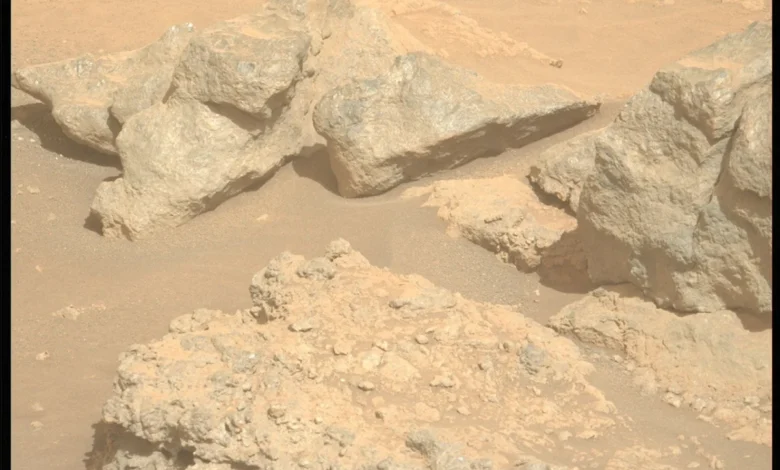
As the rover navigated the southern border of the "Idubi" outcrop, its hazard-avoidance and mast-mounted science cameras recorded structural variations in the local bedrock. The "Tinga" target immediately stood out due to the sharp juxtaposition of contrasting geological units. According to mission updates, this contact zone exposes a layered or juxtaposed history that cannot be explained by a single, uniform event.
The lowermost unit observed at Tinga is currently interpreted by geologists as a polymict breccia. A breccia is a coarse-grained rock composed of broken fragments of minerals or rocks cemented together by a fine-grained matrix. A "polymict" classification indicates that the clasts within the breccia originate from multiple different source lithologies.
On Mars, such formations are predominantly created by high-energy, violent catastrophic events, most notably hypervelocity meteorite impacts. The formation of the Tinga breccia is theorized to be tied directly to the monumental impact event that excavated Jezero Crater itself, or potentially to a similarly massive, localized impact that preceded or accompanied the basin’s creation. This breccia layer serves as the baseline chapter in the geological history recorded at the outcrop, preserving the shattered remnants of early Martian crust.
Following the deposition and consolidation of the breccia, subsequent geological processes left their mark on the landscape. The higher-standing, dark-colored rocks observed at Tinga introduce a secondary, complex layer of interpretation.
Scientific Analysis and Working Hypotheses
The dark rocks towering above the breccia layer at Tinga present the science team with two primary working hypotheses. The first hypothesis suggests that these dark units are directly related to the extensive olivine-bearing unit observed at the nearby "Idubi" outcrop. Under this scenario, lava flows or intrusive igneous dikes associated with Idubi overrode or flowed into the pre-existing terrain, leaving behind the dark, olivine-rich signatures visible today.
The second hypothesis introduces a thermal alteration mechanism. It is possible that the dark rocks at Tinga are actually portions of the underlying breccia that underwent severe thermal metamorphism—colloquially referred to by geologists as being "baked." This thermal alteration would have occurred when scorching, molten or very hot igneous materials from the Idubi unit came into direct physical contact with the cold, fractured rocks of the breccia, chemically and structurally altering the minerals through intense heat.
To resolve these competing hypotheses, remote observation alone is insufficient. The mission team emphasizes that further in situ investigation—utilizing the rover’s contact science instruments, such as the SHERLOC (Scanning Habitable Environments with Raman & Luminescence for Organics & Chemicals) and PIXL (Planetary Instrument for X-ray Lithochemistry) spectrometers, as well as the RIMFAX (Radars Imager for Mars’ Subsurface Experiment) ground-penetrating radar—will be required. These tools will enable scientists to probe the chemical composition, mineralogy, and subsurface geometry of the contact zone with microscopic precision.
Official Perspectives and Mission Team Statements
Researchers closely associated with the mission have underscored the thematic value of targets like Tinga in piecing together the planet’s evolutionary timeline. Margaret Deahn, a Ph.D. candidate at Purdue University and a contributing member of the Mars 2020 science team, articulated the significance of these observations in recent mission documentation.
"Tinga tells a tale about distinct geologic events that occurred just outside Jezero’s crater rim," Deahn noted, highlighting how localized field geology can illuminate regional and planetary-scale processes. The Mars 2020 mission continues to leverage these transitional boundaries to refine models of early Martian magmatism, impact mechanics, and crustal evolution.
The sentiment is echoed across the broader scientific collaboration. Planetary geologists view contact zones—where two different rock formations meet—as holy grails for relative dating. By establishing the physical relationships between the breccia and the dark overlying rocks, scientists can definitively state which event occurred first, thereby constructing a reliable stratigraphic column for the Jezero rim environment.
Broader Impact and Implications for Astrobiology and Planetary Science
While the rocks at Tinga are igneous and impact-derived rather than sedimentary mudstones or lake carbonates typically targeted for fossil biosignatures, they hold profound importance for understanding the habitability and thermal history of Jezero Crater.
Impact events, such as the one that created the breccia at Tinga, are known to generate sustained hydrothermal systems. On early Earth, impact craters provided heat, water circulation, and chemical nutrients that may have fostered prebiotic chemistry or early life. By studying impact breccias and their thermal interactions with surrounding volcanic units, scientists gain critical data regarding the thermal energy budget of ancient Mars.
Furthermore, analyzing olivine-rich units like Idubi and its contact margins provides baseline data on mantle composition and planetary differentiation. Olivine is particularly sensitive to aqueous alteration; when exposed to liquid water, it readily weathers into clay minerals and serpentine, releasing hydrogen and creating environments that can support chemotrophic microbial life. Determining whether the rocks at Tinga were altered by water or exclusively by dry thermal contact helps constrain the hydrological history of the region.
As the Mars 2020 rover pushes forward with its traverse, leaving behind the intricate puzzles of the Tinga outcrop, the mission marches closer to achieving its ultimate objectives. Every contact zone analyzed, every breccia clast cataloged, and every igneous mineral composition measured brings humanity one step closer to decoding the complete origin story of Jezero Crater and the ancient world that once was.