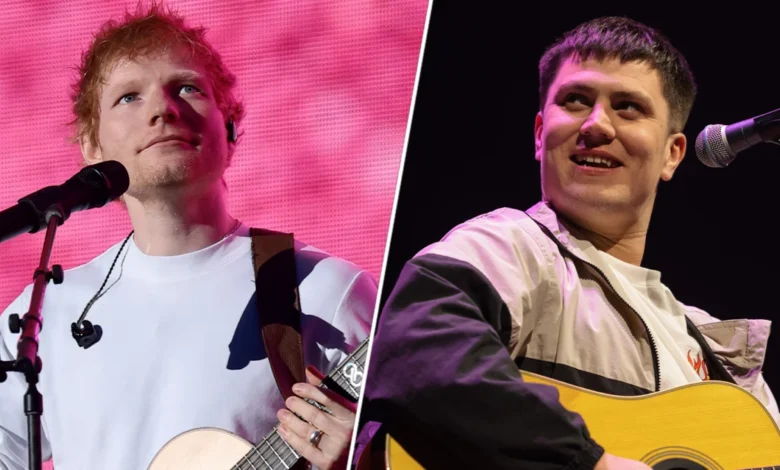
The recent collapse of Ed Sheeran’s "Loop Tour" following the controversial removal of hip-hop artist Macklemore has ignited a firestorm of debate regarding the intersection of live entertainment, corporate influence, and political expression. While the tour, which had become a prominent fixture in the global music circuit, has effectively shuttered due to a mass exodus of supporting acts, the narrative has shifted from the cancellation itself to the culpability of those involved. Central to this discourse is singer-songwriter Aaron Rowe, who, despite resigning from the tour, has publicly exonerated Sheeran, characterizing the decision to drop Macklemore as a "human error" prompted by external pressures from venue ownership.
The Chronology of the Dispute
The controversy stems from an incident earlier this month when Macklemore, while performing as an opener for Sheeran, made explicit, high-profile remarks supporting the "Free Palestine" movement. The fallout was swift. According to reports, Robert Kraft—the owner of Gillette Stadium and a prominent figure in the sports and entertainment industry—issued an ultimatum to the tour organizers. The demand was clear: remove Macklemore or face consequences regarding venue access for the remainder of the tour.
On Monday, Sheeran’s camp confirmed that Macklemore had been removed from the lineup. Shortly thereafter, Sheeran released a formal statement attributing the decision to the tour’s promoters, noting that venue owners had exerted significant pressure to terminate the engagement following the artist’s political statements.
The reaction from the touring party was immediate and decisive. By the end of the week, Aaron Rowe, along with high-profile artists such as Finneas and the band Lukas Graham, announced their withdrawal from the tour. The band Beoga, which has served as a cornerstone of Sheeran’s live sound, also pulled out, effectively dismantling the infrastructure of the production.
Aaron Rowe’s Defense and the Call for Accountability
In a video statement released on Instagram, Aaron Rowe challenged the public’s focus on Sheeran, arguing that the British pop star was a victim of a high-stakes power dynamic rather than the architect of censorship.
"I think you are all focusing on the wrong person here," Rowe stated in the video. "All I keep hearing is Ed Sheeran this, Ed Sheeran that, but you really should be focusing on the likes of Robert Kraft."
Rowe’s defense rests on the premise that Sheeran’s team acted out of a state of "panic" when confronted with the ultimatum. He suggests that the decision-making process was compromised by the immense pressure of navigating a multi-venue tour where owners hold significant leverage over artists. Rowe emphasized that Sheeran’s history of supporting a diverse range of artists—many of whom are explicitly pro-Palestine—contradicts the narrative that Sheeran acted out of personal malice or ideological alignment with the venue owners.
"If Ed Sheeran was a Zionist, why would he have all these people on the tour?" Rowe questioned, highlighting the ideological consistency of the lineup before the recent purge. "It was human error. I know Ed Sheeran has done so much for so many people… all he has inside of him is kindness."
The Role of Corporate Influence in Live Entertainment
The incident has opened a broader conversation regarding the role of venue owners and corporate sponsors in regulating the content of live performances. In the modern music industry, artists are often bound by "morality clauses" or tacit agreements with venue owners, who prioritize their corporate image and stakeholder relations.
Robert Kraft, as the owner of Gillette Stadium, represents the intersection of private sector power and public-facing entertainment. By leveraging the ability to shut down performances, stakeholders like Kraft possess the capacity to dictate the limits of permissible speech within privately held but publicly accessible spaces. Critics argue that this creates a chilling effect on artistic expression, where performers are forced to choose between their political convictions and their professional livelihood.
Rowe’s call to "plaster Robert Kraft’s face everywhere" underscores a growing movement among artists to hold industry gatekeepers accountable for censorship. "In the music industry, there are people with so much money and power that they’re able to basically shut down any opinion they don’t agree with," Rowe asserted.
Broader Industry Implications
The cancellation of the Loop Tour sets a significant precedent. For major touring acts, the loss of support from established opening artists often renders the production unviable. Furthermore, the public nature of these departures serves as a signal to the industry that artists are increasingly willing to sacrifice large-scale touring revenue to maintain their political integrity.
Data from recent concert industry trends suggest that artists are facing heightened scrutiny from both fans and stakeholders regarding their stance on the Israel-Hamas conflict. With social media allowing for instant global visibility of onstage comments, the margin for error for tour management has narrowed considerably. Promoters and venue owners are now grappling with how to mitigate "reputational risk," while artists are grappling with the limitations of their own free speech.
The exit of artists like Finneas and the band Beoga indicates that the decision to remove Macklemore was viewed by many within the industry as a crossing of a professional "red line." By choosing to walk away, these artists have effectively signaled that the autonomy of the performer is non-negotiable.
Fact-Based Analysis of the Fallout
The departure of the openers and the backing band has created a logistical and financial vacuum for the remainder of the tour. Typically, tours of this scale involve complex insurance policies, contractual obligations, and non-refundable deposits with venue operators. The breach of these contracts due to political disagreements creates a legal quagmire that will likely result in litigation.
Moreover, the incident highlights a fundamental shift in the power dynamic of touring. Historically, the artist was the primary entity, with venue owners serving as service providers. However, as venue consolidation continues—with major corporations owning multiple stadium and arena assets—the leverage has tipped toward the infrastructure providers. The "Gillette Stadium incident" serves as a case study in how this consolidation can lead to the suppression of dissent when an artist’s message conflicts with the interests of the venue’s ownership.
Looking Ahead
As the music industry processes the fallout, the question remains whether this incident will lead to more robust protections for artists in their contracts regarding political speech. Currently, most standard touring agreements prioritize the venue’s right to maintain a "neutral" or "safe" environment, a term that is increasingly being interpreted as a mandate to remove controversial content.
For Ed Sheeran, the task of rebuilding his tour or addressing the reputational damage will be substantial. While his supporters, such as Rowe, are attempting to frame the incident as a singular, panicked mistake, the public perception remains divided. The incident has solidified a trend where the personal politics of the performer are no longer separate from the commercial enterprise of the tour.
In conclusion, the collapse of the Loop Tour is more than a scheduling conflict; it is a symptom of a deeply polarized era. The confrontation between Macklemore’s activism and the venue’s authority, mediated through the forced hand of Ed Sheeran, serves as a harbinger for future challenges in the live entertainment industry. As artists navigate the pressures of global conflicts, the industry will need to establish new norms that balance the rights of property owners with the artistic freedom of those who step onto the stage. For now, the silence left by the departed acts serves as a powerful testament to the ongoing tension between commerce and conscience.