America’s Crumbling Classrooms: A GAO Report Reveals Billions in Deferred Maintenance and Severe Facility Crises Nationwide

School districts across the United States are grappling with a profound infrastructure crisis, spending an estimated $214 billion—or roughly 22% of their collective budgets—on operations, maintenance, capital improvements, and bond interest expenses for the 2024–25 academic year, according to a recent report by the Government Accountability Office (GAO). Despite these substantial expenditures, a majority of school officials report that available funding falls woefully short of addressing mounting maintenance and repair needs. The GAO report, which draws upon U.S. Census Bureau data, site visits, and surveys of education and facility leaders, highlights a pervasive nationwide struggle with outdated, decaying, and environmentally compromised school buildings that directly impact student learning, teacher retention, and overall health.
The findings paint a grim picture of daily educational environments where leaky roofs, failing HVAC systems, and extreme temperature fluctuations have become the norm rather than the exception. Just under half of all U.S. school districts are currently managing chronic facility issues, most notably water intrusion from damaged roofs and severe thermal discomfort inside classrooms. These infrastructural failures not only disrupt instruction but have escalated into hazardous conditions requiring medical intervention for both students and staff. As school leaders attempt to navigate these complex challenges, they face significant financial roadblocks, including restrictive local tax bases, inadequate state funding formulas, and predatory vendors seeking to capitalize on desperate districts.
The Scope of the Financial Deficit and Funding Hurdles
The fundamental driver of America’s school infrastructure crisis is a widening gap between capital needs and available revenue streams. During the 2024–25 school year, districts poured billions into upkeep, yet over half of local educational agency officials stated that their operational and capital budgets remain insufficient. While issuing municipal bonds is a traditional mechanism for funding large-scale capital improvements, securing these funds is exceptionally difficult for districts located in economically disadvantaged regions.
The GAO report underscores that a low local tax base hinders efforts to fund school facility needs in approximately 55% of districts nationwide. This burden falls disproportionately on rural school systems, which frequently lack the commercial property wealth or high residential property values required to pass substantial bond measures. Consequently, rural students are often left in deteriorating buildings that local tax revenues cannot sustain.
Federal funding offers little relief. Financial support from the federal government for school infrastructure is minimal, typically restricted to narrowly defined purposes and distributed over limited, short-term windows. At the state level, districts encounter similar administrative and legislative barriers. An estimated 73% of school districts reported that limited state formula funding for facilities severely hindered their ability to meet basic repair and modernization needs. State aid packages frequently fail to account for inflation, escalating construction costs, or the sheer age of facilities constructed during the mid-20th-century baby boom.
Chronic Infrastructure Failures: Water Intrusion and Temperature Extremes
The physical manifestations of underfunded school facilities are widespread and damaging to the educational mission. Nearly 50% of districts contend with persistent building failures, chief among them being water intrusion and inadequate climate control.
Roof maintenance provides a stark example of how budgetary constraints force districts into reactive, short-term fixes rather than permanent solutions. Full roof replacements often require millions of dollars—sums that many districts simply do not possess. As a result, facility managers are forced to patch aging roofs repeatedly.
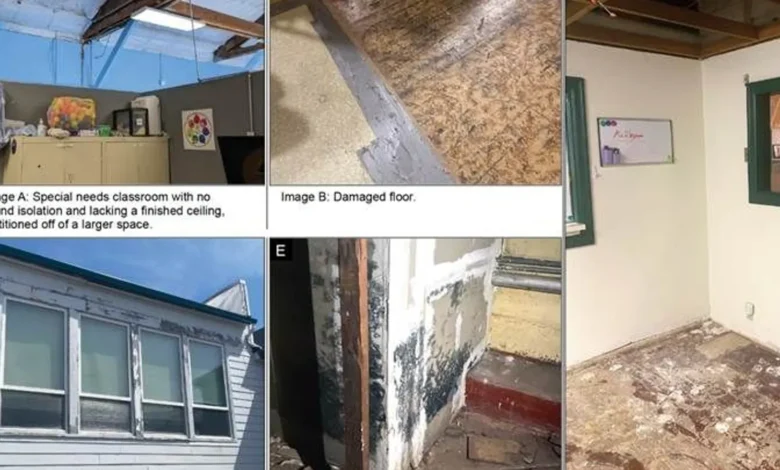
The consequences of deferred roof replacements are visible throughout affected schools. Inspectors and visitors observed damaged ceilings, warped floors, and compromised electrical systems resulting from persistent leaks. Teachers frequently report severe disruptions. In one instance highlighted by the GAO, an educator described a heavy rainstorm creating a "little waterfall" directly inside her classroom, distracting students and creating a potentially hazardous electrical environment.
Simultaneously, outdated or failing heating, ventilation, and air conditioning (HVAC) systems have left classrooms vulnerable to extreme temperature swings. Depending on outdoor weather conditions and the time of year, indoor temperatures can soar past 90 degrees Fahrenheit or plummet below 60 degrees.
These extreme environments severely impede academic performance and cognitive function. When indoor temperatures peak, schools often lack the mechanical cooling capacity to maintain a habitable space. The GAO documented instances where teachers and students were forced to abandon traditional classrooms entirely, relocating to cooler common areas such as cafeterias or holding classes outdoors. While some educators adapted by moving instruction outside, others noted that relocation was so disruptive to lesson plans that they attempted to endure the stifling indoor heat, despite the adverse effects on student focus and health.
Health, Safety, and Human Toll
The deterioration of public school infrastructure extends far beyond mere discomfort, posing tangible risks to the physical health and safety of students and educators. The GAO report revealed that 13% of school districts experience chronic problems with students and staff reporting physical discomfort and illness directly linked to classroom environmental conditions.
The human cost of these structural failures is underscored by documented medical emergencies. In one case cited in the report, a school employee suffered heat exhaustion while teaching in an excessively hot classroom and required emergency hospitalization. In another district, a teacher reported that chronic respiratory health problems were severely exacerbated by widespread indoor mold and inadequate ventilation systems.
Air quality issues, often exacerbated by chronic water leaks and outdated ventilation infrastructure, contribute to elevated rates of absenteeism among students with asthma and other respiratory conditions. Furthermore, persistent thermal discomfort, poor lighting, and distracting building noises combine to lower staff morale, exacerbating existing teacher retention crises and making it increasingly difficult to recruit qualified educators to districts with substandard facilities.
Coping Strategies and Preventive Maintenance Successes
Despite widespread systemic challenges, certain school districts have successfully managed their facilities by shifting toward strategic, proactive maintenance models. The GAO report highlights that districts maintaining functional and safe buildings have prioritized preventive maintenance and developed internal technical expertise to maximize limited resources.
In one notable example, a district facilities director spearheaded a multi-year initiative—backed by the chief financial officer—to install sophisticated utility monitoring systems across all schools. This technology enabled the maintenance team to optimize energy consumption, track building performance in real time, and detect mechanical failures before they escalated into catastrophic system breakdowns. Although this approach required a significant upfront capital investment, it ultimately yielded annual savings of hundreds of thousands of dollars, freeing up operational funds for other critical needs.
Furthermore, school leaders emphasized the vital importance of cultivating in-house facilities expertise. Knowledgeable staff members play a crucial role in evaluating contractor proposals and ensuring that capital is spent effectively. District leaders cautioned against unscrupulous commercial vendors who target cash-strapped school systems with promises of guaranteed cost savings through proprietary energy-efficiency or building-control packages. In many cases, the projected financial returns promoted by these vendors failed to materialize, underscoring the necessity of independent oversight and technical acumen within school administration.
Broader Implications for American Education
The findings of the GAO report arrive at a critical juncture for American public education, highlighting a systemic disinvestment in the physical foundations of learning. As schools navigate the post-pandemic landscape, address chronic absenteeism, and strive to accelerate academic recovery, the physical condition of school buildings remains a foundational prerequisite that cannot be overlooked.
Education policy experts and economists note that safe, thermally regulated, and well-maintained facilities are not merely a matter of aesthetic preference or comfort; they are integral to educational equity. Disparities in facility quality along socioeconomic and geographic lines exacerbate existing achievement gaps, disproportionately penalizing low-income and rural students who attend schools with crumbling infrastructure.
Addressing the national school maintenance backlog will require a coordinated policy response involving increased state-level funding formulas, targeted federal assistance for high-need and rural districts, and innovative financing mechanisms that do not rely exclusively on local property wealth. Without comprehensive intervention, millions of American students will continue to learn in environments that fail to meet basic standards of safety, health, and operational reliability.