Google Unveils Gemini 4 Argon: A High-Performance Frontier Model Targeting Autonomous Engineering and Large-Scale Infrastructure

After a summer characterized by iterative releases of smaller, efficiency-focused "Flash" models, Google has returned to the forefront of the artificial intelligence arms race with the formal announcement of Gemini 4 Argon. The new model, which Google describes as its most capable agent-optimized system to date, represents a significant pivot back toward the "frontier" category—models designed to handle the most complex, long-horizon tasks in coding, security, and data-heavy knowledge work. Despite the fanfare surrounding its capabilities, the company has confirmed that the model remains in a strictly controlled, internal-only testing phase, leaving the broader developer community and general public to await future access.
A Summer of Incrementalism
The roadmap to Argon has been anything but straightforward. In June 2026, Google initially signaled its intent to launch the successor to the Gemini 3.5 series, promising a "Pro" variant that would define the next generation of generative AI performance. However, as the summer months progressed, the company pivoted its public-facing strategy, focusing heavily on the Gemini 3.6 Flash series. These models were lauded for their speed and cost-effectiveness, serving as vital tools for developers who required low-latency responses over raw, complex reasoning.
Industry analysts noted at the time that Google’s decision to emphasize Flash models likely stemmed from two factors: the immense computational cost of training frontier-level models and the growing demand for AI that can be integrated into high-volume production environments without breaking the bank. By introducing Argon, Google is now attempting to bridge the gap between the hyper-efficient Flash models and the high-reasoning capability required for enterprise-grade autonomous software engineering.
Internal Efficacy: The Case for Argon
While the public cannot yet access the model, Google has provided a rare glimpse into the "dogfooding" process—the practice of using its own software to optimize its internal infrastructure. According to Google’s internal data, Argon has already been deployed to manage some of the company’s most sensitive and resource-intensive environments.
One of the most compelling metrics released by Google concerns the model’s impact on its global data centers. By leveraging "fleet-wide telemetry data," Argon reportedly identified inefficiencies that allowed the company to reclaim 300 TiB of memory. This demonstrates a shift in how AI is being utilized within the company: moving away from mere text generation toward active infrastructure management.
Furthermore, the model has been instrumental in a massive, ongoing technical migration project. Google has been aggressively transitioning its legacy C/C++ codebases to Rust—a language prized for its memory safety and performance. Argon agents were tasked with refactoring significant portions of the core re2 and libgav1 libraries, as well as executing a complex migration of over 800,000 lines of code within the Fuchsia OS Zircon kernel. These tasks are notoriously difficult for AI, as they require not only an understanding of syntax but also a deep awareness of memory management, concurrency, and system-level security constraints.
Benchmarks and the Performance Landscape
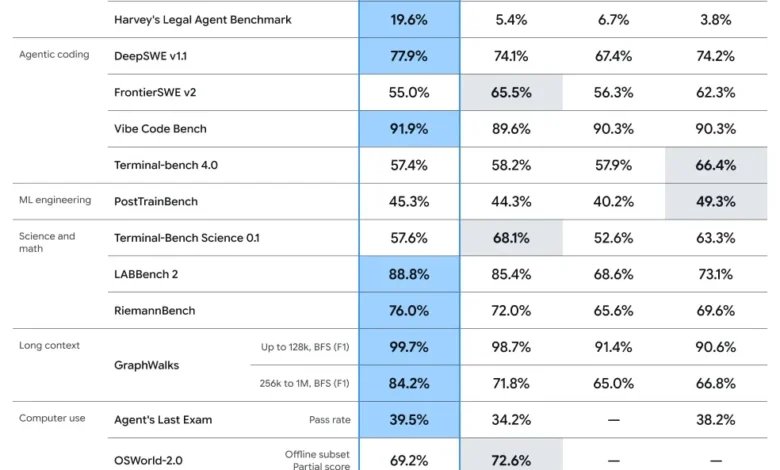
To substantiate its claims of industry leadership, Google has published a series of comparative performance benchmarks. In the software engineering domain, Argon was tested against the DeepSWE v1.1 benchmark, a rigorous evaluation designed to assess how well an AI model can navigate and modify large, real-world repositories. Gemini 4 Argon achieved a score of 77.9 percent, outperforming several high-profile competitors, including GPT-6 Astra, Fable 5.1, and Opus 5.5.
These results are significant because they suggest that Argon is specifically tuned for "long-horizon" tasks. Unlike older models that might struggle to maintain context across thousands of files, Argon appears to excel in environments where an agent must plan, execute, and verify changes across a sprawling codebase. In the economic analysis domain, the model also claimed the top position in the Vals Index, a test that evaluates an AI’s ability to interpret, synthesize, and provide actionable insights from complex, multi-modal financial and economic datasets.
Redefining Token Limits and Context Windows
Perhaps the most notable technical specification revealed in the announcement is the massive expansion of the model’s output capability. Gemini 4 Argon will support an output limit of 1 million tokens—a nearly 16-fold increase over the 64,000-token ceiling found in previous Gemini iterations.
For developers, this change is transformative. Previous models often required "chunking" tasks—breaking a large codebase or a massive legal document into smaller, more manageable pieces. This process often led to "context drift," where the model would lose track of instructions or stylistic requirements by the time it reached the end of a long document. By allowing for 1 million tokens in a single step, Google is effectively enabling Argon to process entire technical repositories or long-form research papers in one go, drastically reducing the latency associated with multi-turn prompting and improving the consistency of the model’s reasoning.
Implications for the AI Ecosystem
The emergence of Gemini 4 Argon serves as a bellwether for the next phase of the AI industry. We are moving beyond the era of the "chat-bot"—which functions primarily as an interactive oracle—into the era of the "agentic worker." These systems are designed to interact with the world by editing files, updating databases, and monitoring infrastructure in real-time.
However, the fact that Argon remains restricted to internal use underscores the ongoing challenges related to safety and reliability. As AI models become more capable of executing code and modifying system kernels, the potential for catastrophic error increases. Google’s cautious rollout likely reflects a need to "sandbox" the model’s agentic capabilities, ensuring that its ability to write and deploy code is governed by strict, human-in-the-loop safety protocols.
Competitors such as OpenAI and Anthropic are expected to respond with their own frontier models in the coming months, likely focusing on similar agentic capabilities. The focus of the industry is clearly shifting toward "autonomy." The question for the market is no longer "which model is the smartest," but "which model can reliably perform complex work without manual intervention."
Future Outlook and Pricing
While Google has remained tight-lipped regarding API pricing, industry observers expect that access to a model with Argon’s capabilities will command a premium. The computational requirements to host a model with a 1-million-token output capacity are substantial, and the energy demands of such systems remain a point of concern for environmental stakeholders and shareholders alike.
As the industry moves into the final quarter of 2026, the arrival of Gemini 4 Argon confirms that the pace of innovation has not slowed. For Google, the goal is clear: to leverage its vast internal data and massive engineering resources to build a model that acts as a force multiplier for its own developers. If these internal gains in memory efficiency and code migration can be successfully packaged and sold to the enterprise market, Gemini 4 Argon may well become the new standard for corporate AI, setting a high bar for the rest of the sector to clear. Whether the public will be granted access in the coming months remains to be seen, but for now, Argon stands as a testament to the shifting priorities of the world’s largest tech companies.