Hidden Earth: Why Protecting Global Fungal Networks Is Essential for Climate Stability and Biodiversity

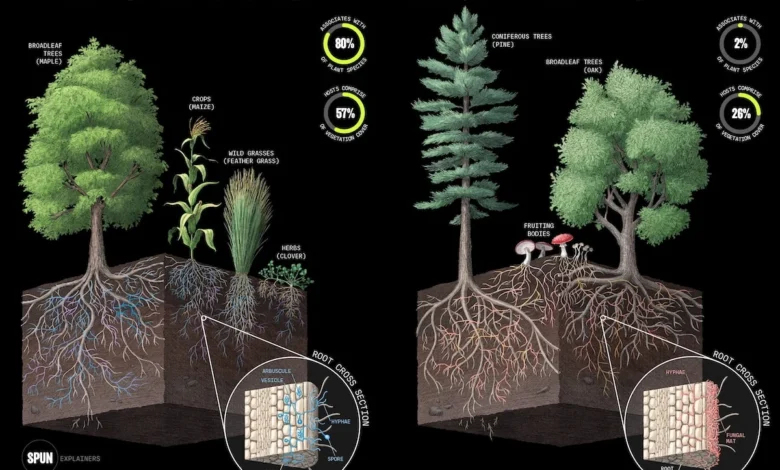
Beneath our feet lies a vast, complex, and largely invisible biological infrastructure that serves as the literal foundation for life on Earth. A groundbreaking study published in the journal Nature has revealed that the planet’s mycorrhizal fungal networks—the symbiotic systems that connect plant roots to soil—are under-represented in global conservation strategies, putting the future of ecosystem stability at significant risk. Researchers from the Society for the Protection of Underground Networks (SPUN) have utilized advanced mapping technology to identify biodiversity hotspots for these fungi, concluding that approximately 90 percent of these critical areas currently reside outside of established protected zones.
The research represents a paradigm shift in how environmental scientists view soil health. Mycorrhizal fungi operate as a planetary circulatory system, facilitating the exchange of essential nutrients between soil and vegetation. By creating intricate subterranean webs, these organisms help plants absorb water, resist pathogens, and survive in nutrient-poor environments. Perhaps most importantly, they act as massive carbon sinks. According to data analyzed by the SPUN team, these fungal communities are responsible for sequestering more than 13 billion tons of carbon dioxide annually, a figure equivalent to roughly one-third of global fossil fuel emissions.
A History of Overlooked Infrastructure
For centuries, conservation efforts have been almost exclusively focused on "above-ground" features. Mountain ranges, forest canopies, and oceanic currents have been mapped and protected with rigorous international frameworks. In contrast, the underground world has remained a scientific blind spot. The history of this oversight is rooted in what researchers call "fungus blindness"—a systemic cognitive bias that prioritizes visible, charismatic megafauna and flora over the microscopic, non-charismatic organisms that underpin them.
The timeline of this shift in focus began in earnest around 2021, when SPUN launched its global mapping initiative. The goal was to aggregate biological data from diverse ecosystems to create the world’s first high-resolution predictive maps of fungal communities. The process involved synthesizing over 2.8 billion fungal sequences collected from 130 countries. This Herculean data-processing task culminated in the recent publication in Nature, which formally maps these biodiversity hotspots and highlights the dangerous disconnect between where the most important fungi live and where current conservation efforts are directed.
The Mechanics of Symbiosis and Climate Resilience
To understand why these networks are vital, one must look back 450 million years. During the early colonization of land by plants, mycorrhizal fungi were the facilitators. Without these symbiotic partners, plants would not have been able to extract minerals from bare rock or survive the harsh terrestrial conditions of the ancient world. This evolutionary history underscores the fact that modern agriculture, forestry, and ecosystem restoration are inherently dependent on the legacy of these fungal connections.

The current research highlights two primary categories of these organisms: arbuscular mycorrhizal and ectomycorrhizal fungi. Both play distinct roles in the carbon cycle. When these networks are disrupted—through intensive tilling, chemical fertilization, or deforestation—the carbon they have stored can be released back into the atmosphere, turning a vital carbon sink into a carbon source. Furthermore, the loss of these networks renders ecosystems less resilient to the ongoing climate crisis. In an era of extreme weather events, from prolonged droughts to catastrophic floods, healthy fungal networks provide the soil structure necessary to hold water and prevent erosion, essentially acting as a natural buffer against the volatility of climate change.
Quantitative Evidence and Geographic Distribution
The data provided by the SPUN study is sobering. Of the identified biodiversity hotspots, only 9.5 percent are located within existing protected areas. This suggests that the vast majority of the world’s most unique underground fungal communities are vulnerable to land-use changes, such as agricultural expansion, urban development, and industrial mining.
The distribution of these hotspots is global, covering diverse biomes. Notable examples include the Guinean forests of West Africa, the temperate rainforests of Tasmania, and the Cerrado savanna in Brazil. Each of these regions harbors endemic fungal taxa that cannot be easily replicated or restored if they are lost. The study utilized a dataset of over 40,000 specimens, but researchers estimate that this represents only a fraction of the total diversity, as less than 0.001 percent of the planet’s surface has been thoroughly sampled for subterranean fungal life.
Official Responses and Expert Commentary
Dr. Toby Kiers, Executive Director of SPUN, has been vocal about the necessity of incorporating underground mapping into policy decisions. "For centuries, we’ve mapped mountains, forests, and oceans. But these fungi have remained in the dark, despite the extraordinary ways they sustain life on land," Kiers noted. The scientific community has largely echoed these sentiments, noting that the maps provided by SPUN are more than just academic tools; they are actionable blueprints for governments and conservation NGOs.
Dr. Merlin Sheldrake, serving as Impact Director at SPUN, emphasized that these tools are designed to alleviate "fungus blindness." By providing policy-makers with empirical data on where these networks are most at risk, the organization hopes to inform the designation of new "underground conservation corridors." The project has garnered significant support from high-profile conservationists, including Jane Goodall, as well as influential authors and researchers like Michael Pollan and Giuliana Furci. Their collective support aims to ensure that underground biodiversity reaches the same level of prominence in environmental policy as satellite imagery of surface-level forest cover.
Broader Implications for Global Policy

The implications of this research extend into the realms of food security and international climate targets. As nations strive to meet their Nationally Determined Contributions (NDCs) under the Paris Agreement, the role of soil health has often been marginalized. By integrating mycorrhizal data into land management practices, countries can improve crop yields without relying on synthetic fertilizers, which are notorious for their high carbon footprint and potential to disrupt natural soil microbial communities.
Furthermore, the "Underground Explorers" initiative—a network of nearly 100 researchers across 80 countries—is currently engaged in a race against time to document these ecosystems before they are permanently altered. Their work in regions like Bhutan, Mongolia, Ukraine, and Pakistan serves as a model for decentralized, collaborative science. By training local researchers and establishing standardized protocols for fungal sampling, SPUN is building a global framework for soil stewardship that transcends geopolitical boundaries.
Restoration and Future Outlook
The transition from theory to practice remains the most significant challenge. Traditional ecological restoration has often focused on replanting trees, yet such efforts frequently fail when the necessary fungal partners are absent from the soil. Dr. Alex Wegmann of The Nature Conservancy has pointed out that "restoration practices have been dangerously incomplete because the focus has historically been on life aboveground." The new maps provide quantitative targets for restoration managers, allowing them to assess the health of the soil microbiome before and during reforestation or rewilding projects.
As the world continues to grapple with the multifaceted impacts of the climate crisis, the "invisible" work of fungi is becoming increasingly visible to the scientific and policy-making communities. The goal, according to Jason Cremerius, SPUN’s chief strategy officer, is to make underground biodiversity as fundamental to environmental decision-making as satellite imagery.
Ultimately, the preservation of these networks is not merely an act of conservation for the sake of science; it is an act of self-preservation for humanity. By safeguarding the organisms that sustain our food systems, regulate our water cycles, and store our atmospheric carbon, we are securing the biological infrastructure that has allowed life to thrive on this planet for nearly half a billion years. The findings published in Nature serve as a call to action, demanding that the international community expand its definition of what constitutes a protected area to include the depths beneath our feet. As the data clearly shows, we cannot protect the surface if we continue to ignore the foundation upon which it rests.