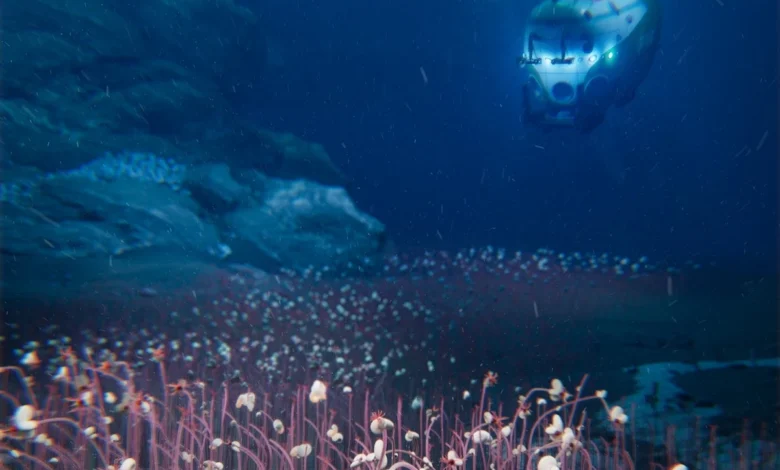
In a landmark achievement for deep-sea exploration, a team of scientists led by the Institute of Deep-sea Science and Engineering at the Chinese Academy of Sciences has identified the deepest and most extensive chemosynthesis-based community ever documented. Utilizing the manned submersible Fendouzhe, researchers explored the abyssal depths of the Mariana, Kuril-Kamchatka, and western Aleutian trenches, discovering a thriving ecosystem of mollusks, tubeworms, and crustaceans nearly six miles beneath the surface of the Pacific Ocean. This discovery fundamentally alters scientific understanding of carbon cycling in hadal zones and suggests that life at the extreme limits of planetary pressure is far more resilient and widespread than previously hypothesized.
The Frontiers of the Hadal Zone
The hadal zone, named after the Greek underworld Hades, comprises the deepest trenches on Earth, typically ranging from 6,000 to 11,000 meters (approximately 3.7 to 6.8 miles) below sea level. For decades, these regions were considered biological deserts, characterized by crushing pressures exceeding 1,000 times that of sea level, near-freezing temperatures, and total darkness.
While previous expeditions, including the historic 1960 Trieste descent and James Cameron’s 2012 Deepsea Challenger mission, confirmed the presence of isolated, hardy organisms like amphipods, the complexity of the newly discovered communities marks a significant departure from these findings. The Fendouzhe expedition recorded vast, vibrant colonies of siboglinid Polychaeta (tubeworms) and Bivalvia (clams and mussels) spanning a massive geographical range of over 1,500 miles. These organisms are not merely surviving; they are thriving in a high-density, complex social structure that relies entirely on chemical energy rather than the sun.
A Chronology of the Expedition
The discovery was the result of a rigorous, multi-year scientific campaign. During the 2024 calendar year, the Fendouzhe submersible completed 23 distinct dives into the Mariana Trench alone. These missions were designed to map the geological features of the seafloor and identify potential "oases" of life.
- Early 2024: Planning and logistical deployment of the Fendouzhe submersible, a vessel designed to withstand the extreme pressures of the deepest oceanic trenches.
- Mid-2024: The commencement of the 23-dive campaign in the Mariana Trench. High-resolution imaging systems and robotic sampling arms were deployed to document the seafloor.
- Late 2024: Discovery of extensive microbial mats and associated macrofauna in areas previously thought to be devoid of life.
- July 2025: Formal publication of the findings in the journal Nature, providing the first comprehensive isotopic and biological analysis of the trench communities.
The Mechanics of Chemosynthetic Survival
The absence of sunlight at depths of nearly six miles renders photosynthesis impossible. Instead, the organisms discovered by the Chinese Academy of Sciences rely on chemosynthesis. Isotopic analysis conducted by the research team confirms that these communities are sustained by fluids rich in hydrogen sulfide and methane. These chemicals are transported along active geological faults that traverse deep sediment layers.
The process is self-sustaining: methane is produced microbially from deposited organic matter, which in turn feeds the mats of bacteria. These bacteria serve as the primary food source for the larger animals, such as the foot-long tubeworms and clam colonies observed by the researchers. The clustering of these species around microbial mats suggests a highly evolved symbiotic relationship, mirroring the biological activity seen in hydrothermal vents, but occurring on a scale and at a depth previously considered unsustainable for such complex life.
Supporting Data and Scientific Analysis
The data gathered from the Fendouzhe missions provides a new baseline for oceanographic research. The study reports that these communities exist at depths ranging from 3.6 to 5.92 miles. The sheer density of the population—thousands of bivalves and diverse invertebrate species—challenges the "isolated pocket" theory of deep-sea biology.

Lead author Xiatong Peng noted that the geological similarities between these trenches and other, as-yet-unexplored hadal zones suggest that such communities may be a standard feature of the deep-ocean floor rather than an anomaly. The discovery forces a re-evaluation of current carbon cycling models. If these vast communities exist across the global trench system, they represent a significant, previously unaccounted-for sink for deep-sea carbon, playing a larger role in the planet’s climate regulation than current oceanic models reflect.
The Debate Over Deep-Sea Mining
This scientific breakthrough arrives at a politically sensitive time. As nations and corporations look toward the seafloor for critical minerals—such as cobalt, nickel, and manganese—needed for the global transition to renewable energy, the discovery of thriving ecosystems at these extreme depths provides new ammunition for conservationists.
Marine biologists argue that the existence of such complex, fragile life in the "last wild zone" of the planet demonstrates that the ocean floor is not a barren, static wasteland. The International Seabed Authority (ISA) is currently embroiled in debates regarding the implementation of regulations for deep-sea mining. Critics of the industry point to the Fendouzhe findings as evidence that the potential for irreversible ecological destruction is far higher than previously estimated. The risk of destroying an entire, undiscovered food web—one that potentially serves as a key component of the deep-sea carbon cycle—remains a central concern in ongoing international negotiations.
Implications for Future Exploration
The success of the Fendouzhe submersible underscores the importance of advanced human-piloted and robotic technology in deep-sea research. As co-author Mengran Du noted, the dive experience is akin to "traveling through time," with each descent revealing layers of the Earth’s history and biology that have remained shielded from human influence for millennia.
The implications of this study are twofold. First, it expands the definition of "habitable zones" on Earth, proving that high-pressure, low-temperature environments can support significant biomass. This has immediate relevance to the field of astrobiology; if life can thrive in the high-pressure, chemically-rich environments of the Mariana Trench, the likelihood of finding similar life forms on ocean-covered moons within our solar system, such as Europa or Enceladus, increases significantly.
Second, the findings emphasize the necessity of increased international cooperation in oceanic exploration. With the majority of the hadal zone remaining unmapped, the scientific community is now calling for a coordinated effort to survey other trenches to determine if the Mariana Trench discovery is part of a global, interconnected deep-sea biological network.
As researchers continue to analyze the data, the discovery serves as a reminder of how much remains unknown about the planet. The "alien" landscape described by past explorers is, in reality, a vibrant, interconnected world that operates on a timescale and in a dimension entirely distinct from the terrestrial surface. The Fendouzhe expedition has not only set a new record for depth; it has fundamentally expanded the biological map of the world, ensuring that future deep-sea research will be guided by the knowledge that the ocean’s darkest valleys are, in fact, teeming with life.