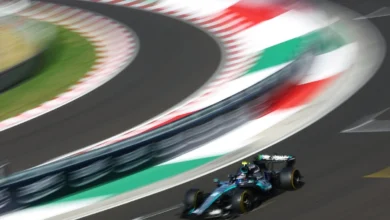
Max Verstappen surges to the top in final Azerbaijan Grand Prix practice as Baku street circuit challenges intensify

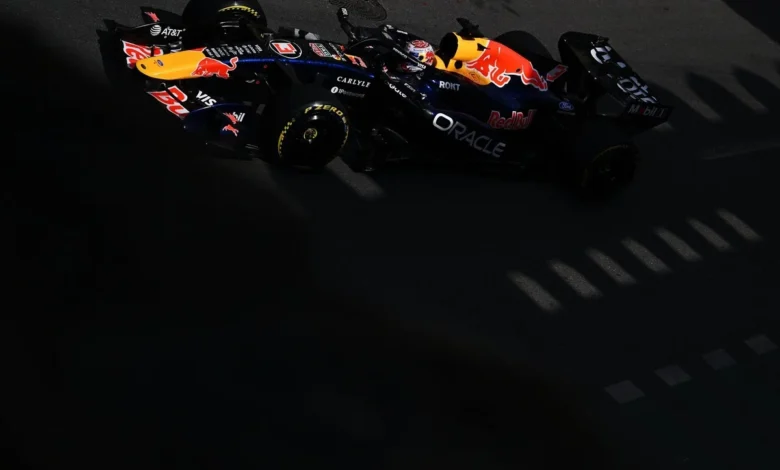
Max Verstappen defied the prevailing narrative of Mercedes’ dominance in Baku by clocking the fastest time in the third and final practice session for the Azerbaijan Grand Prix. On a street circuit known for its unforgiving walls and unique aerodynamic requirements, the Red Bull Racing driver utilized a perfectly timed slipstream during the closing moments of the one-hour session to edge out his rivals. His performance, a 1m43.922s, served as a potent reminder of the reigning champion’s ability to extract peak performance when it matters most, even as his RB20 struggled with handling characteristics that he vividly described as "jumping like a kangaroo."
The session, which serves as the final dress rehearsal before the all-important qualifying hour, unfolded under conditions that were significantly more volatile than those experienced during Friday’s running. Gusting winds across the Caspian Sea-adjacent circuit turned the Baku City Circuit into a treacherous playground, forcing drivers to contend with an unpredictable car balance that caught out several members of the grid.
A Session Defined by Strategic Slipstreaming
As the field transitioned from race-pace simulations to low-fuel qualifying runs, the strategic importance of the 2km-long main straight became the session’s defining variable. At the Baku City Circuit, where the longest straight on the Formula 1 calendar demands a precise aerodynamic setup, finding a "tow"—or slipstream—from a leading car can be worth several tenths of a second.
The early stages of FP3 were relatively subdued, with the Alpine team initially setting the pace. However, as the track temperature fluctuated and the wind intensified, the major contenders began to assert their authority. Fifteen minutes into the session, Charles Leclerc moved to the top of the timing sheets with a 1m45.564s, signaling the Ferrari squad’s intent to maintain their strong form from the previous day.
However, the session was briefly disrupted when race control deployed a Virtual Safety Car (VSC) to remove debris—a stray tree branch—that had been blown onto the track. This interruption broke the rhythm for several drivers, including Verstappen, who had been struggling to find a consistent balance. Upon the restart, the battle for the top spot intensified between the Mercedes duo of George Russell and the rising star Antonelli, both of whom demonstrated impressive pace on the medium tyre compound before switching to the softs for their final performance runs.
The Mercedes Charge and Verstappen’s Late Response
Mercedes entered the weekend with a distinct aura of confidence, having shown ominous speed throughout the practice sessions on Friday. By the halfway point, Russell had firmly established himself as a pacesetter, posting a 1m44.715s on mediums. When the Silver Arrows eventually committed to the soft compound, their performance trajectory suggested they were the team to beat.
With 15 minutes remaining, Russell lowered the benchmark to 1m44.177s, eventually refining it further to a 1m44.021s. Throughout these runs, he was shadowed closely by his teammate, Antonelli, who finished just 0.252s behind him. At this juncture, the narrative seemed set for a Mercedes-dominated qualifying session.
Yet, Verstappen, who had spent much of the session struggling with the ride quality of his Red Bull, capitalized on a massive tow on his final flying lap. By tucking in behind a competitor on the long main straight, he managed to bridge the gap, crossing the line in 1m43.922s. This lap was a masterclass in opportunistic driving, though it served to mask what appears to be a genuine struggle with the RB20’s mechanical stability in low-speed corners.

Incidents and Operational Challenges
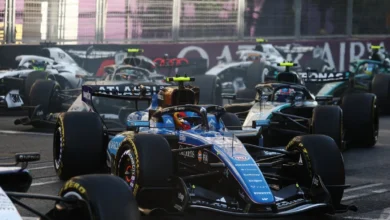
The Baku City Circuit is notoriously unforgiving, and FP3 provided a stark reminder of the consequences of even a minor misjudgment. The wind, which appeared stronger than it had been on Friday, exacerbated the drivers’ struggles with car balance.
Lance Stroll, representing Aston Martin, suffered a significant setback when he tagged the wall at Turn 1. The impact necessitated an immediate end to his session and forced him to abandon his car, likely creating a significant workload for his mechanics ahead of the qualifying session.
Verstappen himself was not immune to the circuit’s traps. His frustration was evident over the team radio as he reported that his car was "jumping like a kangaroo," a testament to the difficult ride height and suspension settings required to navigate the bumps of the historic city streets. He was forced to utilize the Turn 15 runoff area after a braking error, a fate shared by several other drivers who found the transition from high-speed straights to tight, technical corners to be particularly challenging under gusty conditions.
Implications for Qualifying and Race Strategy
The results of FP3 have left the grid in a state of high tension. While Verstappen claimed the top spot, the performance spread between the top three teams—Red Bull, Mercedes, and Ferrari—remains razor-thin.
- Max Verstappen (Red Bull): Despite his top time, the technical complaints regarding the car’s handling suggest that Red Bull is still searching for a "sweet spot" in their setup. If they cannot resolve the "kangarooing" effect, qualifying could prove to be an exercise in damage limitation.
- George Russell (Mercedes): Russell’s pace was arguably the most consistent of the field. His ability to go fast on both medium and soft compounds indicates that the Mercedes W15 is well-balanced for the Baku circuit. However, his lock-ups into Turn 1 and Turn 7 suggest he is pushing the car to the absolute limit of its adhesion.
- Ferrari and McLaren: Lewis Hamilton managed a late surge to finish third, keeping Ferrari firmly in the hunt. Meanwhile, McLaren’s muted performance—with Oscar Piastri and Lando Norris finishing seventh and eighth—has raised eyebrows. While the team introduced upgrades specifically designed to improve low-speed cornering, they have yet to unlock the raw pace required to challenge for pole position.
Broader Tactical Context
The Azerbaijan Grand Prix is a unique test for the 2024 grid. The combination of the ultra-long start-finish straight and the tight, 90-degree corners of the old city sector creates a classic "downforce vs. drag" dilemma for engineers. Teams must decide whether to run a lower-downforce configuration to maximize speed on the straight or a higher-downforce setup to gain time in the technical sectors.
The data from this final practice session suggests that the field has largely converged on a compromise setup. The fact that the top runners are separated by mere fractions of a second implies that the pole position will likely be decided by who can best manage tyre preparation—specifically the out-lap temperature—and who can secure the cleanest tow in the final sector.
Furthermore, the participation of Isack Hadjar in ninth and the continued development of Franco Colapinto (tenth) highlights the evolving landscape of the grid. As teams look to integrate young talent and test new components, the margin for error becomes even smaller.
Conclusion: The Calm Before the Storm
As the sun sets over Baku and the teams retreat to their garages to analyze the telemetry from this high-intensity hour, the competitive landscape remains fluid. Verstappen’s headline-grabbing lap has certainly put the rest of the field on notice, but the underlying performance of the Mercedes and Ferrari cars suggests that the fight for pole position will be one of the most closely contested of the season.
With the wind expected to remain a factor and the track surface evolving with every session, the qualifying hour later today will be as much about driver adaptability as it is about engineering precision. The Azerbaijan Grand Prix has long been known for its unpredictability, and if the final practice session is any indication, the streets of Baku are set to provide yet another dramatic chapter in the 2024 Formula 1 World Championship. For the fans, the message is clear: the gap between the championship leaders has never been smaller, and the streets of Baku remain the ultimate arbiter of who possesses the fastest machine this weekend.