This story was originally published in the August 11, 1994 issue of Rolling Stone.
The Santa Monica beachfront, a quintessential California scene of sun-kissed patrons and the rhythmic crash of waves, provided the backdrop for a decidedly unconventional tableau. At Gladstone’s, a renowned seafood institution synonymous with generous portions, the members of the influential rock band L7 were engaged in what they termed a "punk thing to do" – a celebratory feast of epic proportions. Platters piled high with lobster, clams, mussels, and shrimp, a veritable bounty fit to feed a nation, were delivered by a waitress whose attire, according to vocalist Donita Sparks, was a testament to the era’s fashion sensibilities.
"Ever since we signed to a major label, whenever we have any kind of meeting, we make them take us out for lobster," Sparks explained with an almost defiant cheerfulness, embodying the band’s established ethos of embracing the unconventional. This indulgence in extravagant seafood was not merely a culinary preference but a symbolic assertion of their hard-won success and a playful subversion of expectations.
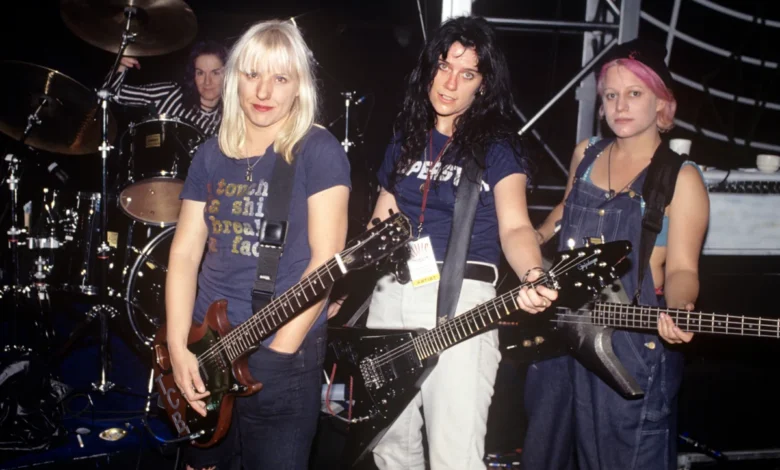
Bassist Jennifer Finch, sporting a cropped top that, like Sparks’, defied conventional modesty, offered her own observation. "Our waitress doesn’t have enough clothes on," she noted. Yet, in the context of L7’s visual presentation, Finch’s own ensemble, combined with her pierced navel, extensive tattoos, and a robust physique, projected an image that was less about overt sensuality and more about a confrontational, unapologetic self-possession. The members of L7, by design and by nature, stood out as a striking anomaly amidst the more conventional beachside clientele. Drummer Dee Plakas’s vibrantly green hair, a bold statement of individuality, and guitarist Suzi Gardner’s embrace of a ’70s-revival leather patch jacket, a piece of sartorial rebellion, further cemented their distinct aesthetic.
Emerging into an era dominated by grunge and the burgeoning riot grrrl movement, L7 found their sound and spirit deeply rooted in the raw, unadulterated energy of old-school punk rock. Their DIY, "fuck-you" attitude was a direct lineage from seminal acts like the Ramones, the Sex Pistols, and X. This punk inheritance manifested in their music through an inspired, often gloriously messy, and intensely energetic delivery. Sparks and Gardner wielded their guitars like formidable weapons, unleashing mean, squealing, and subversive riffs. Their lyrics, delivered with a tough, uncompromising edge, articulated a fierce, almost Thelma & Louise-esque feminism, a "blow-up-the-truck" defiance against societal constraints.
This sentiment was powerfully encapsulated in "Shirley," an anthemic track from their latest release, Hungry for Stink. The song samples a pivotal moment from the film Heart Like a Wheel, featuring drag racer Shirley Muldowney. When asked what a beautiful girl was doing racing in such a male-dominated arena, Muldowney’s laconic reply – "Winning" – is looped repeatedly, a mantra of female empowerment and a defiant rebuttal to gendered expectations.
"It was so ironic, because in the beginning, we used to get a lot of questions like that," Finch reflected, drawing a parallel between Muldowney’s experience and their own. "Woman in a man’s world, all that kind of crap." L7 consistently emphasized their refusal to be pigeonholed into categories like "foxcore" or narrowly defined "riot grrrls," pushing back against journalistic attempts to confine their identity.
Challenging Genre and Embracing Identity
Finch articulated a strong aversion to the categorization of music based on gender. "To create genre out of gender is just horrible to me," she stated. "I think journalism perpetuates that. I hope the story angles for L7 will eventually be the same as for Nirvana or Cracker. There’s a uniqueness in being a woman, but not that much." This desire for their music to be judged on its artistic merit, independent of their gender, underscored a sophisticated understanding of the media’s role in shaping perception.
Despite their reservations about being defined by their gender, L7 were not hesitant to use their femininity as a tool of provocation. A now-infamous incident at England’s Reading Festival in 1992 saw Sparks remove her tampon onstage and toss it into the astonished audience. This act, while shocking, was a potent, albeit unconventional, statement of bodily autonomy and a deliberate disruption of patriarchal norms. While Tampax never capitalized on the unique endorsement opportunity, Midol, whose cramp-relief products were listed on L7’s concert rider, did once send the band a substantial package of merchandise, a testament to the unexpected ways in which their actions resonated.
A Unified Front: The L7 Collective
Central to L7’s enduring strength was a formidable sense of camaraderie, a unity that rivaled that of any professional sports team. Their interactions were characterized by a shared dedication to their craft, their politics, and their collective identity. There were no individual "stars" within L7; they operated as a cohesive unit, eschewing individual interviews or photo shoots in favor of presenting a united front. This team-oriented approach was evident in their conversations, where they often finished each other’s sentences and engaged in a tapestry of inside jokes, a testament to their deep, shared history.
"Being misquoted happens to us a lot," Finch admitted, hinting at the challenges of navigating public perception. Her suspicion towards the interviewer, asking if the story was pitched or assigned and if the journalist had traveled from New York specifically for this interview, underscored their protective stance over their narrative and their image.
Roots in the Los Angeles Underground
L7’s origins trace back to the mid-1980s in Los Angeles, a fertile ground for burgeoning punk and alternative scenes. They honed their sound at the residence of Maxine Nazworthy, the heiress to the Max Factor fortune, who became a pivotal patron for a generation of L.A. punk musicians, including bands like the Chemical People, Redd Kross, and Down by Law. This unlikely association with high society provided a stark, almost ironic, contrast to the gritty realities of their musical aspirations.
"It was funny driving to Beverly Hills to rehearse," Finch recalled, a wry smile playing on her lips. "Very ironic." Finch, the sole native Angeleno in the band, was joined by Sparks and Plakas, who hailed from Chicago, and Gardner, who grew up in Sacramento. Gardner’s early experiences in her hometown had left her disillusioned with the local music scene. "All these losers that were in my hometown playing rock & roll, they didn’t have a clue," she stated. "I knew I had to get out."
Gardner’s past also included a tangential connection to the disturbing events that inspired the 1986 film River’s Edge. "Suzi was involved in the River’s Edge scandal," Sparks interjected. Gardner elaborated, explaining the film’s resonance with the environment and social circles she inhabited. " River’s Edge [the film based on a real case wherein a teenager murders his girlfriend, then takes his buddies to see the body] epitomizes that whole area and the kids I hung out with." A chilling anecdote followed: "Suzi found the body," Finch added. Gardner, with a palpable sense of near-miss, confessed, "I nearly was that body. I swear to God, I came, like, this close."
Fortunately, Gardner’s trajectory shifted, leading her to connect with Sparks. After navigating through several less-than-ideal bandmates, the formation of L7 was solidified with the addition of Finch and Plakas. Their early releases, including the self-titled debut on Epitaph in 1988 and the 1990 Sub Pop EP Smell the Magic, laid the groundwork for their burgeoning career. However, it was the 1992 release of Bricks Are Heavy and its unexpectedly commercial single, "Pretend We’re Dead," that propelled them into the mainstream, selling over 250,000 copies and significantly expanding their audience.
Expanding Horizons: Film and Festival Stardom
L7’s reach extended beyond the music industry when they were cast as the fictional band The Camel Lips in John Waters’ 1994 cult film Serial Mom. "Babes in Toyland couldn’t do it," Finch quipped, referencing another prominent female-fronted band of the era. "We were honored to do it, ’cause we’ve been John Waters fans for a long time." This collaboration with the iconic filmmaker, known for his eccentric and boundary-pushing cinema, was a natural fit for L7’s own rebellious spirit.
The band was poised for a landmark summer, headlining Lollapalooza, a touring music festival that had become a cultural phenomenon. The anticipated success of Hungry for Stink was further amplified by its critical reception. The album was lauded for its raw, stripped-down energy, a deliberate rejection of fleeting trends, and a testament to the band’s unwavering commitment to their core sound.
While Hungry for Stink showcased L7’s signature defiance, it also featured moments of vulnerability, such as the love-and-angst-tinged track "Andres." Sparks’ vocal performance on the album was particularly noteworthy, a dynamic range that shifted from soaring melodies to guttural growls, often within the same phrase, drawing comparisons to the avant-garde vocal stylings of Björk. However, it was the album’s pervasive spirit of deep defiance that elevated it to classic status. On "Fuel My Fire," Sparks’ impassioned declaration, "People like you just fuel my fire!" was underscored by a relentless, almost dizzying rhythm section that was both assaulting and exhilarating.
Rock for Choice: Activism Beyond the Stage
The sentiment of "People Like You" extended beyond interpersonal grievances, addressing what L7 perceived as oppressive political forces, particularly those associated with conservative ideologies. Their primary political focus, however, remained steadfastly on Rock for Choice, a pro-choice organization they co-founded in 1991. Their aspiration for Rock for Choice to have a prominent presence among the Lollapalooza booths that summer highlighted their commitment to amplifying their activism on a national platform.
"When we started Rock for Choice," Sparks explained, "one of the things that concerned us the most was that Bush was in office representing a huge contingent to take away women’s rights. Since then, we’ve moved on to other issues, more grassroots: Right now, Rock for Choice money is buying surveillance equipment and bulletproof vests for clinic workers, which run around $2,500 apiece." This pragmatic approach demonstrated a commitment to tangible support for reproductive healthcare providers facing increasing threats and violence.
Rock for Choice benefit concerts had successfully raised significant funds for the Fund for the Feminist Majority. Sparks recalled a large show in Pensacola, Florida, featuring Pearl Jam, which, despite its high profile, yielded less substantial returns due to exorbitant production costs and stringent security demands imposed by local law enforcement. "It’s good-old-boy territory. They were going to cancel the show otherwise," she noted, illustrating the challenges of organizing events in politically conservative areas.
Navigating Fame and Fanaticism
Despite the occasional heckler at their shows, often resorting to crude demands like "Show us your tits" – a sentiment Finch mimicked in a perfect "Beavis and Butt-head-ese" – L7 maintained a firm control of their stage and their message. "But we’re the ones with a microphone. To battle us is ridiculous," Finch stated, underscoring their dominance in confrontational situations.
Even as their star status ascended, the band’s financial realities remained grounded. Leftover food from their Gladstone’s feast was lovingly wrapped in tinfoil, a pragmatic approach to resource management. Gardner wistfully spoke of the extensive repairs needed for her 1973 Cadillac, while Plakas drove a clunker adorned with bumper stickers. "My dad still drives us to the airport," Finch shared, acknowledging the continued support of their families, who often served as unofficial tour managers, providing meals and transportation when the band visited their hometowns.
A glimpse into their burgeoning international fame came during their tours of Brazil and Japan in support of Bricks Are Heavy. While the adoration of fans was a testament to their global appeal, the intensity of their reception presented unique challenges. "At first, it’s novel, and then it’s a pain in the ass," Gardner admitted. Brazilian fans, in particular, were known for their aggressive enthusiasm, a stark contrast to the more reserved approach of their Japanese counterparts. "In Japan, they’ll sit in front of your hotel for hours, and when you walk out, they’ll smile to see if you want to be approached," she observed.
"In Brazil, they’ll rip your hair out," Plakas added with a shiver. Finch attempted a diplomatic approach, stating, "You just tell them to calm down, and they usually listen." Sparks, however, offered a stark counterpoint: "Not in Brazil." The language barrier and the sheer fervor of the Brazilian fans led to chaotic scenes, including fans chasing their tour bus. "They wanted our cigarette butts," Finch recounted, a surreal testament to the extreme devotion of some fans.
Encounters with Icons and the Future
Their growing recognition also led to more confident interactions with celebrities. Finch recounted a peculiar encounter with Angelyne, the enigmatic Los Angeles personality known for her distinctive persona and ubiquitous billboards. Finch asked Angelyne for an autograph with a "Good luck on Lollapalooza" message. Angelyne, in a memorable impression by Finch, claimed to have just done an interview for "a Lollapalooza," revealing a disconnect from the festival’s nature. The interaction concluded with Angelyne offering Finch her business card for video work, a surreal moment that Finch found both bizarre and amusing.
Reflecting on the encounter, Finch mused, "I liked her. I saw a lot of us in her, in 20 years, with her pink Corvette…" This observation, tinged with both humor and a touch of melancholic foresight, hinted at the enduring allure of flamboyant self-expression and the potential trajectories of fame. As L7 stood on the precipice of a major Lollapalooza summer and anticipated substantial sales for Hungry for Stink, their journey was a powerful testament to the enduring relevance of raw, uncompromising rock and roll, delivered with a feminist fury that refused to be silenced.