Bridging Ancient Stone and Modern Sky: NASA’s Astronomy Picture of the Day Captures the Solar Analemma Over the Callanish Stones

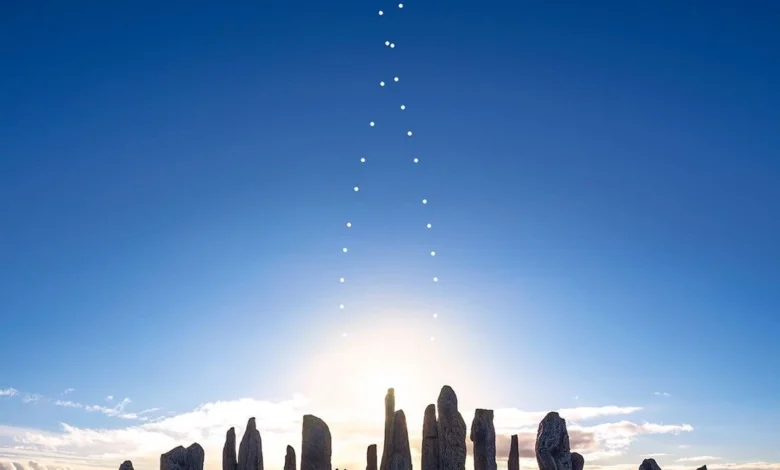
The intersection of ancient human engineering and modern celestial mechanics has been captured in striking detail by astrophotographer Giuseppe Petricca, earning the prestigious designation of NASA’s Astronomy Picture of the Day (APOD) for September 20, 2026. Featured on NASA’s newly transitioned science portal at science.nasa.gov/apod, Petricca’s composite image showcases a mesmerizing figure-eight solar analemma traced across the daytime sky above the prehistoric Callanish Stones on the Isle of Lewis in the Outer Hebrides of Scotland. This compelling visual representation not only highlights the harmonious interplay between Earth’s orbit and axial tilt but also underscores the enduring legacy of ancient megalithic sites that have silently marked the passage of time for millennia.
Main Facts of the Observation and Celestial Mechanics
At its core, the featured image is an analemma—a multi-exposure composite photograph created by capturing the position of the Sun from the exact same geographic location at the exact same time of day at regular intervals over the course of a full calendar year. Rather than remaining static, the Sun traces a distinct, elongated figure-eight pattern in the sky.
The physical drivers behind this celestial choreography are well-documented by planetary scientists and astronomers. The figure-eight shape is the direct mathematical and physical consequence of two primary factors: the 23.5-degree tilt of Earth’s rotational axis relative to its orbital plane, and the slight ellipticity (oval shape) of Earth’s annual orbit around the Sun, in accordance with Kepler’s laws of planetary motion. Because Earth’s speed varies as it travels closer to or farther from the Sun along its elliptical path, and because the planet is tilted on its axis, the Sun appears to advance and lag behind standard clock time while simultaneously shifting north and south throughout the year.
In Petricca’s composition, images captured every few days at local noon near the village of Callanish reveal the Sun positioned near the lower loop of the figure-eight. This placement reflects the temporal context of the photographic series, which was captured around the time of the December solstice, when the Sun reaches its lowest apparent altitude in the Northern Hemisphere’s midday sky. Conversely, during the June solstice, the Sun would occupy the topmost loop of the analemma. The midpoint crossings of the figure-eight correspond to the spring and autumn equinoxes, periods when day and night are of approximately equal length across the globe.
Chronology and Historical Context of the Callanish Stones
The foreground of the award-winning composition anchors the modern astronomical feat in deep antiquity. The Callanish Stones—or Tursachan Comghlain in Scottish Gaelic—comprise an arrangement of 13 primary megaliths forming a majestic stone circle with an avenue of stones and a burial cairn, erected approximately during the Bronze Age around 2700 BC.
To provide a comprehensive chronology of the site and the recent astronomical documentation:
- c. 2700 BC: Neolithic and early Bronze Age communities construct the Callanish stone circle on a ridge overlooking Loch Roag in the Outer Hebrides, utilizing local Lewisian gneiss slabs.
- 20th Century: Archaeologists and archaeoastronomers, most notably Professor Alexander Thom in the 1960s and 1970s, conduct extensive surveys suggesting potential alignments between the stones and lunar or solar extremes, though academic consensus remains divided regarding intentional astronomical design.
- Annual Cycle (2025–2026): Astrophotographer Giuseppe Petricca executes a year-long photographic project, capturing the Sun at consistent intervals from a fixed vantage point near the megalithic monument.
- September 20, 2026: NASA features Petricca’s completed Callanish Analemma as the Astronomy Picture of the Day, coinciding with institutional updates regarding the migration of the APOD archive to NASA’s centralized science domain.
Supporting Data and Technical Parameters
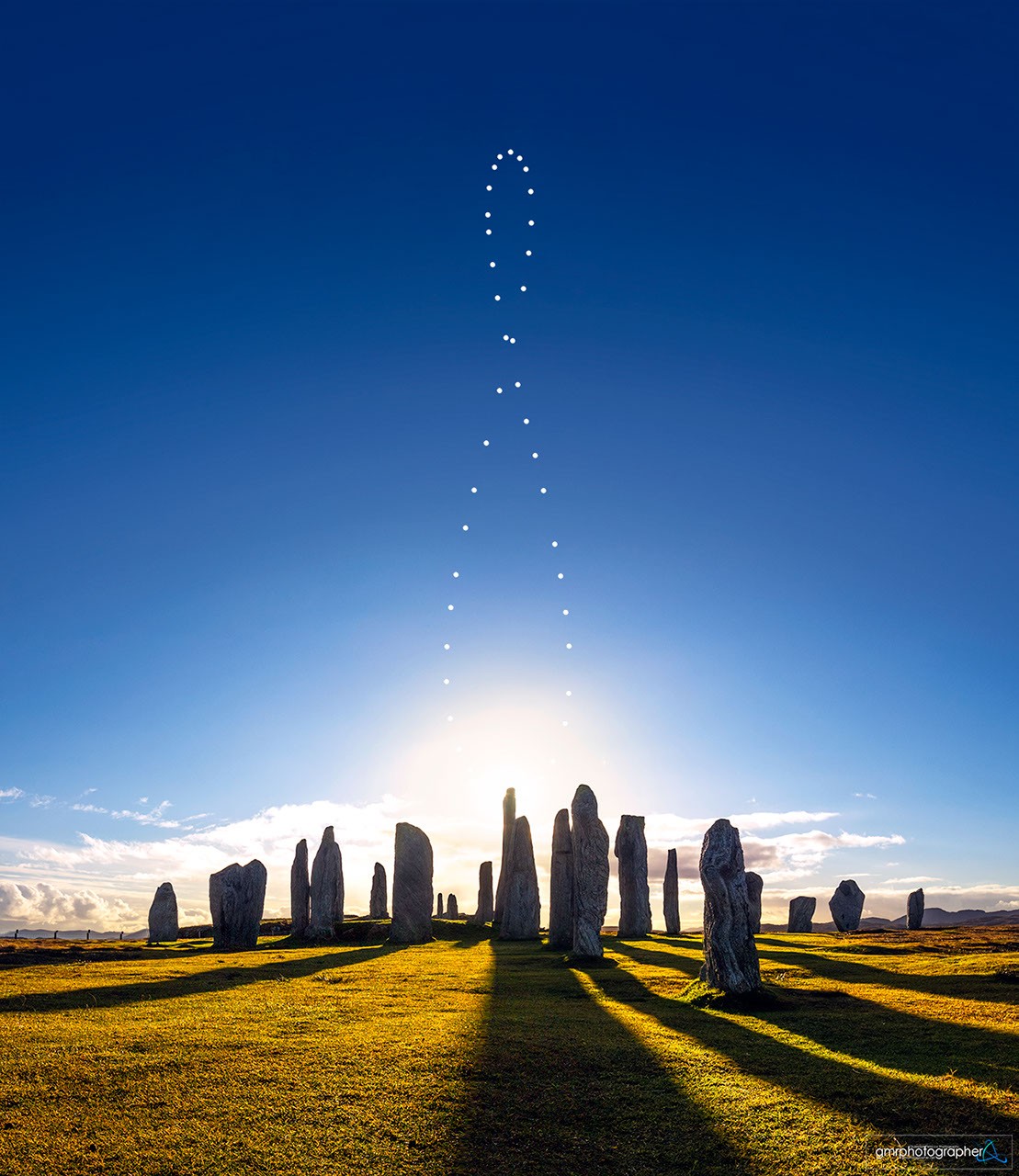
Astrophotography projects of this magnitude require rigorous planning, precise geographic positioning, and steadfast patience. Creating a clean solar analemma involves overlapping dozens of individual frames onto a single base landscape exposure.
- Geographic Coordinates: The Callanish monument is situated at approximately 58.2988° N, 6.7435° W on the west coast of the Isle of Lewis, Scotland.
- Temporal Methodology: Exposures are typically taken at mean solar noon, accounting for the Equation of Time—the difference between apparent solar time and mean solar time.
- Equipment and Processing: Modern digital astrophotography utilizes specialized solar filters to protect camera sensors during daytime captures, followed by precise stacking and alignment software to blend the diurnal solar progression seamlessly into the landscape plates without introducing optical distortion or lighting discrepancies.
Official Responses and Institutional Perspectives
The publication of the Callanish Analemma arrives during a period of operational transition for the Astronomy Picture of the Day service. Initiated decades ago by professional astronomers Robert Nemiroff and Jerry Bonnell—and currently curated alongside collaborating editors Cecilia Chirenti and Keighley Rockcliffe—APOD stands as one of NASA’s most enduring and widely accessed educational outreach initiatives.
In official announcements accompanying the September 20 release, NASA leadership highlighted the ongoing migration of the primary APOD repository from its historic domain (apod.nasa.gov) to the unified agency framework at science.nasa.gov/apod. This institutional shift falls under the broader NASA Science Activation program, which aims to streamline public access to peer-reviewed astronomical explanations, high-resolution imagery, and educational resources.
While formal statements from the scientific team emphasize the pedagogical value of daily astronomical explanations written by professional astronomers, academic reactions from the broader astronomical and archaeological communities underscore the cultural resonance of pairing modern celestial tracking with ancient monuments. Observers and historians note that structures like Callanish serve as a tangible reminder of humanity’s ancient impulse to observe, record, and interpret the regular cycles of the cosmos.
Broader Impact and Scientific Implications
The enduring appeal of the solar analemma extends far beyond its aesthetic qualities; it serves as a powerful didactic tool in earth and space sciences. Analemmas provide educators with a clear, visual method to explain complex orbital mechanics to students and the general public. By demonstrating how the combination of axial tilt and orbital eccentricity manifests in our skies, images like Petricca’s bridge abstract mathematical formulas with tangible, observable reality.
Furthermore, the integration of ancient archaeological sites into contemporary astronomical media fosters a multidisciplinary appreciation of human history. Whether or not the original builders of the Callanish Stones calculated the exact trajectory of the analemma—a geometric concept formalized long after the Bronze Age—the juxtaposition reinforces a profound philosophical continuity: humanity has consistently looked upward at the same sky, measuring time through the steady, predictable motion of our local star.
As NASA completes its digital migration to centralize its scientific outreach, features like the Callanish Analemma ensure that the intersection of historical heritage and modern astrophysics remains accessible to a global audience, inspiring the next generation of astronomers, photographers, and stargazers to look closer at the sky above them.