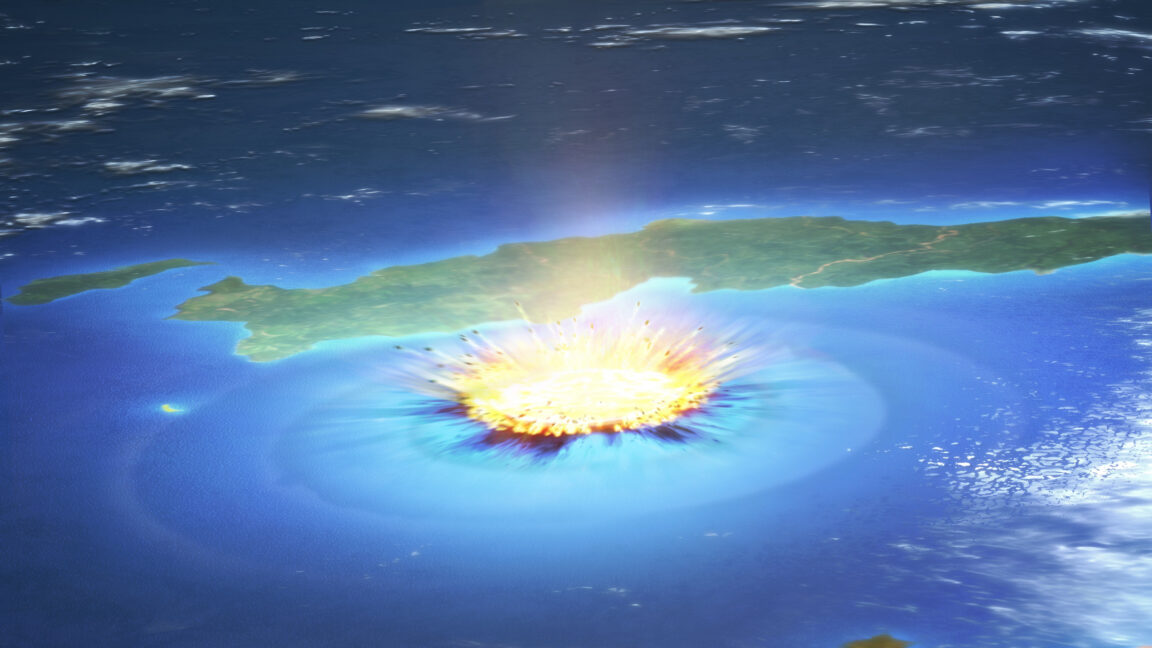
Sixty-six million years ago, the trajectory of life on Earth was irrevocably altered when a massive asteroid, estimated to be roughly 10 to 15 kilometers in diameter, struck the Yucatan Peninsula. The Chicxulub impact is widely recognized as the primary driver of the Cretaceous-Paleogene (K-Pg) extinction event, an atmospheric and geological catastrophe that eradicated roughly 75 percent of all plant and animal species, most notably the non-avian dinosaurs. However, while the immediate aftermath was defined by tsunamis, wildfires, and a multi-year “impact winter” caused by debris blocking the sun, new geological evidence suggests that the crater itself may have functioned as a sanctuary for life. Recent isotopic analysis indicates that a subterranean hydrothermal system ignited by the impact persisted for at least eight million years, providing a stable, nutrient-rich environment that could have sustained microbial life during the planet’s most volatile period.
The Geology of a Cataclysm
The Chicxulub crater is one of the most studied geological structures on the planet. Spanning approximately 150 kilometers in diameter, the crater serves as a physical record of the immense energy released upon impact—a force estimated to be billions of times greater than the atomic bomb dropped on Hiroshima. When the asteroid struck the shallow waters of the Yucatan, it did not merely crater the surface; it fractured the Earth’s crust to depths reaching nearly 35 kilometers.
This deep-crustal deformation created a network of faults and fractures that allowed seawater to penetrate deep into the hot, fractured rock of the impact basin. As seawater interacted with the superheated debris and the exposed mantle, a complex hydrothermal convection system was established. This process is analogous to modern-day hydrothermal vents found along mid-ocean ridges, which are known to host thriving ecosystems independent of photosynthesis, relying instead on chemosynthesis to convert chemical energy from the Earth into biological sustenance.
Challenging the Timeline of Longevity
For years, the scientific consensus regarding the Chicxulub hydrothermal system was that it was a relatively short-lived phenomenon. Early models suggested that the heat generated by the impact would dissipate within approximately two million years. However, a study recently published in the journal Communications Earth & Environment, led by Dr. Annemarie Pickersgill of the University of Glasgow’s SUERC Center for Isotope Sciences, has fundamentally revised this timeline.
By analyzing rock core samples recovered during a 2016 drilling expedition into the impact crater, Dr. Pickersgill’s team utilized potassium-argon dating to determine the age and thermal history of the subsurface rocks. The methodology relies on the radioactive decay of potassium-40 into argon-40. In molten or high-heat environments, argon gas—a byproduct of decay—escapes the rock. As the rock cools and solidifies, the argon becomes trapped. By measuring the ratio of potassium to argon, researchers can precisely date the last time a rock was subjected to the extreme heat of the hydrothermal system.
The findings were significant: the isotope data indicates that the hydrothermal activity persisted for at least eight million years post-impact. This means the system remained active until approximately 58 million years ago, a duration four times longer than previously estimated.
Computer Simulations and Thermal Dynamics
To validate the findings derived from the physical rock samples, the research team developed high-fidelity computer simulations of the impact crater’s cooling process. These simulations tracked the fluid flux and temperature gradients within the subterranean fractures over millions of years.
The data revealed a clear progression of cooling. At a depth of one kilometer, the temperature within the hydrothermal system reached a steady state of 90°C (194°F) shortly after the impact. Within 1.5 to 2.3 million years, the system cooled to levels more conducive to a wider range of microbial life. As the system further cooled to below 50°C (122°F) over the subsequent five million years, it provided a remarkably stable environment for microbial colonization. By the eight-million-year mark, the fluid flux had diminished to the point where the system effectively ceased to function.
This extended window of time is crucial. For life to flourish in an isolated environment, it requires more than just a source of heat; it requires longevity. The eight-million-year duration provided a sufficiently long “prebiotic laboratory” where chemical reactions could stabilize and primitive organisms could not only survive but propagate throughout the porous rock structure of the crater.
Implications for Astrobiology
The significance of this discovery extends far beyond the history of Earth. It offers a new framework for understanding how life might survive—or even emerge—on other planetary bodies that have been subjected to significant asteroid impacts.
"Longer periods of hydrothermal activity will generate extended windows of opportunity for prebiotic chemical reactions to occur, life to develop, and micro-organisms to thrive and propagate beyond their point of origin," noted Dr. Pickersgill.

This perspective is particularly relevant for the study of Mars and the icy moons of the outer solar system, such as Europa or Enceladus. Many of these bodies show evidence of past or present impact craters and potential subsurface water. If a relatively small impact like Chicxulub can sustain a hydrothermal system for eight million years, larger impacts on early Earth or on other planets could have potentially maintained habitable conditions for significantly longer periods. This suggests that impact craters, often viewed primarily as agents of destruction, may also act as "cradles" for life in the early stages of a planet’s development.
A Sanctuary Amidst Mass Extinction
While the surface of the Earth was experiencing a “nuclear winter” and the collapse of global food chains, the subterranean environment of the Chicxulub crater was, in effect, shielded. The extreme heat and chemical composition of the hydrothermal fluids would have been inhospitable to many, but for thermophilic (heat-loving) bacteria and archaea, the crater may have functioned as a refuge.
The fact that microbes have been found to colonize only eight of the 70 currently known underwater impact craters globally indicates that habitability is not a guarantee. It requires a specific convergence of structural integrity, fluid availability, and thermal longevity. The Chicxulub crater represents a “goldilocks” scenario where these factors aligned perfectly, potentially allowing life to endure a period of global devastation that wiped out the dominant surface species.
Future Research Directions
The work conducted by Dr. Pickersgill and her team opens several new avenues for planetary science. Future research will likely focus on identifying specific biomarkers within the drilled samples to confirm whether the Chicxulub hydrothermal system was indeed inhabited. While the current study proves that the conditions for life were present, the quest to identify actual micro-fossil evidence remains the next major hurdle.
Furthermore, this study underscores the necessity of continued drilling into impact structures. By expanding the dataset to include other, older craters, geologists hope to establish a more robust model for how impact-induced hydrothermal systems contribute to the global distribution of life over geological time.
In conclusion, the Chicxulub impact serves as a poignant reminder of the duality of planetary history. While the asteroid that struck the Yucatan Peninsula 66 million years ago was the herald of the end for the dinosaurs, it also inadvertently created a long-lasting, deep-crustal ecosystem. This hydrothermal system, persisting for millions of years, highlights the resilience of life and provides a compelling case that even in the aftermath of a global catastrophe, the Earth’s own internal heat can provide a path for continuity and survival. As we look toward the stars and evaluate the habitability of other worlds, the story of Chicxulub remains a critical piece of the puzzle, illustrating that the scars left by cosmic collisions may hold the keys to understanding the origins and persistence of life in the universe.
Related posts: