The automotive world is defined by the perpetual struggle to harmonize two inherently conflicting objectives: the pursuit of pure, uncompromising track performance and the regulatory requirements of road legality. With the introduction of the Ferrari 296 Challenge Stradale, the Maranello-based manufacturer has arguably pushed this boundary further than ever before. This vehicle represents a departure from the modern trend of increasingly heavy, hybrid-assisted supercars, opting instead for a stripped-back, high-downforce philosophy that prioritizes mechanical purity and aerodynamic efficiency. By shedding the hybrid components that characterize the standard 296 GTB, Ferrari has engineered a machine that functions as the closest production-car equivalent to a dedicated competition vehicle ever to emerge from its gates.
The Origins of the Challenge Lineage
To understand the significance of the 296 Challenge Stradale, one must look at the evolution of Ferrari’s "Challenge" series. Since 1993, the Ferrari Challenge has served as the backbone of the company’s customer racing program. Historically, these race-prepared cars were built strictly for closed-circuit competition, far removed from the public thoroughfare. The lineage began with the 348 Challenge, a series that provided a platform for gentlemen drivers to experience the intensity of professional racing. Over three decades, this program evolved through the F355, 360, 430, 458, 488, and the current 296 architecture.
For years, there existed a distinct divide: the road-going "Stradale" models, designed for the enthusiast, and the "Challenge" models, built for the podium. The 296 Challenge Stradale collapses this divide. Developed in tandem with the 296 Challenge Evo—which is set to anchor the Ferrari one-make series starting in 2027—the road-legal variant inherits the technical DNA of its track-only sibling. This cross-pollination of engineering is not merely a marketing exercise; it is a fundamental shift in how Ferrari approaches its high-performance product roadmap.
Engineering the Removal of Complexity
The most striking technical decision behind the 296 Challenge Stradale is the total omission of the hybrid system. While the 296 GTB utilizes a powerful electric motor to augment its twin-turbocharged V6, the Challenge Stradale discards this technology entirely to focus on weight reduction and throttle responsiveness. The result is a dry weight of just 2,932 pounds—a staggering 308-pound reduction compared to the standard 296 GTB.
This weight savings is achieved through a meticulous engineering process. Ferrari implemented a lighter transmission casing and shaft, extensive use of carbon fiber for interior and structural components, and the total removal of the battery pack and electric drive unit. Furthermore, the interior has been significantly refined, allowing buyers the option of exposed carbon fiber and removable seat coverings, further emphasizing the car’s utilitarian, performance-first aesthetic.
The power unit remains a 3.0-liter twin-turbocharged V6, but it has been recalibrated for singular operation. By optimizing boost pressure, adjusting variable valve timing, and enhancing thermal insulation, Ferrari has achieved a 32 percent increase in dynamic torque compared to the standard GTB engine. The engine, which features turbochargers mounted within the "V" to reduce lag, provides an immediate, visceral connection between the driver’s right foot and the rear wheels. The eight-speed dual-clutch transmission further complements this, utilizing a dual-personality software logic: an aggressive, lightning-fast shift pattern for the track, and a slightly more refined calibration for public roads.
Aerodynamic Dominance and Chassis Rigidity
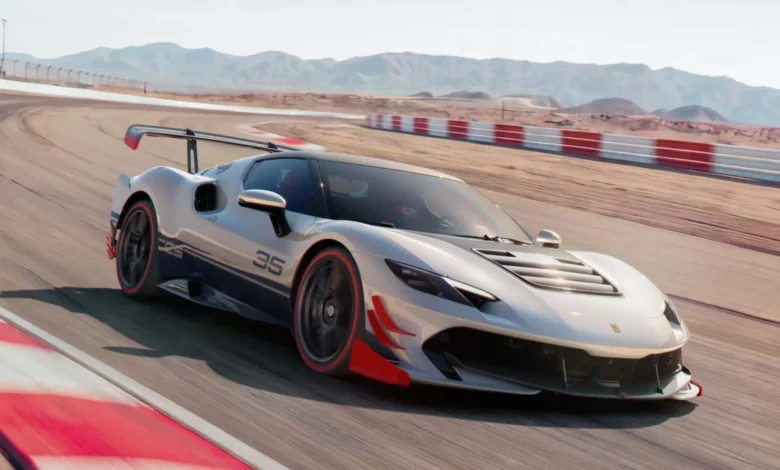
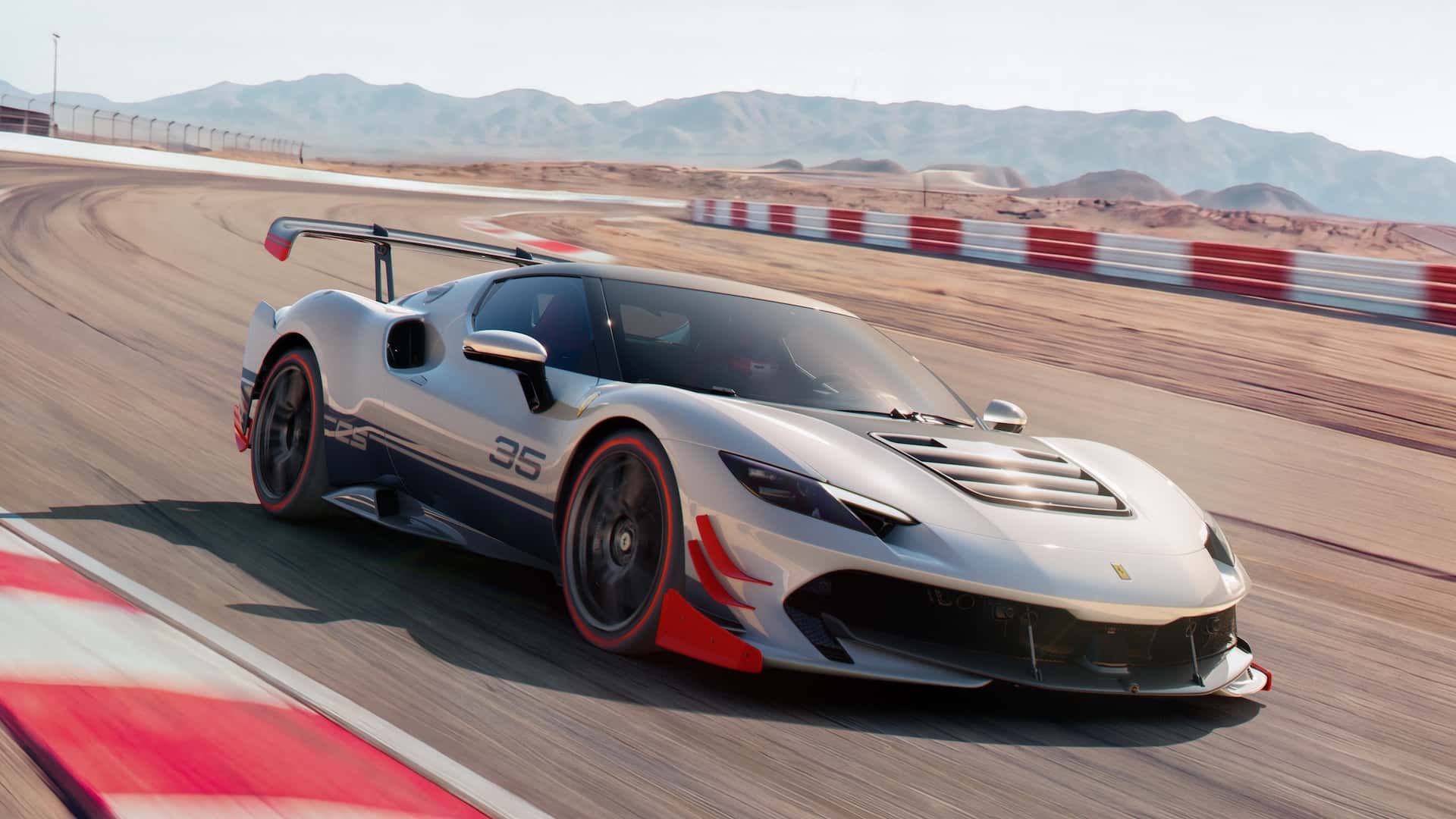
The 296 Challenge Stradale is as much an exercise in aerodynamics as it is in powertrain engineering. The car generates 1,360 pounds of downforce at 155 miles per hour, representing a 72 percent increase over the 296 GTB. This figure is achieved through a suite of aggressive body modifications, including a front hood technical insert, a double-keel diffuser, and a fixed rear wing. The rear wing, while inspired by the 296 Challenge Evo, features unique under-mounted supports to comply with international road homologation standards, particularly those in the North American market.
The chassis has been stiffened to accommodate the extreme forces generated by this downforce. Body roll has been reduced by 68 percent, and the suspension geometry now utilizes a secondary, smaller spring in series with the primary spring—a technology directly lifted from the Challenge Evo race car. These semi-active dampers provide the necessary compliance for road use while maintaining the surgical precision required for track work. Stopping power is managed by a high-performance carbon-ceramic braking system, which operates without the complication of regenerative braking, ensuring a consistent and predictable pedal feel that remains vital for track-day confidence.
The Implications of the 296 Challenge Stradale
The release of the 296 Challenge Stradale carries significant implications for the supercar market. It signals that even in an era of electrification and hybridization, there remains a substantial demand for "pure" internal combustion performance. By removing the hybrid components, Ferrari has catered to a segment of the market that prioritizes the visceral, analog experience of driving.
Furthermore, the vehicle serves as a bridge between the company’s road car manufacturing and its racing division. With a price point of approximately $307,000, the 296 Challenge Stradale positions itself as an exclusive, high-performance tool for owners who intend to push their vehicles to the limit. The introduction of a predictive traction control system, specifically calibrated for track use—a first for a Ferrari road car—demonstrates the company’s intent to provide an experience that is as safe as it is exhilarating.
Analysis of the Competition and Market Positioning
When comparing the 296 Challenge Stradale to its contemporaries, the vehicle occupies a unique space. While many manufacturers are moving toward all-wheel-drive or high-output hybrid systems to chase lap times, Ferrari has chosen to maintain a rear-wheel-drive architecture. This choice necessitates higher levels of chassis refinement and driver skill, distancing the car from the "easier" driving experience of the 296 Speciale.
The 296 Challenge Stradale is not designed to be the most approachable car in the Ferrari stable. It is designed to be the most challenging. The removal of the electric motor’s "fill-in" torque means that the driver must manage the power delivery with greater precision. This is a car that demands respect and rewards technical proficiency. It is an unapologetic nod to the company’s founder, Enzo Ferrari, who famously believed that road cars were primarily a means to finance his racing ambitions. In the case of the 296 Challenge Stradale, the line between the two has never been thinner.
Official Perspectives and Future Outlook
While Ferrari has not provided exhaustive quotes from its engineering team, the official stance on the 296 Challenge Stradale is one of "disruption of balance." By stripping away the electronic and hybrid aids that characterize the modern automotive landscape, the company is testing the limits of what a road-legal car can achieve on a circuit. The 1 minute 18.5-second lap time at the Fiorano test track is a testament to the efficacy of this approach.
Looking forward, the 296 Challenge Stradale sets a benchmark for the next generation of Ferrari vehicles. As the company moves toward the 2027 start of the new one-make racing series, the data gathered from owners driving these cars on the track will undoubtedly influence the development of future models. The car is not merely an end-of-lifecycle iteration of the 296; it is a testbed for extreme performance technologies that are likely to filter down into more mainstream models.
Conclusion
The Ferrari 296 Challenge Stradale stands as a masterclass in focused engineering. It is a vehicle that succeeds by doing less: less weight, less complexity, and fewer electronic interventions. In an industry increasingly preoccupied with battery density and autonomous assistance, Ferrari has doubled down on the fundamentals of automotive performance: power-to-weight ratio, aerodynamic efficiency, and mechanical feedback. For the enthusiast, it represents the pinnacle of the current V6 era, offering a driving experience that is as close to a professional race car as one can legally purchase. It is a bold, uncompromising statement from a manufacturer that continues to prove its mastery over both the road and the track.