The Technological Framework of Audio Intelligence
The backbone of this new functionality lies in the integration of the S11 processor, which features a sophisticated "Secure Exclave." This hardware-level partition acts as a digital vault, inaccessible even to the device’s own operating system. When the Apple Watch detects ambient audio, the data is routed immediately into this encrypted buffer. According to Apple’s technical documentation, the audio stream is never saved as a file. Instead, it is processed in a transient, real-time loop that is overwritten continuously within the local hardware.
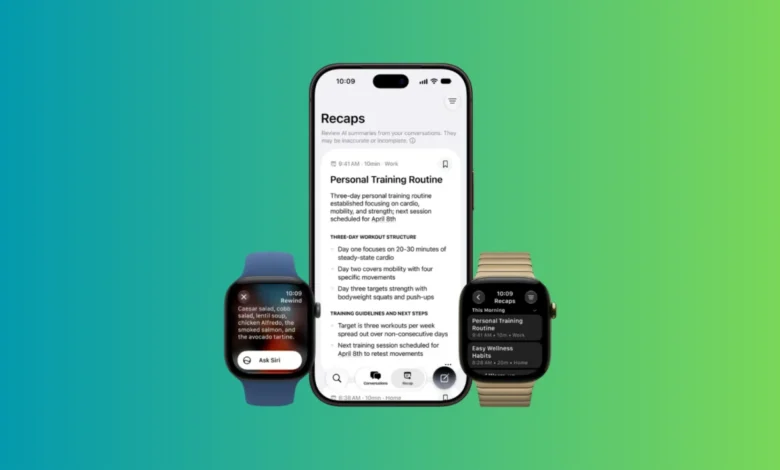
The workflow from input to summary is designed to minimize exposure. Once the raw audio enters the Secure Exclave on the watch, it is encrypted and transmitted to a paired iPhone. On the handset, an on-device AI model transcribes the input, distilling it into a condensed summary—typically half the length of the original conversation—while stripping out personally identifiable information (PII). Following this local processing, the original audio data is purged. Only the sanitized, truncated transcript and minimal metadata—such as approximate timestamps and coarse geographic data—are uploaded to Apple’s Private Cloud Compute (PCC) servers for further refinement.
Apple has implemented a third-party relay system to mask user IP addresses during this upload process, ensuring that the cloud-based AI processing remains decoupled from the user’s specific Apple ID. Once the summary is generated via Siri Recap, it is delivered to the user and, according to Apple, automatically deleted from the cloud every seven days unless the user manually opts to save the content.
Chronology and Development Context
The path to the Series 12 launch began in early 2024, when industry analysts first observed a shift in Apple’s patent filings toward "Ambient Contextual Awareness." By late 2025, reports from supply chain partners suggested that the S11 chip would include dedicated neural engines optimized for low-latency, on-device audio processing. The September 9 announcement represents the culmination of an eighteen-month development cycle focused on embedding Artificial Intelligence into the "Private Cloud" infrastructure.
Critics note that this development follows a broader trend in the tech industry, where companies are racing to normalize "always-on" AI assistants. While the Siri Recap feature is presented as a convenience—allowing users to retrieve key points from meetings or lectures without needing to take notes—it fundamentally changes the nature of a wearable device from a reactive tool to a persistent, ambient sensor.
Privacy Safeguards and the "Consent Gap"
Apple has invested significant resources in addressing potential backlash by emphasizing the lack of persistent recordings. Their official stance is that because no audio file is ever created or stored, the device technically avoids the legal definitions of "recording" under many wiretapping statutes. This argument rests on the distinction between transient processing and data retention.
However, legal experts point to a significant "consent gap." While the user of the device has opted into these features, individuals in the immediate vicinity—colleagues, family members, or strangers in public—have not. Although the watch emits a brief audio chime and a visual cue when the "Live Rewind" feature is active, these notifications are subtle and easily missed in crowded environments. The "Siri Recap" function, which operates silently, lacks any such notification mechanism, effectively allowing for the accumulation of summarized data from conversations where the participants may be unaware that their words are being parsed by an AI model.

Legal and Ethical Implications
The legal landscape surrounding these features is complex. In the United States, twelve states maintain "all-party consent" laws, which mandate that all individuals involved in a private conversation must agree to be recorded. While Apple’s legal counsel contends that the ephemeral nature of the Secure Exclave buffer bypasses these laws, privacy advocates argue that the intent of these statutes is to protect the expectation of privacy in communication.
In the European Union, the General Data Protection Regulation (GDPR) imposes stringent requirements on the processing of personal data. The potential for these devices to capture and summarize conversations containing sensitive information—such as medical discussions, private financial details, or privileged legal exchanges—raises questions about whether "summarization" constitutes a form of data collection that requires more robust, explicit consent. If a device summarizes a conversation and stores that text in iCloud, it is no longer ephemeral; it becomes a permanent record of a third party’s speech, stored on a server.
The Risk of Account-Level Breaches
While Apple maintains an exemplary track record regarding server-level security, the vulnerability of the end-user remains a persistent concern. The transition from "ephemeral processing" to "saved summary" is where the most significant risks reside. When a user chooses to save a summary into apps like Apple Notes or the Journal, that data becomes part of their permanent iCloud backup.
The security landscape of the last twelve months has been marked by significant credential harvesting operations. For example, in January of this year, a data leak exposed over 900,000 iCloud logins on a public server. In such an event, an attacker who gains unauthorized access to an Apple ID gains access to everything, including these stored conversation summaries. This shifts the threat model from one of "corporate surveillance" to "identity compromise," where an individual’s private conversations could be exfiltrated and weaponized by malicious actors.
Industry and Public Reaction
The reaction to the Series 12 announcement has been bifurcated. Tech enthusiasts have lauded the efficiency of the Audio Intelligence suite, noting that for professionals, the ability to automate note-taking in high-pressure environments is a transformative utility. Conversely, privacy advocacy groups, including the Electronic Frontier Foundation (EFF) and various European data protection authorities, have called for more transparent, granular controls.
Public sentiment, as reflected in early forum discussions and social media discourse, highlights a growing fatigue regarding "ambient surveillance." Many users have expressed discomfort at the idea of wearing a device that is constantly "listening," regardless of the technical safeguards. Apple has responded to these concerns by emphasizing that the features are entirely opt-in. During the initial setup of a Series 12 or Ultra 4, the user is presented with a clear choice to enable or disable these audio functions. Furthermore, users retain the ability to toggle individual aspects of the AI suite through the settings menu, allowing for a tailored approach to privacy.
Analytical Perspective: The Normalization of AI
The broader implication of this release is the continued normalization of AI in the physical world. By integrating these features into the Apple Watch, the company is attempting to bridge the gap between human memory and digital record-keeping. The success of this endeavor will likely depend not on the technical sophistication of the S11 chip, but on whether the public perceives the trade-off between convenience and privacy as equitable.
As the device reaches consumers, the true test will be how these features perform in the "real world." Will the audio chime be sufficient to alert those nearby? Will the summaries prove accurate enough to justify the potential security risks? And, perhaps most importantly, will regulators step in to clarify whether the transient processing of audio by a wearable device constitutes an infringement of privacy rights? For now, the Apple Watch Series 12 stands as a technological marvel that demands a high degree of digital literacy and ethical consideration from its users, marking a significant, and perhaps irreversible, step in the evolution of personal technology.