1998 Family Sedans Get Pushed To Their Limits On Track In The Latest Best Motoring Episode

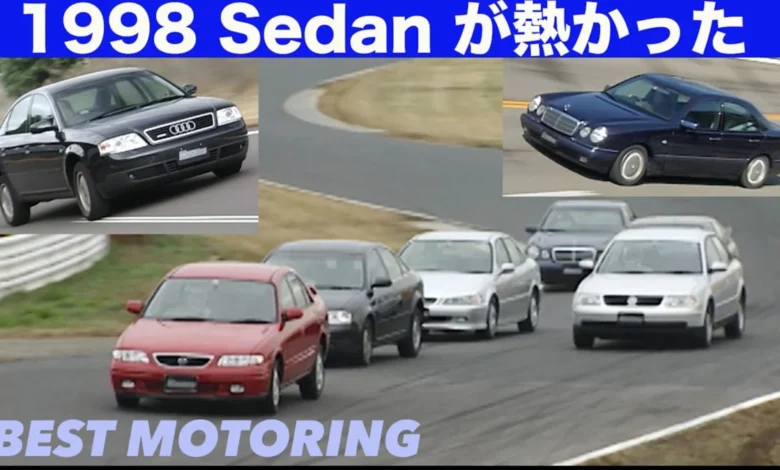
The enduring legacy of the Japanese automotive media landscape finds one of its most compelling expressions in the archives of Best Motoring, a publication and video series that bridged the gap between enthusiast journalism and professional motorsport analysis. Spanning from 1987 to 2011, the series carved out a distinct niche by subjecting everyday production vehicles to high-intensity, five-lap circuit battles. While the automotive industry has evolved significantly in the decades since, recent archival uploads have reignited interest in the late 1990s era, specifically a high-stakes comparison of six midsize family sedans that were never intended for the rigors of competitive track driving.
The Context of the 1998 Midsize Sedan Comparison
In the late 1990s, the midsize sedan market was the primary battleground for global automotive manufacturers. The segment was defined by a balance of practicality, comfort, and increasingly, technical sophistication. In the featured 1998 comparison, Best Motoring gathered a diverse field representing both the Domestic Japanese Market (JDM) and European luxury imports.
The roster included the Honda Accord SiR, the Nissan Primera Camino Te-V, the Mazda Capella Zi-R, the Volkswagen Passat 1.8T, the Audi A6 2.8 Quattro, and the Mercedes-Benz E320. The inclusion of these vehicles was not merely a test of acceleration or top speed, but a calculated effort to determine how varying chassis architectures, transmission types, and engine outputs translated into real-world track performance. By placing professional racing drivers behind the wheel, Best Motoring removed the variable of driver error, allowing the mechanical attributes of each vehicle to dictate the outcome.
Chronology of the Evaluation
The Best Motoring format was meticulously structured to provide objective data. The process typically began with a technical briefing, followed by a standing-start race where the cars were pushed to their absolute mechanical limits.
- Phase One: Technical Specification Review: Each vehicle was analyzed for its power-to-weight ratio, transmission efficiency, and suspension geometry. The JDM entries represented the peak of Japanese four-cylinder technology at the time, utilizing Variable Valve Timing (VTEC) and high-revving naturally aspirated configurations.
- Phase Two: The Standing Start: The drivers executed a simultaneous launch. Given that several of the vehicles utilized automatic transmissions, the start was a critical determinant of early race positioning.
- Phase Three: The Five-Lap Circuit Battle: The drivers navigated the technical segments of the track, often trading paint and utilizing defensive lines that would typically be reserved for dedicated race cars. This phase served to highlight the stability control, braking fade, and cornering grip of each chassis.
Comparative Technical Analysis
The field presented a fascinating cross-section of automotive engineering philosophies from the late 20th century. The JDM entries focused on agility and engine response, while the European entries leveraged torque and sophisticated all-wheel-drive systems.
- Honda Accord SiR: Equipped with a 2.0-liter four-cylinder engine featuring VTEC, this vehicle produced 177 horsepower. Its reliance on a five-speed automatic transmission made it a case study in how electronic shift logic manages power delivery in a performance context.
- Nissan Primera Camino Te-V: A precursor to the Infiniti G20 in the United States, this model featured a 2.0-liter engine outputting approximately 140 horsepower. Its use of a Continuously Variable Transmission (CVT) highlighted the early limitations and potential of the technology in a high-load environment.
- Mazda Capella Zi-R: Known globally as the 626, this vehicle utilized a 168-horsepower 2.0-liter engine paired with a four-speed automatic. It served as a baseline for standard front-wheel-drive handling dynamics in the midsize segment.
- European Imports: The Volkswagen Passat 1.8T provided a turbocharged alternative to the naturally aspirated Japanese engines. Meanwhile, the Audi A6 2.8 Quattro and the Mercedes-Benz E320 represented a higher market tier, introducing complexities such as permanent all-wheel-drive systems and more robust chassis tuning, which fundamentally altered their performance profiles on the circuit.
Professional Driver Perspectives
The drivers utilized by Best Motoring were not typical automotive journalists; they were seasoned professionals with extensive experience in the All-Japan Grand Touring Car Championship (JGTC) and the Japanese Formula 3000 series. Their feedback throughout the sessions emphasized the disparity between "daily driving comfort" and "track-day composure."
In post-race assessments, these drivers frequently noted the "understeer bias" inherent in the front-wheel-drive sedans, noting that the heavy front-end weight distribution necessitated a precise entry into corners to avoid scrubbing off momentum. Conversely, the rear-wheel-drive and all-wheel-drive European models were praised for their composure under braking, though their increased curb weight often served as a hindrance during the tight, technical transitions of the track.
Broader Impact and Industry Implications
The implications of these tests extend beyond simple entertainment. By subjecting these sedans to extreme conditions, Best Motoring provided an unfiltered look at the engineering safety margins built into mass-produced vehicles. The ability of a standard 1998 family sedan to complete five laps of high-intensity racing without catastrophic mechanical failure served as a testament to the manufacturing standards of the era.
Furthermore, these videos act as a historical record of a transitional period in automotive history. The late 1990s marked the cusp of widespread adoption for technologies like stability control and complex electronic transmission mapping. The Best Motoring series captured the exact moment when the industry began shifting its focus from purely mechanical performance to electronically assisted driving dynamics.
Archival Value and Digital Accessibility
The continued popularity of the Best Motoring archive on platforms such as YouTube underscores a significant trend in digital media: the preservation of niche historical content. With over 830 videos in their official catalog, the channel serves as a primary source for automotive historians and enthusiasts alike.
The digital transition has allowed for a broader audience to engage with these tests. Where once these segments were locked behind the paywalls of Japanese domestic magazines and VHS/DVD distribution, they are now available for global study. This accessibility has encouraged a new generation of analysts to revisit the data, often using modern software to compare the lap times and performance telemetry against contemporary vehicles.
Analyzing the Results: Why It Matters Today
One might ask why a 1998 comparison of midsize sedans remains relevant in an age of electric vehicles and autonomous driving. The answer lies in the fundamental physics of the automobile. The principles of weight transfer, tire contact patches, and engine thermal management remain constant.
The comparison between the JDM sedans and their European counterparts provides a snapshot of global competition. At the time, Japanese manufacturers were attempting to prove that their mass-market products could hold their own against the prestige of European luxury brands. While the Mercedes-Benz and Audi entries possessed higher price points and more luxurious interiors, the Best Motoring tests often revealed that the Japanese sedans could close the performance gap through superior power-to-weight optimization and chassis tuning.
Conclusion
The latest episode of Best Motoring, featuring the 1998 midsize sedan showdown, is more than a nostalgic look back; it is a clinical observation of automotive capabilities at the turn of the century. By maintaining a rigorous, objective, and track-focused methodology, the series continues to offer valuable insights into the design philosophies that shaped the cars we drive today. As the industry pivots toward electrification and software-defined vehicles, these archival records remain vital for understanding the mechanical foundations upon which modern automotive performance is built. Whether viewed for their historical significance or their sheer entertainment value, these battles between humble family sedans stand as a hallmark of enthusiast media at its most effective and informative.