The political landscape underwent a significant shift during the recent midterm elections, altering not only the composition of Congress and various statehouses but also reshaping how the American public consumes breaking news. For the first time in six election cycles, traditional broadcast television networks outperformed cable outlets in primetime viewership on election night, marking a major departure from a multi-year trend that had favored 24-hour cable news networks.
According to official Nielsen ratings, a combined 31.21 million viewers tuned into primetime election coverage across 13 major broadcast and cable outlets on Tuesday. This figure represents a substantial increase from the 25.43 million viewers recorded during the 2022 midterm elections. Of the total audience, 57 percent—equating to 17.79 million people—chose broadcast networks such as NBC, ABC, CBS, Univision, Telemundo, and PBS. Meanwhile, cable channels captured the remaining 43 percent, drawing 13.42 million viewers. This dynamic completely inverses the viewership distribution from four years prior, when cable channels commanded 57 percent of the midterm coverage audience.
A Historical Shift in Television Viewing Habits
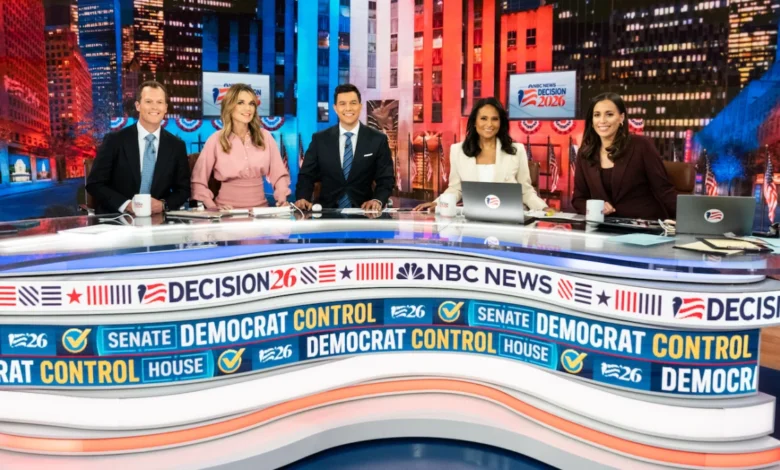
The resurgence of broadcast television on election night breaks a prolonged drought. It has been 14 years since broadcast networks captured a clear majority of election night viewers, with only a roughly 50-50 split occurring during the 2016 presidential election cycle. Furthermore, this year marks the first time since 2012 that a broadcast network claimed the top spot among all competitors on election night, with NBC finishing first overall.
NBC secured 6.74 million viewers during Tuesday’s primetime hours, more than doubling its average viewership from the 2022 midterms. ABC also experienced a dramatic surge, growing its audience by 57 percent compared to four years ago to reach 5.19 million viewers. CBS posted a more modest performance with 2.76 million viewers, though this still represented an 8 percent increase from the previous midterm cycle. Spanish-language broadcasters Univision (1.54 million) and Telemundo (1.06 million), along with public broadcaster PBS (approximately 500,000), rounded out the remainder of the broadcast total.
The shift was further underscored by contrasting fortunes among cable news giants. While networks like CNN and MS NOW improved their overall numbers compared to 2022, Fox News suffered a steep decline, shedding nearly 3.5 million viewers. However, media analysts note that the overall growth of the major broadcast networks collectively outpaced the losses sustained by Fox News, indicating that the migration of viewers from cable to broadcast stems from deeper systemic changes rather than the ratings downturn of a single network.
The Decline of Traditional Cable and Cord-Cutting Trends
Industry analysts point to structural changes in American households as a primary driver of the ratings shift. Over the past four years, the linear television landscape has experienced widespread declines. Households subscribing to multi-channel providers—including traditional cable, satellite, and digital multichannel video programming distributors (MVPDs) such as YouTube TV or Hulu + Live TV—now represent only 42.5 percent of television-equipped homes. This is down sharply from 52.3 percent four years ago, reflecting a net loss of more than 10 million subscribing households.
As cord-cutting accelerates, viewers increasingly rely on broadcast networks, which remain easily accessible via digital antennas or free streaming services, alongside broader digital platforms. This accessibility played a crucial role in capturing audiences who no longer maintain traditional cable packages but still sought comprehensive, real-time coverage of the election results.
Ideological factors may have also played a role in the fluctuating numbers. Fox News, which generally skews toward a conservative audience, experienced a challenging night as the Republican party suffered notable losses in key races, potentially depressing engagement among its core demographic. Conversely, left-leaning outlets saw improvements that aligned with Democratic gains in various competitive races.
In contrast, networks like ABC and NBC positioned their coverage around broad-based, inclusive appeal, a strategy that executive producers believe resonated with a fatigued electorate. Marc Greenstein, executive vice president of creative production and field operations for NBC News, highlighted the network’s deliberate editorial focus on moving past polarized talking points. He pointed to reporting initiatives on programs like the NBC Nightly News and Meet the Press designed to bypass the traditional partisan "food fight" in favor of exploring substantive policy issues and points of commonality among voters.
Technological Innovation and Multi-Platform Strategy
Beyond traditional television ratings, NBC News achieved a dominant multi-platform victory on election night. A key driver of this digital engagement was the dedicated "Kornacki Cam"—a continuous live stream tracking data analyst Steve Kornacki as he broke down precinct returns throughout the night.
According to data analytics firm Streams Charts, NBC News led all election night digital streams, accumulating 4.39 million hours of viewing across its YouTube channels. Independent political streamer Hasan Piker followed in second place with 1.75 million hours. The Kornacki Cam not only dominated digital metrics but also represented a notable technological breakthrough for the broadcast network.
Greenstein revealed that Kornacki was stationed just 15 feet away from the network’s main anchor desk in the studio. Typically, such proximity would create severe audio bleed issues, preventing simultaneous broadcasting and live streaming. However, NBC utilized advanced audio-filtering software developed by a company called Waves. The technology was so new to the network that engineers adopted it on short notice during rehearsals for Saturday Night Live just weeks prior to the election.
"I talked to our engineering team maybe a week and a half before the elections, and it just so happened that [Saturday Night Live] had just started using it not too long before," Greenstein said. "We were literally in the midst of rehearsals when we turned this thing on, and we decided to take the risk and put it out there because we thought it was much more important to really integrate Steve into the [TV] broadcast."
The integration proved successful, allowing the linear television broadcast and the digital live stream to run concurrently without interfering with one another. Greenstein noted that the dual-platform approach was mutually reinforcing, drawing digital audiences into the linear broadcast while providing second-screen utility for television viewers. Additionally, NBC’s decision desk earned industry praise for being among the fastest to call pivotal races, including being the first to project Democratic control of the U.S. Senate.
Gravitas and the Future of Live Event Broadcasting
Despite the meticulous preparation and technological investments, network executives admitted they could not predict the final outcome of the ratings race prior to Tuesday night.
"We like to think we put in really good groundwork and incredible preparation going into the night, so we always hope that the audience will pay us back for that work," Greenstein said in an interview with The Hollywood Reporter. "One thing I will say is that I think NBC, maybe more than others, we just do big events well as a network. You look at the Super Bowl, the Olympics, election night — we just have a bigness and a gravitas. I think that matters on these type of nights, and I think that is an advantage we have."
The success of broadcast networks during the midterm elections signals a potential evolution in how major national events are consumed. While cable news networks have historically dominated continuous political coverage through partisan commentary and round-the-clock panels, the 2026 midterms demonstrated a renewed public appetite for the authoritative presentation, wide accessibility, and institutional weight associated with traditional broadcast journalism.
As cord-cutting continues to erode the subscriber base of pay-TV providers, broadcast networks have demonstrated that they can successfully adapt by combining their historic reach with modern digital streaming strategies. Whether this dynamic will persist into the next presidential election cycle remains to be seen, but Tuesday’s ratings establish a clear precedent: when major political shifts occur, a significant portion of the American electorate still turns to the foundational pillars of broadcast television for guidance.