Kia Expands its Electric Commercial Vehicle Footprint in the UK with the Official Order Launch of the PV5 Chassis and PV5 Cargo L2/H2 Variants

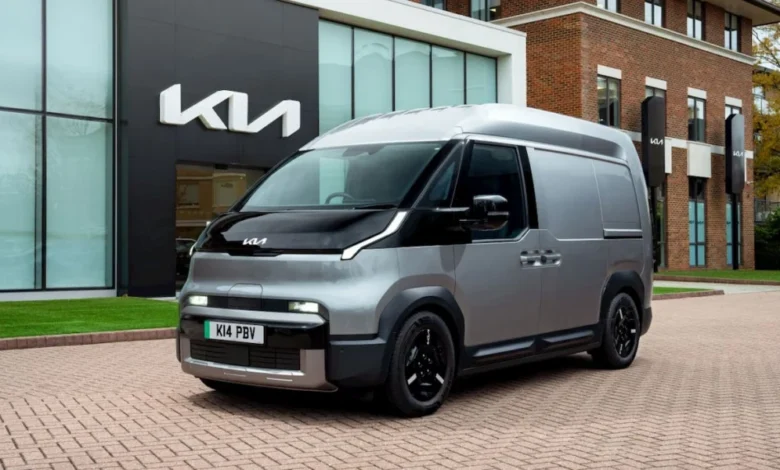
Kia has officially opened order books in the United Kingdom for two highly anticipated additions to its commercial electric vehicle lineup: the PV5 Chassis and the high-roof PV5 Cargo L2/H2. This strategic rollout marks a significant milestone for the South Korean automaker as it accelerates its aggressive push into the commercial fleet and light-duty transport sector. Utilizing Hyundai Motor Group’s dedicated modular skateboard platform—known as the E-GMP.S—the PV5 serves as the vanguard for Kia’s ambitious new Platform Beyond Vehicle (PBV) business division. By engineering an architecture designed from the ground up to support interchangeable body styles and modular applications, Kia is targeting a versatile segment of the market that demands high customization, operational efficiency, and a zero-emission footprint.
The expansion of the PV5 family into the UK market arrives at a critical juncture for commercial operators. With stringent urban low-emission zones, escalating fuel costs, and tightening corporate sustainability mandates dominating the landscape, fleet managers and independent contractors alike are actively seeking scalable electric alternatives to internal combustion engine (ICE) utility vehicles. By introducing specialized variants like an open-bed chassis cab capable of bespoke third-party conversions and an expanded high-capacity cargo van, Kia is positioning itself to capture a diverse cross-section of the European commercial transport ecosystem.
Background and Strategic Vision for Kia’s PBV Business

The genesis of Kia’s Platform Beyond Vehicle strategy traces back to the company’s broader corporate transformation plan, which emphasizes electrification, software-defined mobility, and tailored user experiences. Recognizing that traditional commercial vehicles often require costly and complex aftermarket engineering to suit specialized industrial needs, Kia designed the E-GMP.S skateboard architecture to accommodate limitless configuration possibilities. Unlike passenger cars or traditional unibody vans built on modified passenger platforms, PBVs are conceived as mobile workspaces and utility platforms.
The PV5 represents the foundational model of this strategy. Since its initial conceptual unveiling and subsequent global announcements, industry analysts have closely monitored how Kia plans to execute its modular vision. The core philosophy of the PBV division relies on a flexible manufacturing approach and strategic partnerships with established coachbuilders and conversion specialists. In the UK, this strategy is vividly demonstrated through Kia’s collaboration with the TGS Automotive Group, which provides certified factory-level conversions for the open-bed chassis variant. This partnership ensures that commercial buyers can secure specialized work vehicles—such as tippers, dropsides, and box bodies—directly through official channels while maintaining manufacturer-backed standards and warranties.
Detailed Specifications of the PV5 Chassis and Conversions
At the heart of the UK-spec PV5 Chassis is a robust, long-range 71.2 kWh battery pack, which delivers a targeted WLTP driving range of up to 258 miles (416 km) on a single charge. While international markets may eventually see a standard-range 51.1 kWh configuration, the UK launch prioritizes the extended range to mitigate operational anxiety for trade professionals and municipal service providers operating over mixed urban and rural routes.
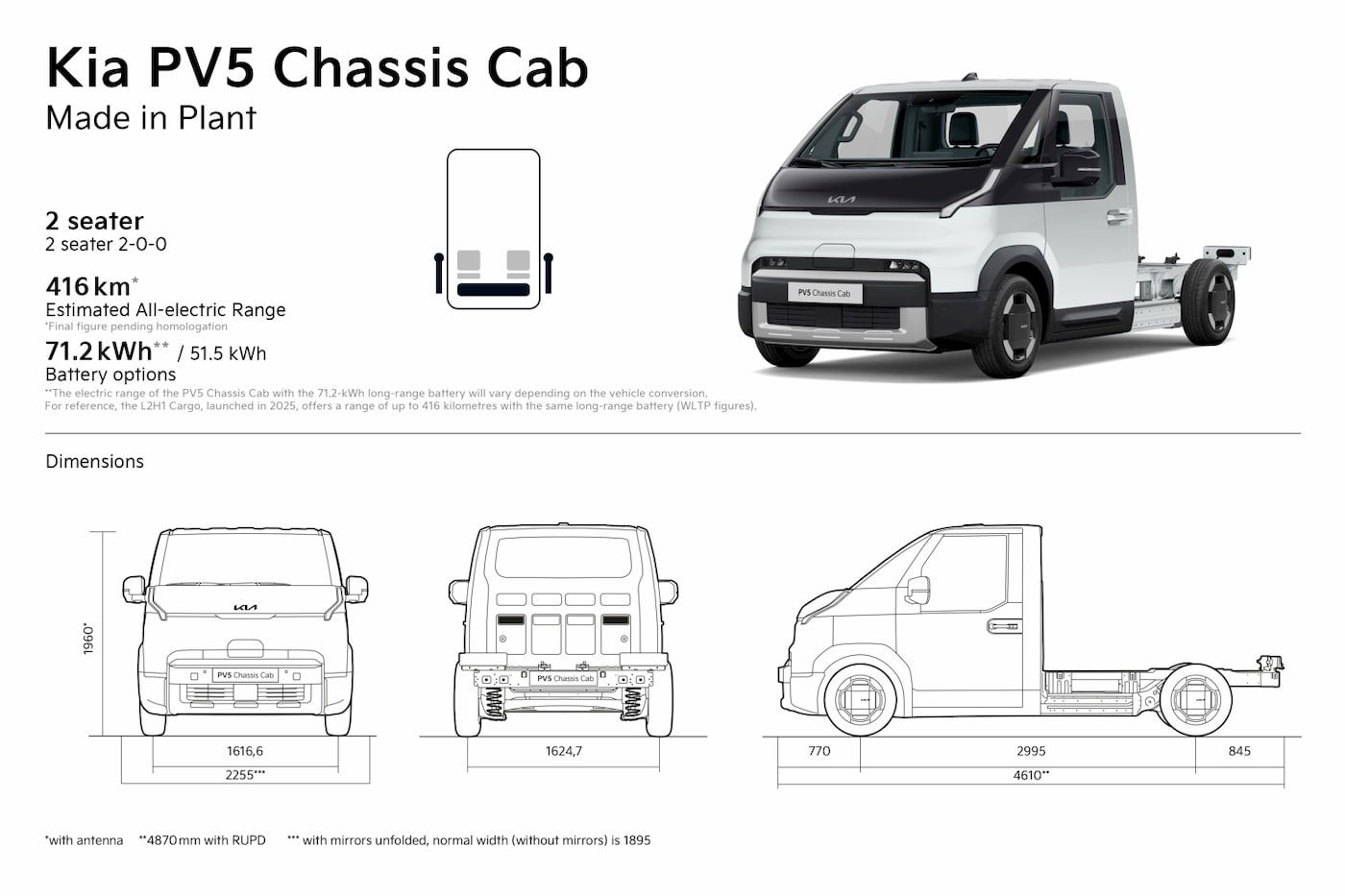
Dimensionally, the PV5 Chassis measures 4,610 mm in length, 1,895 mm in width, and 1,935 mm in height, anchored by a 2,995 mm wheelbase. This compact footprint, paired with a tight 5.5-meter turning radius, is engineered specifically to address the congestion and spatial constraints typical of tight inner-city delivery routes, narrow residential streets, and congested construction sites.
Inside the cabin, the vehicle bridges the gap between rugged utility and modern connectivity. The driver and passenger are greeted by a functional two-seat layout equipped with a contemporary 12.9-inch central touchscreen navigation system and a clear 7.5-inch digital driver display. Crucially for modern commercial operations, wireless Apple CarPlay and Android Auto come standard, ensuring seamless integration of dispatch, navigation, and communication tools.
When it comes to charging capabilities, the PV5 Chassis supports DC fast charging at speeds up to 120 kW. This performance metric allows the 71.2 kWh battery to replenish from 10% to 80% capacity in approximately 30 minutes, minimizing operational downtime during busy shifts. For overnight or depot charging, an 11 kW AC onboard charger facilitates a complete 10% to 100% recharge in roughly 6 hours and 30 minutes.
Because the base chassis is supplied as an "incomplete vehicle," its payload capacity varies depending on the specific superstructure fitted by TGS Automotive Group. Official figures indicate that the Dropside configuration supports a maximum payload of up to 633 kg, while the heavier-duty Tipper model accommodates up to 561 kg.
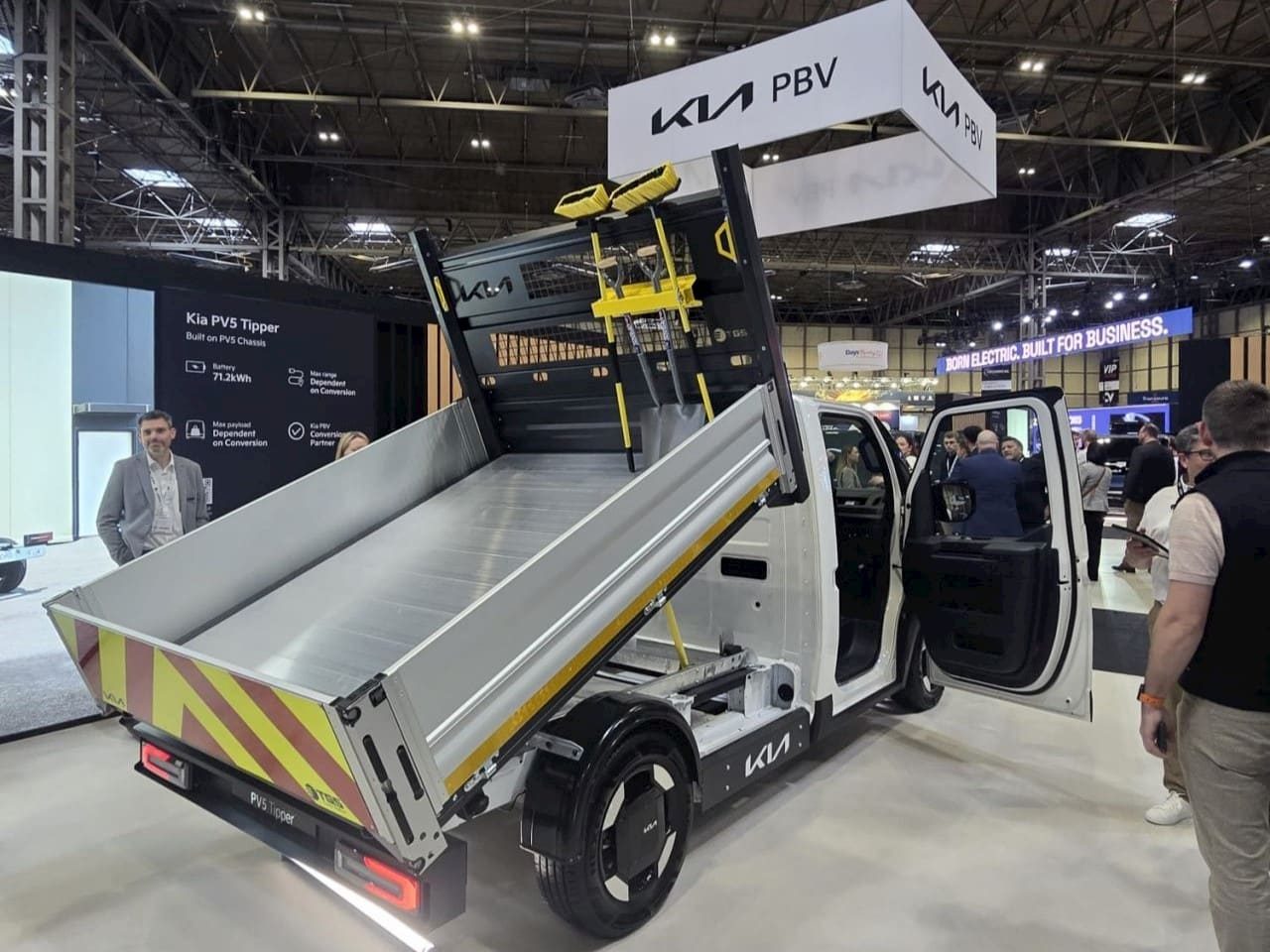
Pricing structure for the PV5 Chassis variants in the UK reflects competitive positioning against established legacy commercial brands. The base PV5 Chassis ‘Plus’ Long Range starts at a basic price of £30,605 (excluding VAT), which adjusts to an on-the-road (OTR) price of £32,916 once accounting for the expected £5,000 UK Zero Emission Van Grant (ZEVG). For fully converted solutions, the PV5 Dropside ‘Plus’ LR starts at an OTR price of £40,110, while the PV5 Tipper ‘Plus’ LR begins at £41,310, inclusive of the government incentive.
The High-Capacity PV5 Cargo L2/H2 Variant
Complementing the chassis cab is the introduction of the PV5 Cargo L2/H2, a larger, high-roof panel van designed to maximize internal volume for couriers, logistics firms, and tradespeople who prioritize vertical storage space.
The Cargo L2/H2 variant measures 4,695 mm long, 1,895 mm wide, and stands at an elevated 2,200 mm tall, while retaining the same 2,995 mm wheelbase found across the PV5 family. The taller roof architecture unlocks an impressive internal cargo area height of 1,815 mm, expanding total load capacity to 5.2 cubic meters—a notable step up from standard low-roof alternatives.

Operational flexibility is a hallmark of the Cargo L2/H2 configuration. Kia offers the model in both three- and four-door layouts, with seating configurations accommodating two or three occupants depending on fleet requirements. The three-door variants support a maximum payload capacity of up to 630 kg, whereas the four-door iterations—featuring dual sliding side doors for enhanced loading and unloading ergonomics—offer a payload capacity of up to 600 kg. Furthermore, both versions boast a robust towing capacity of up to 1,500 kg, broadening their utility for contractors hauling equipment trailers.
Underneath the sheet metal, the Cargo L2/H2 relies on the same 71.2 kWh battery architecture as its chassis counterpart, delivering a WLTP-certified driving range of up to 239 miles. The cabin environment mirrors the passenger-centric ergonomics of the wider PV5 lineup, featuring the signature 12.9-inch touchscreen navigation unit and 7.5-inch driver cluster.
Pricing for the PV5 Cargo L2/H2 range in the UK spans several trim levels and seating options:
- PV5 Cargo L2/H2 ‘Essential’ (Two-seat LR): Basic price £32,355; OTR price £35,016 (including £5,000 ZEVG).
- PV5 Cargo L2/H2 ‘Essential’ (Three-seat LR): Basic price £32,355; OTR price £35,016.
- PV5 Cargo L2/H2 ‘Plus’ (Two-seat LR): Basic price £33,355; OTR price £36,216.
- PV5 Cargo L2/H2 ‘Plus’ (Three-seat LR): Basic price £33,355; OTR price £36,216.
- PV5 Cargo L2/H2 ‘Plus Walk Through’ LR: Basic price £34,425; OTR price £37,500.
Market Implications and Economic Analysis

The commercial release of these two PV5 variants arrives at a transformative period for the British light commercial vehicle (LCV) market. Fleet operators face escalating pressure from both regulatory frameworks—such as expanding Clean Air Zones and Ultra Low Emission Zones (ULEZ)—and corporate environmental, social, and governance (ESG) reporting requirements.
However, transitioning commercial fleets to electric power has historically been hampered by high initial acquisition costs, limited model variety in specialized sectors like tippers and dropsides, and concerns over operational range and payload trade-offs. Kia’s pricing strategy, which factors in the £5,000 Zero Emission Van Grant, aims to blunt the initial capital expenditure hurdle. With entry-level OTR pricing hovering around the mid-£30,000 threshold for cargo variants and low-£40,000 figures for fully converted utility variants, the PV5 undercuts several legacy European competitors while offering superior native-EV skateboard architecture rather than retrofitted internal combustion platforms.
Industry analysts suggest that the true competitive advantage of the PV5 platform lies in its software-defined vehicle (SDV) capabilities and holistic fleet management ecosystem. By integrating advanced telematics, predictive maintenance scheduling, and modular interior packaging, Kia is attempting to sell an integrated operational solution rather than merely a vehicle. For small-to-medium enterprises (SMEs) and large national fleets alike, the ability to acquire a factory-backed tipper or dropside electric vehicle without wading through complex third-party homologation processes represents a significant reduction in operational friction.
Looking ahead, as order books expand and initial customer deliveries commence across the UK, the performance and reliability of the E-GMP.S platform in demanding commercial environments will serve as a bellwether for Kia’s broader global PBV ambitions. If the PV5 can successfully prove its durability, range accuracy, and total cost of ownership advantages in real-world commercial applications, it could fundamentally alter the competitive landscape of the light electric commercial vehicle market across Europe and beyond.