Analysis of Tesla Q2 2026 Financials Reveals Stagnation in Robotaxi Growth Despite Corporate Expansion Claims

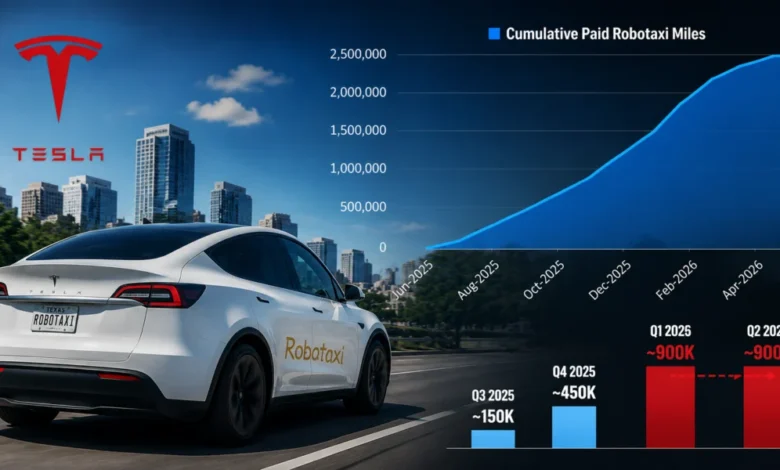
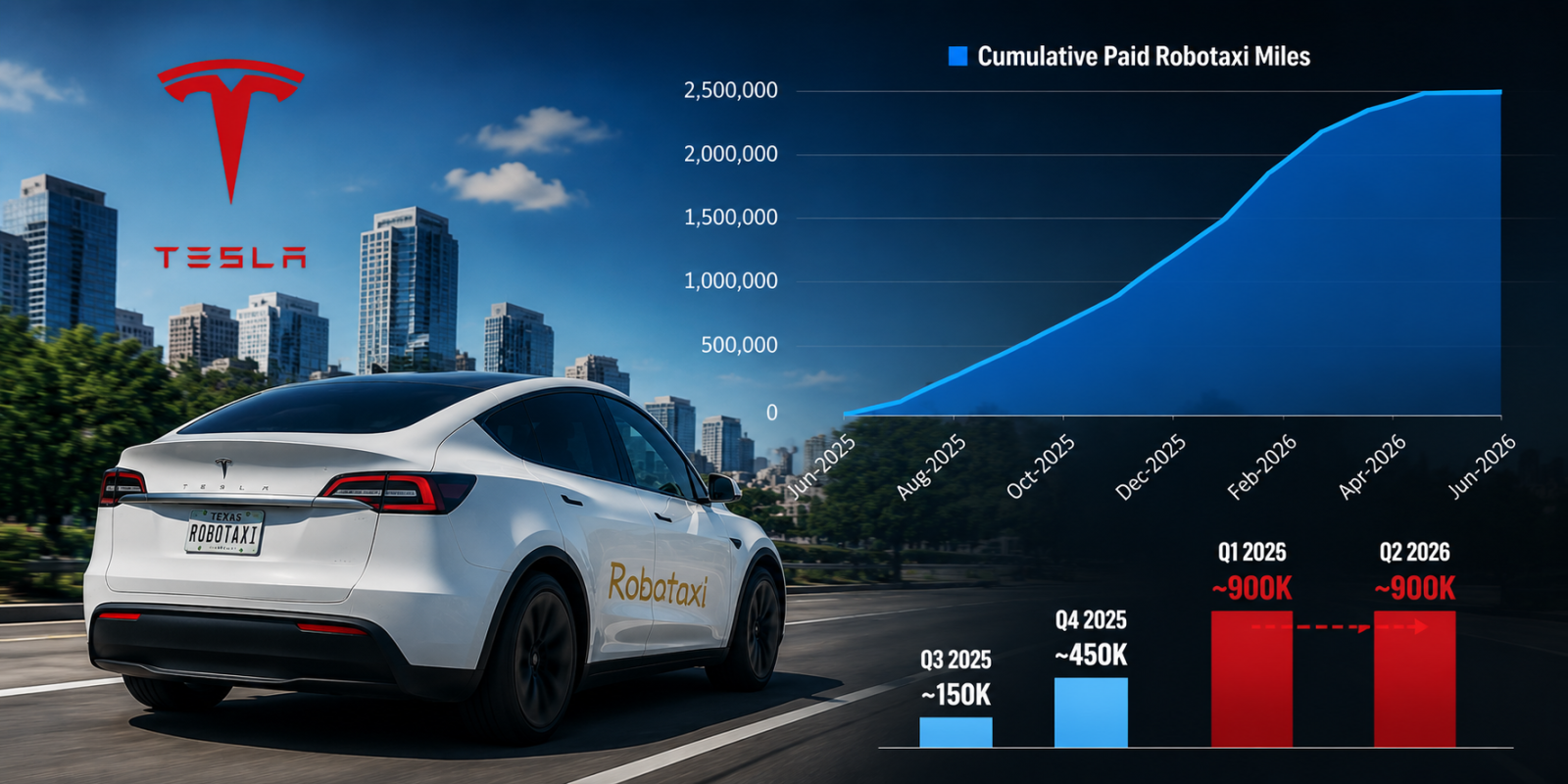
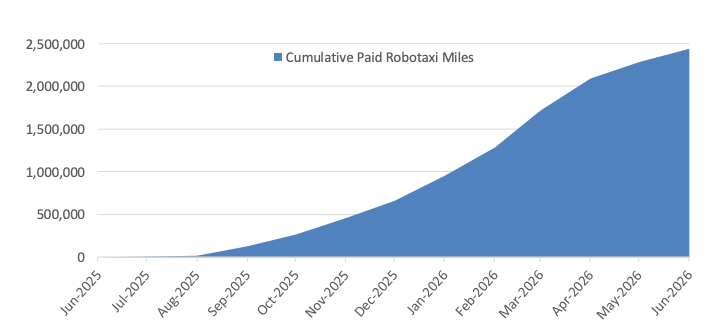
In its second-quarter 2026 financial update, Tesla Inc. presented shareholders with a narrative of aggressive expansion regarding its proprietary Robotaxi service. Central to this narrative was a cumulative "paid Robotaxi miles" chart, which showcased a climb surpassing the 2.4 million-mile milestone. While the upward trajectory of a cumulative graph is designed to convey momentum, a granular analysis of the underlying data suggests a different reality. When the quarterly figures are isolated, the data reveals that Tesla’s autonomous ride-hailing growth has effectively reached a plateau, with the second quarter of 2026 failing to exceed the performance metrics established in the first quarter.
The discrepancy between Tesla’s public messaging and its operational data highlights a pivotal moment for the electric vehicle manufacturer. As the company increasingly tethers its market valuation to artificial intelligence and autonomous software rather than hardware sales alone, the stagnation of its Robotaxi pilot program raises significant questions about the scalability of its Full Self-Driving (FSD) technology and its ability to compete with established autonomous vehicle (AV) leaders.
The Cumulative Chart Fallacy and Quarterly Reality
In corporate reporting, cumulative charts are frequently utilized to maintain a positive visual trend. Because a cumulative total only adds new data to a running sum, the resulting line will invariably move upward and to the right, regardless of whether the rate of growth is accelerating, slowing, or remaining stagnant. To discern the actual health of a business unit, analysts must calculate the "delta"—the specific change occurring within a set period.

According to Tesla’s Q2 2026 update, the Robotaxi service added approximately 900,000 paid miles during the three-month window. While this figure contributes to the impressive 2.4 million-mile total, it is nearly identical to the 900,000 miles added during Q1 2026. This flat quarter-over-quarter performance indicates that the "ramp-up" phase observed throughout late 2025 has stalled.
Furthermore, a monthly breakdown of the Q2 data suggests a concerning decelerating trend toward the end of the period. Estimates derived from the company’s internal curves indicate that nearly 500,000 of the quarter’s miles were logged in April alone. This implies that May and June combined for only 400,000 miles, or an average of 200,000 miles per month. If this run-rate continues, Tesla would exit the quarter on pace for only 600,000 miles in Q3, a significant drop from the 900,000-mile quarterly average.
A History of Autonomy Promises: A Chronology of Guidance
To understand the weight of the current stagnation, one must view it through the lens of Tesla’s historical commitments to autonomous driving. CEO Elon Musk has long positioned autonomy as the primary driver of Tesla’s future value.
- 2016: Tesla announced that all vehicles being produced had the necessary hardware for full self-driving.
- 2019: During Tesla’s "Autonomy Day," Musk predicted that the company would have one million "Robotaxis" on the road by 2020, allowing owners to earn income by adding their cars to a shared network.
- 2022-2023: Tesla shifted focus toward a dedicated Robotaxi vehicle platform, moving away from the idea that existing consumer models would simply receive a software update to become fully autonomous.
- Early 2026: Tesla officially launched its paid Robotaxi pilot in select Texas markets, billing it as the beginning of a global rollout.
The Q2 2026 results represent the third consecutive earnings report where the company has failed to meet its own short-term internal guidance for fleet expansion and mileage growth. This pattern has led to increased scrutiny from institutional investors who are seeking tangible evidence that Tesla can transition from a supervised driver-assist system to a truly driverless commercial service.
Geographic Expansion vs. Fleet Density
In an effort to counter the narrative of slowing growth, Tesla announced on July 21, 2026—just one day prior to its earnings call—that it was expanding its Robotaxi service areas to include Tampa and Orlando, Florida. This added to its existing operations in Austin and Dallas, Texas. However, data suggests that increasing the number of "dots on a map" has not correlated with an increase in the number of active vehicles.
Reports indicate that Tesla’s active "unsupervised" fleet—referring to the internal testing designation—remains remarkably small, hovering around 21 to 25 vehicles across all four metropolitan areas. In Austin, which served as the primary launch site, the fleet size actually appears to have contracted. After peaking at 25 vehicles in late April, the number of active units in the city drifted down to approximately 17 by the end of June.
This suggests that Tesla is spreading a static or shrinking pool of resources across a wider geographic footprint. While this strategy may create the appearance of a growing network, it often results in longer wait times for users and lower overall throughput, as fewer cars are available per square mile in each city. The flat mileage data for Q2 is the statistical manifestation of this stagnant fleet size.
The Human Factor: Supervised vs. Driverless Operations
A critical distinction remains between Tesla’s Robotaxi service and those of its competitors: the presence of a human safety monitor. Despite the "Robotaxi" branding, the majority of Tesla’s paid rides, particularly those operating under California’s regulatory framework, still require a Tesla employee to sit in the driver’s seat.
While these rides are "paid" and contribute to the mileage charts shown to investors, they do not represent the autonomous "Level 4" or "Level 5" capabilities that the company has promised. Instead, they function as a supervised pilot program with a paywall. The reliance on human monitors limits the service’s profitability, as the labor costs associated with the safety driver negate the primary economic advantage of a robotaxi—the removal of the human operator.
In contrast, competitors like Waymo (owned by Alphabet Inc.) have successfully transitioned to fully driverless operations in multiple cities, including Phoenix, San Francisco, and Los Angeles. Waymo currently completes over 100,000 paid, truly driverless trips per week. To put Tesla’s scale into perspective, its entire cumulative history of 2.4 million miles is roughly equivalent to what Waymo’s fleet covers in a matter of weeks.
Market Reactions and Investor Concerns
During the Q2 2026 earnings Q&A session, shareholders expressed growing impatience with the pace of the Robotaxi rollout. The primary concern among analysts is the "valuation gap." Tesla currently trades at a price-to-earnings (P/E) ratio that far exceeds traditional automotive manufacturers like Ford or Toyota. This premium is based on the expectation that Tesla will eventually dominate the autonomous software and ride-hailing markets.
If the Robotaxi service continues to show flat growth and a shrinking fleet, the justification for this premium valuation begins to erode. Analysts from several major firms noted that the "flat" Q2 performance suggests Tesla is encountering unforeseen technical or regulatory hurdles in transitioning its FSD software from a consumer convenience feature to a robust commercial taxi platform.
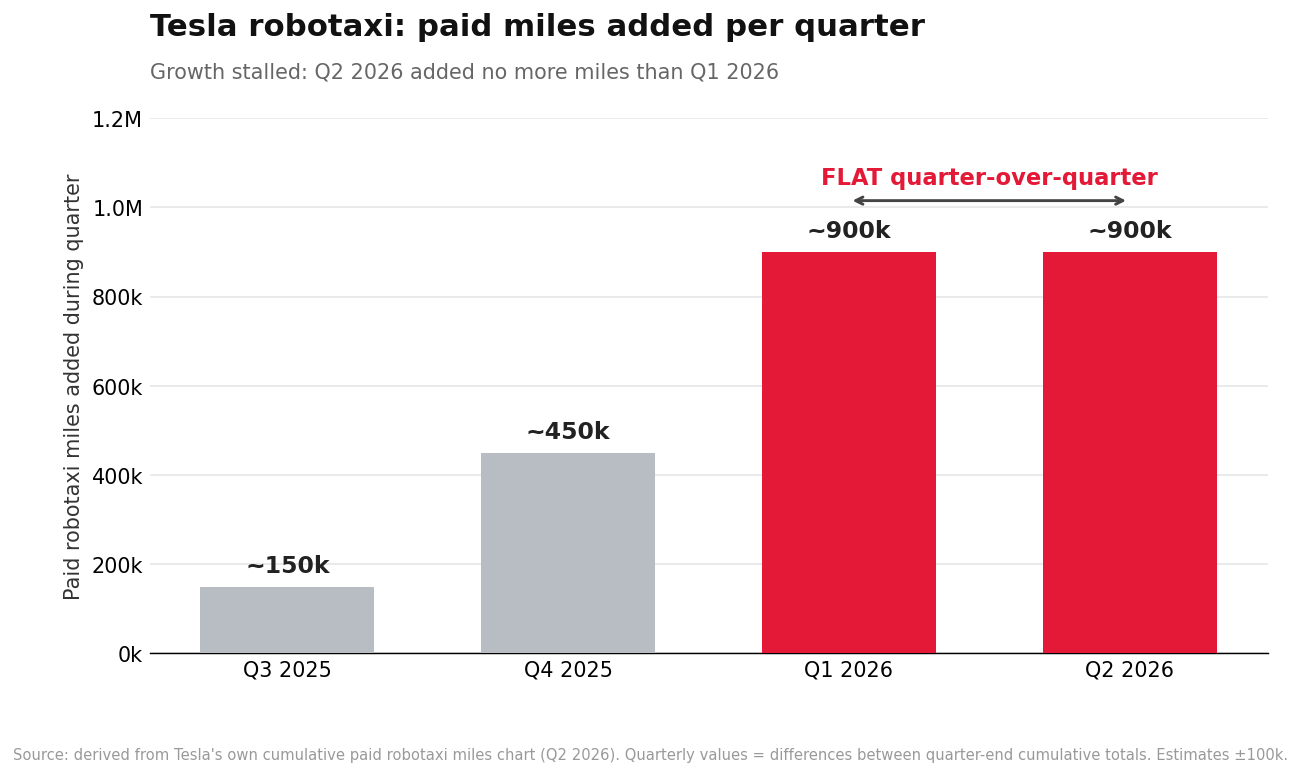
"The chart provided in the deck is technically accurate, but it is contextually misleading," noted one senior automotive analyst. "If you are an investor looking for a growth story, you don’t look at the cumulative total; you look at the quarterly velocity. And right now, the velocity is zero."
Implications for the Future of Autonomous Ride-Hailing
The stagnation of Tesla’s Robotaxi growth carries broader implications for the autonomous vehicle industry. It underscores the immense difficulty of moving from "99% autonomous" to "100% autonomous." Tesla’s approach, which relies primarily on computer vision (cameras) rather than the LiDAR (Light Detection and Ranging) sensors used by Waymo and Zoox, continues to be a point of intense debate among engineers.
The flat mileage figures may suggest that Tesla’s vision-only system is struggling with the "long tail" of rare edge cases—complex traffic scenarios that occur infrequently but must be handled perfectly for a vehicle to operate safely without a human monitor.
Furthermore, the regulatory environment remains a significant hurdle. While Texas has been relatively permissive for AV testing, other states require more rigorous data sharing regarding "disengagements" (instances where a human must take control). Tesla’s reluctance to release detailed disengagement data for its Robotaxi fleet has led to friction with some municipal transportation authorities, potentially slowing its ability to scale in key urban markets.

Conclusion: The Road Ahead
As Tesla moves into the second half of 2026, the pressure to revitalize its Robotaxi growth will be immense. To regain investor confidence, the company will likely need to demonstrate a significant increase in its active fleet size and a clear path toward removing the safety driver from its commercial operations.
The data from the Q2 2026 update serves as a reality check against the high-octane rhetoric often associated with Tesla’s autonomy goals. While 2.4 million cumulative miles is a notable achievement for any pilot program, it remains a fraction of the distance required to prove the safety and reliability of a global autonomous network. Until the quarterly mileage additions begin to show an upward curve again, the claim that the service is "expanding" remains a projection rather than a proven reality. The question for the Q3 earnings call is now clearly defined: if the service area is growing and the technology is improving, why has the output remained the same?
Related posts: