GoSun Unveils the Moonrider 27: An All-Electric Solar-Chargeable Farm Tractor Aiming to Transform Small-Scale Agriculture

The market for agricultural utility vehicles has long been dominated by fossil fuels, but Ohio-based clean technology firm GoSun is looking to disrupt the status quo with the introduction of the Moonrider 27. Co-developed in partnership with Indian tractor manufacturer Moonrider, the new all-electric utility vehicle introduces integrated solar-charging capabilities designed to reduce both the financial and environmental costs of small-scale farming and property management. While previous attempts to introduce electric tractors have often struggled with market adoption due to battery limitations and charging infrastructure constraints, GoSun’s innovative approach to autonomous, renewable energy replenishment aims to offer a viable, cost-effective alternative to traditional diesel machinery.
Main Facts and Specifications of the Moonrider 27
At the core of the GoSun Moonrider 27 is a 20 kW electric motor—roughly equivalent to 27 horsepower—engineered to deliver instantaneous torque to all four wheels. This four-wheel-drive system ensures optimal traction and robust pulling power across a diverse array of challenging terrains, from muddy fields to uneven orchard floors.

Powering the electric drivetrain is a 24 kWh Lithium Iron Phosphate (LFP) battery pack. According to the manufacturer, this energy storage system is capable of delivering up to five hours of continuous operation under standard load conditions. For the average hobby farm, small-scale agricultural producer, or property manager, a five-hour operational window easily translates to a full day of routine chores, including hauling, mowing, and light tilling.
Crucially, the Moonrider 27 retains industry-standard utility features, such as a rear-mounted 540 rpm mechanical power take-off (PTO). This inclusion allows operators to utilize pre-existing farm implements—ranging from rototillers and brush mowers to post-hole diggers—that are already present in their barns, eliminating the need for costly equipment upgrades.
The Integration of Solar Charging Technology
What sets the Moonrider 27 apart from other electric tractors currently in development is its emphasis on off-grid energy generation. While the vehicle can be charged conventionally using a standard 220/240V AC Level 2 electrical outlet, it also features an optional 1.1 kW integrated solar array designed to harness ambient sunlight while parked or even during daylight operations.
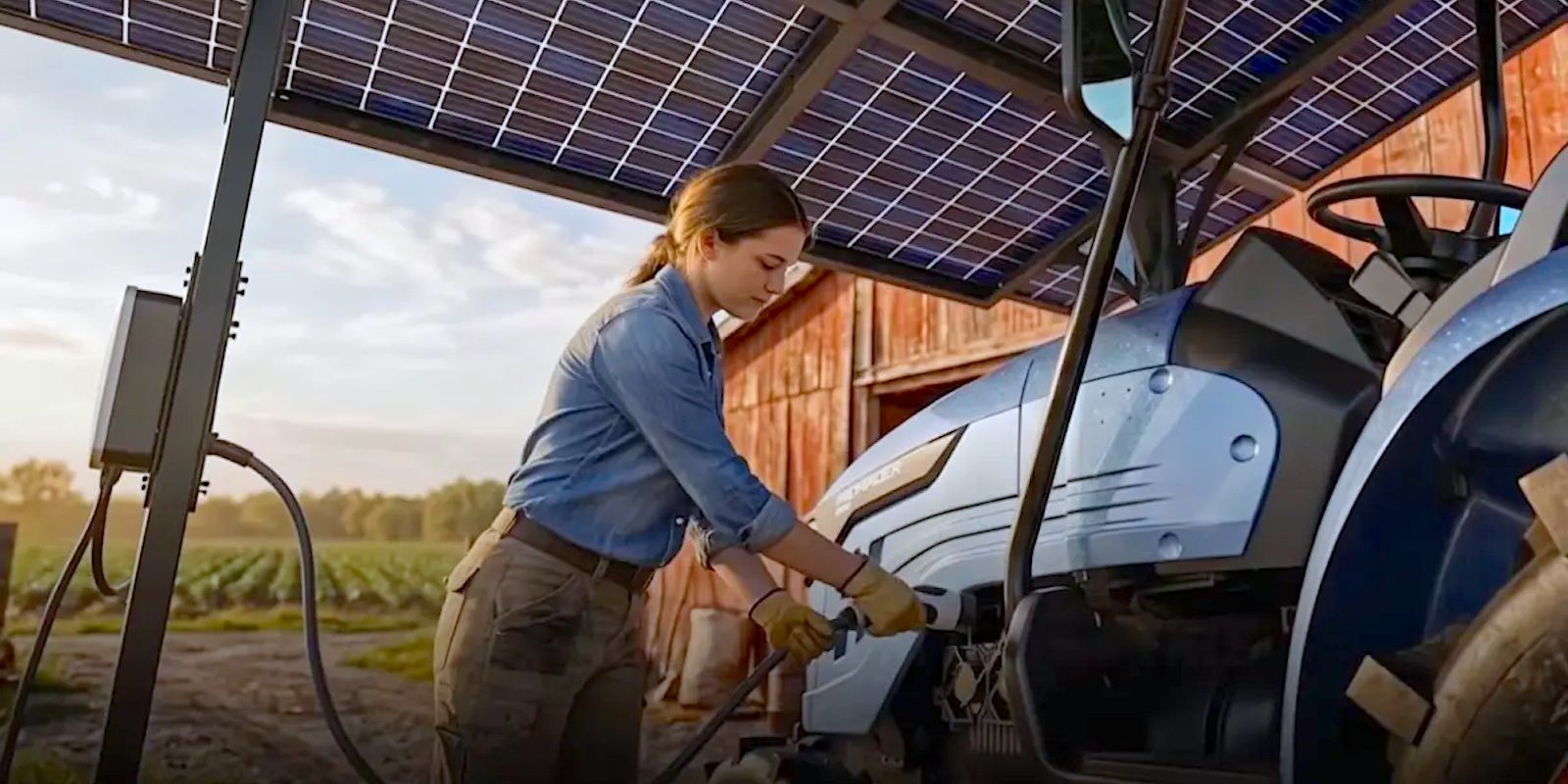
GoSun notes that during peak sunlight months, the integrated solar array can generate enough electricity to provide approximately 1.5 hours of additional runtime on a sunny day. For operators who utilize the tractor intermittently rather than running it to depletion daily, the solar canopy effectively reduces or entirely eliminates the need to plug the vehicle into an external power source. Under optimal conditions, properties with moderate usage profiles may go days, weeks, or even months without traditional recharging, marrying agricultural utility with decentralized solar energy production.
Background Context and the Evolution of Electric Agriculture
The agricultural sector accounts for a significant portion of global greenhouse gas emissions, with diesel-powered machinery contributing heavily to both carbon output and local air and noise pollution. For decades, traditional tractor manufacturers have prioritized internal combustion engines due to their reliability, high torque output, and extended operational ranges during peak harvest seasons.
However, the rapid advancement of lithium-ion and LFP battery chemistries, coupled with falling costs for photovoltaic panels, has catalyzed a reevaluation of electric mobility in heavy industries. While large-scale commercial farming operations requiring massive horsepower and round-the-clock harvesting cycles remain challenging territory for current battery technology, the compact utility tractor segment—often operating on small acreage where daily tasks require fewer than 30 horsepower—represents a ripe market for electrification.

GoSun, historically recognized for its portable solar cookers and off-grid consumer appliances, has steadily expanded its footprint into larger solar-powered ecosystems. The collaboration with Moonrider brings specialized heavy-machinery manufacturing expertise together with GoSun’s consumer-focused clean energy design philosophy.
Statements and Industry Perspective
The commercial launch of the Moonrider 27 underscores a growing industry shift toward sustainable property management. Addressing the rationale behind the vehicle’s development, GoSun founder and CEO Patrick Sherwin emphasized the liberation that renewable-powered equipment offers to rural landowners.
"Small-scale farming and property management have relied on noisy, costly diesel utility vehicles for far too long," said Sherwin. "With our new All-Electric Tractor, we are empowering farmers and land managers to literally work in the sunshine—reducing operational costs while protecting the soil and air."

By eliminating the need for regular trips to fuel stations, reducing engine noise to near-zero levels, and removing the maintenance overhead associated with internal combustion engines—such as oil changes, spark plug replacements, and exhaust system repairs—the Moonrider 27 aims to lower the total cost of ownership for agrarian workers.
Broader Impact and Market Implications
The introduction of the Moonrider 27 arrives at a critical juncture for the North American and global compact tractor markets. While several major agricultural equipment manufacturers have introduced prototype or limited-production electric tractors, widespread adoption has been hindered by high initial purchase prices and a lack of standardized charging infrastructure in rural fields.
By integrating photovoltaic generation directly onto the vehicle, GoSun attempts to bypass the infrastructure bottleneck. Farmers working in remote fields do not need to rely on localized grid tie-ins to replenish their equipment’s batteries; the energy source travels with the machine.

Furthermore, the environmental implications extend beyond carbon reduction. Electric utility vehicles produce no localized particulate emissions, making them ideal for enclosed spaces such as greenhouses, barns, and livestock facilities where diesel exhaust poses health risks to both workers and animals. Additionally, the quiet operation of electric motors reduces stress on livestock and improves communication among farm workers.
As regulatory pressures mount and fuel prices remain volatile, the success of the GoSun Moonrider 27 may serve as a bellwether for the viability of solar-assisted electric utility vehicles in mainstream agriculture. If small-scale farmers embrace a tractor that can largely sustain its own energy needs through sunlight, the agricultural industry may witness an accelerated transition away from fossil-fueled utility equipment in the years to come.
Related posts: