In a landmark development that has sent ripples through India’s political landscape, Dharmendra Pradhan, the Union Minister for Education, tendered his resignation on Saturday afternoon, bowing to immense public pressure following a week of escalating mass demonstrations led by a burgeoning youth movement. This unprecedented concession marks a significant victory for the newly formed Cockroach Janata Party (CJP) and represents the first instance in 12 years of the Bharatiya Janata Party’s (BJP) governance where a high-profile minister, known for his staunch loyalty to Prime Minister Narendra Modi, has been compelled to step down due to widespread public dissent. The resignation underscores a pivotal shift in the dynamics of public accountability and youth activism in the world’s largest democracy.
Pradhan’s announcement, made via a social media post, cited the prevailing "situation that has arisen at Jantar Mantar and across the country" and expressed a desire to prevent "anti-national forces" from exploiting the unrest. He affirmed his deep respect for "the aspirations, feelings, and legitimate expectations of the country’s youth." This carefully worded statement acknowledged the gravity of the situation while attempting to frame his departure in terms of national stability rather than a direct admission of fault or failure. The minister had been at the epicentre of a national uproar stemming from a series of high-stakes examination leaks that have jeopardized the futures of millions of students across India.
The Genesis of Discontent: A Cascade of Exam Leaks
The crisis that ultimately led to Pradhan’s downfall began months ago with reports of widespread irregularities and question paper leaks in several crucial national entrance examinations. These included, but were not limited to, the National Eligibility cum Entrance Test (NEET), a gateway for medical admissions, and the University Grants Commission-National Eligibility Test (UGC-NET), vital for university professorships and research fellowships. The magnitude of these leaks was staggering; it is estimated that over 2.4 million candidates appeared for NEET alone, with millions more affected by other compromised exams. The leaks exposed deep systemic flaws within the examination bodies, including the National Testing Agency (NTA), responsible for conducting these high-stakes tests.
The impact on students was immediate and devastating. Months, and in many cases, years of rigorous preparation, often under immense financial strain for families, were rendered meaningless. Reports of widespread despondency, anxiety, and even instances of student suicides emerged from various parts of the country, highlighting the profound emotional and psychological toll. At least a dozen student suicides were tragically linked to the exam scandal, turning a bureaucratic failure into a national tragedy. Parents, many of whom had invested their life savings in coaching classes and study materials, voiced their anguish and anger, demanding justice and accountability. The perceived apathy and slow response from the education ministry initially only fueled their frustration.
The Emergence of the Cockroach Janata Party (CJP)
In the vacuum of effective government response, a new, unconventional youth political movement coalesced: the Cockroach Janata Party (CJP). The name, intentionally provocative and self-deprecating, was inspired by a viral meme that emerged online, likening the marginalized, often ignored youth to resilient "cockroaches" who, despite being trodden upon, would persist and multiply. Far from being a traditional political party with a formal structure, the CJP rapidly grew into a decentralized, digitally-driven collective, leveraging social media platforms to organize, mobilize, and amplify its demands. Its primary objective was singular: the resignation of Dharmendra Pradhan, whom they held directly responsible for the systemic failures leading to the exam leaks.
The CJP’s early activities, commencing in May, involved online petitions, social media campaigns, and smaller, localized protests. Their leaders, many of them students or recent graduates, adopted powerful forms of civil disobedience, including lengthy hunger strikes in Delhi, drawing public sympathy and media attention. The movement effectively tapped into a broader undercurrent of youth discontent, not just about exam irregularities but also about perceived government neglect of employment opportunities, educational quality, and the overall future prospects of India’s vast young population. The CJP articulated a sense of disillusionment that resonated deeply, transforming their specific demand into a symbol of a larger struggle for justice and transparency.
A Week of Unprecedented Mobilization and Confrontation
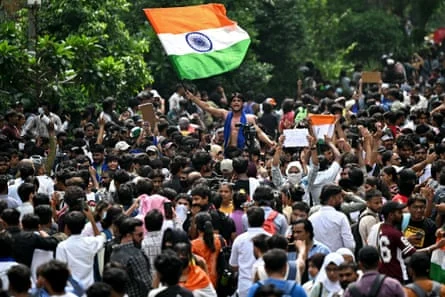
The protests reached a critical juncture and escalated dramatically during the past week, culminating in a nationwide uprising that severely tested the Modi government’s resolve. On Monday, the CJP orchestrated a massive demonstration in Delhi, drawing hundreds of thousands of young people and students to the streets, marking one of the largest youth-led protests seen in the capital in years. What began as peaceful gatherings, however, quickly turned confrontational as law enforcement agencies responded with force. Police deployed tear gas, water cannons, and baton charges against the protesters, leading to hundreds of injuries and further galvanizing public outrage. Images and videos of the police crackdown circulated widely, fueling accusations of state repression and strengthening the resolve of the demonstrators.
Throughout the week, the Delhi sit-in at Jantar Mantar became a focal point of national dissent, with thousands continuously flocking to express solidarity and demand Pradhan’s resignation. The movement was not confined to the capital; demonstrations erupted spontaneously across the country, with hundreds of thousands reportedly taking to the streets in major metropolitan centers like Kolkata, Mumbai, Bengaluru, and Chennai. Universities and colleges became hubs of activism, as students boycotted classes and organized solidarity marches. The sheer scale and organic nature of these protests, largely driven by social media coordination and peer mobilization, presented an unprecedented challenge to the BJP, a party known for its robust organizational machinery and strong control over public discourse.

Government’s Shifting Stance and Pradhan’s Exit
For several weeks leading up to this intensified phase, the Modi government had largely adopted a posture of dismissive silence towards the CJP protesters. Official statements downplayed the significance of the demonstrations, and initial responses focused on bureaucratic reviews rather than addressing the core demand for ministerial accountability. However, as the movement swelled into an undeniable mass phenomenon, the government’s stance began to shift. The sheer numbers, combined with the widespread media coverage and the increasing political pressure, forced the administration to acknowledge the crisis.
Just hours before CJP leaders were scheduled to meet with senior BJP ministers to reiterate their non-negotiable demand for Pradhan’s resignation, the education minister made his pivotal announcement. This timing suggests a strategic move to preempt the meeting, perhaps to manage the narrative or to prevent further escalation that a public refusal might have triggered. While Prime Minister Modi had earlier agreed to fast-track investigations into the exam leaks and ensure justice for affected students, he had conspicuously avoided any mention of Pradhan’s potential removal. Pradhan’s resignation, therefore, represents a significant capitulation, demonstrating the extraordinary power of sustained public pressure, particularly from a unified youth front.
Reactions and Implications
The news of Pradhan’s stepping down was met with ecstatic celebrations by tens of thousands of CJP supporters gathered at Jantar Mantar in Delhi. Cheers erupted, flags waved, and slogans of "Victory for Youth!" and "Accountability Achieved!" reverberated through the crowd. CJP leaders, while celebrating the immediate win, were quick to emphasize that this was merely the first step. They reiterated their commitment to ensuring comprehensive reforms in the examination system, swift justice for the victims of the leaks, and greater transparency and accountability from all government institutions. "This is not the end, but the beginning," declared a prominent CJP youth leader, highlighting their intention to remain vigilant.
The Prime Minister’s Office (PMO) swiftly issued a brief statement confirming the acceptance of Pradhan’s resignation. While expressing regret over the circumstances, the PMO statement praised Pradhan’s past contributions to the education sector and reaffirmed the government’s commitment to safeguarding the integrity of India’s examination system and securing the future of its youth. This immediate damage control effort aimed to stabilize the political fallout and project an image of responsive governance.
Opposition parties, who had largely supported the CJP’s demands, seized upon the development as a significant blow to the BJP. Leaders from various opposition fronts lauded the youth movement for its tenacity and effectiveness, calling Pradhan’s resignation a testament to the government’s inability to ignore public sentiment indefinitely. They demanded a broader inquiry into the systemic corruption within examination bodies and called for a comprehensive overhaul of the education ministry’s oversight mechanisms. Many analysts view this as a potential rallying point for a fragmented opposition, offering a template for future collective action against the ruling party.
For the BJP, Pradhan’s resignation is a moment of introspection. While it may temporarily defuse the immediate crisis, it also sets a powerful precedent. For over a decade, the Modi government has been characterized by its remarkable resilience to public pressure, often riding out controversies with minimal political cost. This incident demonstrates that even loyal, high-ranking ministers are not immune to public accountability, especially when faced with a mobilized and determined populace. It signals a potential shift in the political landscape, empowering youth movements and potentially encouraging greater assertiveness from civil society in demanding transparency and good governance.
The Path Forward: Education Reform and Accountability
The departure of Dharmendra Pradhan opens a new chapter for India’s education sector. The immediate challenge for the government will be to appoint a successor who can restore confidence in the examination system and address the deep-seated issues that led to the leaks. This will necessitate not just superficial changes but potentially fundamental structural reforms within the NTA and other examination bodies. Calls for independent oversight, robust technological safeguards against paper leaks, and stricter penalties for those involved in such malpractices are likely to intensify.
Beyond the immediate crisis, the CJP’s success carries profound implications for Indian democracy. It has showcased the latent power of organized youth, demonstrating their capacity to influence policy and demand accountability from even the most entrenched political establishments. The "cockroach meme" has evolved into a symbol of resilience and collective power, potentially inspiring other marginalized groups to mobilize. This episode could mark the beginning of a new era of youth activism, where digital tools and grassroots organizing converge to challenge traditional power structures. The Modi government, now having faced an unprecedented direct challenge to its authority, will likely need to recalibrate its approach to public grievances, acknowledging that ignoring the "aspirations, feelings, and legitimate expectations" of India’s vast youth population comes with significant political risks. The nation watches to see if this victory for youth will translate into lasting reforms and a more accountable governance framework.
Related posts: