Robert Kraft Confirms Decision to Bar Macklemore from Gillette Stadium Over Pro-Palestine Statements and Antisemitism Concerns

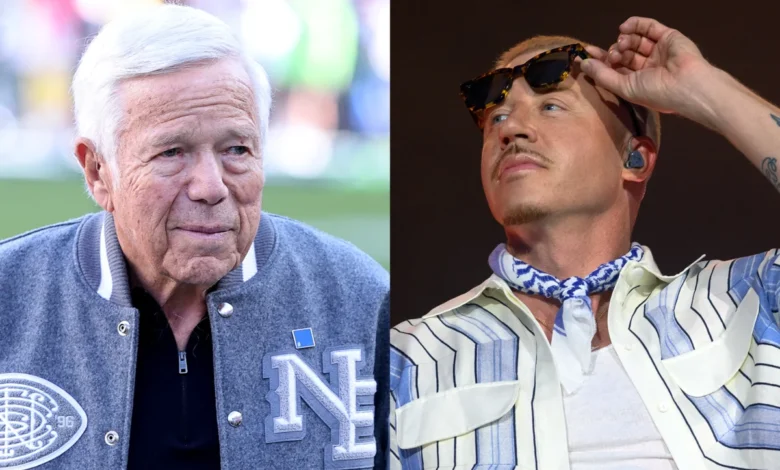
The intersection of sports, entertainment, and geopolitical activism has once again taken center stage, resulting in the high-profile removal of Grammy-winning rapper Macklemore from Ed Sheeran’s ongoing Loop tour. New England Patriots owner Robert Kraft has officially confirmed that he personally barred the Seattle-born artist from performing at Gillette Stadium. The decision follows a series of controversial on-stage statements and demonstrations by Macklemore regarding the ongoing Israel-Hamas war, bringing renewed scrutiny to the boundaries of free speech, political expression, and the responsibilities of major venue operators in the United States.
The controversy escalated rapidly after Macklemore, whose legal name is Ben Haggerty, joined Sheeran’s tour in early September for consecutive performances at MetLife Stadium in East Rutherford, New Jersey. During the initial concert, the rapper utilized his platform to voice explicit support for Palestinians, shouting "Free Palestine" to a stadium audience. Furthermore, he displayed graphic imagery depicting the humanitarian devastation in Gaza and the West Bank, and performed his politically charged protest song "Hind’s Hall." The track, which gained significant traction online, was originally written in honor of pro-Palestinian student demonstrators at Columbia University.
The Fallout and the Tour Removal
Following the performances at MetLife Stadium, industry whispers quickly turned into public disclosures as Macklemore was abruptly dropped not only from the upcoming Gillette Stadium dates in Foxborough, Massachusetts, but from the remainder of Ed Sheeran’s tour entirely. In a public statement addressing the removal, Macklemore alleged that Robert Kraft had directly contacted Ed Sheeran to inform him that the rapper would be prohibited from entering the stadium.
Moreover, Macklemore leveled a more expansive allegation against the billionaire Patriots owner and sports mogul. According to the rapper, Kraft allegedly coordinated with a coalition of other major sports stadium owners, issuing an ultimatum to Sheeran’s management: keep Macklemore on the bill, and face a blanket ban across multiple high-capacity venues nationwide. While Kraft’s representatives did not immediately respond to requests for comment regarding the alleged venue-owner coalition, Kraft readily acknowledged his direct role in keeping the rapper out of Gillette Stadium.
Robert Kraft’s Defense and Rationale
In a formal statement provided to media outlets, Robert Kraft defended his decision, anchoring it firmly in the venue’s stated policies against hate speech and discrimination. Kraft, who is Jewish and has a long-standing history of philanthropy supporting Jewish and Israeli causes, asserted that his choice was driven by Macklemore’s recent actions as well as historical incidents.
Kraft specifically pointed to what he termed a "broader history of antisemitic rhetoric and imagery" linked to the rapper. Observers noted this was an apparent reference to a heavily scrutinized 2014 incident where Macklemore wore a costume featuring a prosthetic nose, wig, and beard during a surprise appearance in Seattle. The costume drew swift accusations of antisemitic caricature. At the time, Macklemore issued a public apology, maintaining that the outfit was intended merely as a disguise to blend into a crowd, rather than a malicious depiction of Jewish stereotypes.
Reiterating Gillette Stadium’s commitment to providing a secure and welcoming environment, Kraft stated that allowing Macklemore to perform would cross the line into promoting speech that is deeply hurtful to the Jewish community. However, Kraft was careful to frame his stance as distinct from silencing legitimate humanitarian concern. He argued that advocacy for innocent Palestinians should not be weaponized to diminish the suffering of the Jewish community or obscure the atrocities committed by Hamas.
"Too many lives have been lost and there has been too much suffering, but only sharing selective information and ignoring the actions of Hamas is not honest and only advances more divisiveness and hate," Kraft stated. He highlighted his decades-long history of directing financial resources toward athletic and entrepreneurial initiatives for Palestinians, maintaining that standing up for Palestinian individuals and standing firmly against antisemitism and Hamas are not mutually exclusive principles.
The Debate Over Free Speech and the Definition of Antisemitism
The clash between Kraft and Macklemore touches upon a broader, highly contentious global debate regarding the linguistic and political boundaries that separate legitimate criticism of the Israeli government from antisemitism.
In the wake of his removal from the tour, Macklemore forcefully rejected the notion that his pro-Palestinian advocacy or his criticism of Zionism constitutes bigotry against Jewish people. In his own published statement, the rapper emphasized the gravity of antisemitism while warning against its perceived misuse as a shield against political accountability.
"Antisemitism is real," Macklemore wrote. "And that is exactly why the word matters too much to be used as a shield against criticism of the Israeli state. When criticizing Israel, opposing Zionism, or saying ‘Free Palestine’ gets conflated with hatred of Jewish people, it doesn’t protect Jewish people. It protects Israel from accountability."
This perspective resonates strongly with a segment of activists and artists who argue that large-scale venues and corporate-backed sports stadiums are practicing a form of ideological censorship by penalizing artists who speak out on foreign policy issues. Conversely, venue owners, corporate sponsors, and Jewish community leaders argue that mass-entertainment spaces must enforce strict community standards to ensure that ticket-holding patrons do not feel unsafe or subjected to rhetoric that borders on or incites hatred.
Broader Implications for Live Entertainment and Public Venues
The public dispute between a prominent NFL franchise owner and a major touring artist highlights a growing trend of ideological friction within the live entertainment industry. As geopolitical conflicts—particularly the war in Gaza—polarize public opinion globally, musicians, actors, and athletes are increasingly utilizing massive public platforms to voice political stances.
For venue operators, this shift presents unprecedented operational and legal challenges. Stadiums like Gillette Stadium and MetLife Stadium are massive commercial enterprises that host hundreds of thousands of visitors annually. Venue executives must balance the First Amendment rights and expressive freedoms of performing artists against their own corporate liability, community relations, and the expectations of diverse fanbases.
When private venues bar specific artists, it frequently sparks legal and ethical debates about de-platforming, corporate censorship, and the concentration of cultural gatekeeping power in the hands of wealthy sports franchise owners and real estate magnates. However, from a legal standpoint in the United States, private venues generally retain the right to deny access based on conduct, contract terms, or policies violation, provided such decisions do not violate protected class anti-discrimination laws.
The Path Forward: Calls for Dialogue
Despite the high-stakes public exchange of accusations and ideological defenses, Robert Kraft concluded his remarks by extending an olive branch. Expressing "tremendous respect" for Ed Sheeran and his capacity to foster unity and joy through music, Kraft noted that his ultimate objective aligns with the stated desires of many peacemakers.
Kraft stated that he would welcome an opportunity to sit down directly with Macklemore to discuss the complex facts surrounding the Middle East conflict, emphasizing that "ultimately our goal is the same—peace for all people, an end to suffering, and an end to all hate."
As of press time, representatives for Macklemore have not responded to requests for further comment regarding Kraft’s invitation for dialogue, leaving the status of their potential reconciliation uncertain as Ed Sheeran continues his tour without his original opening act.
Related posts: