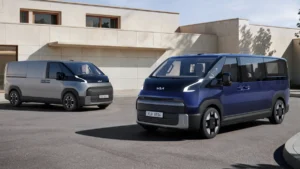
Kia Expands Commercial EV Lineup with Unveiling of the Spacious and Modular PV7 Electric Van at IAA Transportation 2026

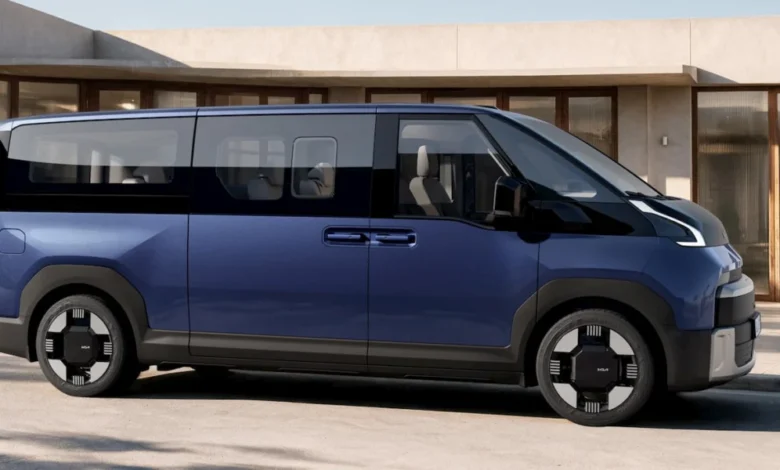
The commercial electric vehicle sector is experiencing a rapid evolution as legacy automakers transition from passenger-focused architectures to highly adaptable, modular utility platforms designed specifically for modern logistical demands. At the forefront of this shift is South Korean automotive giant Kia, which formally introduced its largest zero-emission van to date, the PV7, at the IAA Transportation 2026 summit held in Hanover, Germany. Representing the second major addition to Kia’s dedicated Platform Beyond Vehicle (PBV) commercial ecosystem following the smaller PV5, the PV7 arrives with ambitious targets. Aiming to secure a commanding foothold in the fiercely competitive light commercial vehicle (LCV) market, the vehicle marries expansive dimensions, advanced high-voltage battery architecture, and a highly versatile interior layout designed to accommodate both heavy-duty cargo transport and high-capacity passenger shuttling operations.
Unveiling at IAA Transportation 2026: Setting the Stage for Commercial Electrification
The debut of the Kia PV7 in Hanover underscored the brand’s long-term commitment to reshaping the fleet management, logistics, and public transit industries. IAA Transportation serves as one of the world’s premier stages for commercial vehicles, logistics innovations, and supply chain technologies, making it the ideal venue for Kia to showcase its next-generation commercial strategy. The PV7 builds directly upon the foundational engineering of the E-GMP.S platform—a specialized skateboard architecture optimized exclusively for commercial applications. By utilizing a completely flat floor design and a modular structural framework, engineers have engineered a vehicle capable of spawning multiple body styles, or "top hats," tailored to specific enterprise requirements.
Industry analysts tracking the commercial EV sector have noted that fleet operators are increasingly seeking out purpose-built vehicles rather than adapted passenger car platforms. Kia’s strategic roadmap reflects this demand, with the manufacturer announcing plans to roll out an expansive portfolio of 23 distinct PV7 variants over the coming years. These upcoming derivatives will cater to diverse commercial use cases, spanning traditional cargo haulers, specialized passenger variants, chassis cab foundations, and various bespoke conversion models designed for specialized trades, emergency services, and mobile businesses.
![Kia’s new EV van is over 17.5 ft long and can haul 9 people or lots of cargo [Images]](https://electrek.co/wp-content/uploads/sites/3/2026/09/Kia-PV7-EV-van-images.jpeg?quality=82&strip=all&w=1400)
Comprehensive Battery Specifications, Powertrain Options, and Range Capabilities
Performance and operational uptime are critical metrics for commercial fleet operators, and Kia has engineered the PV7 to meet these rigorous demands. The vehicle will be offered with two distinct nickel-cobalt-manganese (NCM) battery pack capacities: a standard 71.5 kWh unit and a larger, long-range 96.2 kWh configuration. For logistics companies requiring extended operational radiuses, the Long Range Cargo variant delivers an estimated all-electric driving range exceeding 460 kilometers (approximately 285 miles) under the stringent Worldwide Harmonized Light Vehicles Test Procedure (WLTP) testing cycle.
Under standard configurations, the PV7 utilizes a front-wheel-drive (FWD) layout powered by a front electric powertrain capable of generating up to 268 horsepower (200 kilowatts) and a robust 309 pound-feet (420 Newton-meters) of torque. Furthermore, Kia has confirmed plans to introduce an advanced all-wheel-drive (AWD) option in subsequent production phases to enhance traction in adverse weather conditions and challenging terrain.
Charging efficiency remains a cornerstone of the E-GMP.S platform architecture. Equipped with an advanced 800-volt high-voltage electrical system, the Kia PV7 supports ultra-fast DC charging capabilities. When connected to a compatible 350 kW DC fast charger, the vehicle can replenish its battery from 10% to 80% capacity in approximately 25 minutes, thereby minimizing operational downtime during busy delivery routes or transit shifts. Additionally, the van incorporates Kia’s signature Vehicle-to-Load (V2L) technology, allowing operators to draw electrical power directly from the vehicle’s high-capacity battery to run heavy-duty power tools, camping equipment, mobile worksite electronics, or external electrical appliances.
Dimension Analysis, Interior Flexibility, and Cargo Capacity
In terms of physical footprint, the PV7 dwarfs its corporate stablemates and several prominent market competitors. Both the Passenger and Cargo models measure 5,350 millimeters (17.55 feet) in length, 1,995 millimeters in width, and 1,990 millimeters in height, underpinned by a generous wheelbase of 3,500 millimeters. To put these dimensions into perspective, the PV7 is substantially larger than the PV5 Passenger variant, which measures 4,695 mm long with a 2,995 mm wheelbase. Furthermore, the production-spec PV7 surpasses the physical dimensions of the initial concept vehicle displayed at the Consumer Electronics Show (CES) in 2024, which measured 5,270 mm in length.
![Kia’s new EV van is over 17.5 ft long and can haul 9 people or lots of cargo [Images]](https://electrek.co/wp-content/uploads/sites/3/2026/09/Kia-PV7-EV-debut.jpeg?quality=82&strip=all)
When compared against other established electric haulers in the European market—such as the long-wheelbase Volkswagen ID. Buzz, which spans 4,962 mm in length with a 3,239 mm wheelbase—the Kia PV7 offers superior spatial volume and packaging efficiency.
The PV7 Cargo is engineered to maximize utility, available in both two- and three-seat configurations. It provides a standard cargo volume of up to 6.1 cubic meters, while the High Roof derivative expands total capacity to an impressive 8 cubic meters. Maximum payload capacities range from up to 1,165 kilograms (2,568 pounds) for the Long version up to 1,200 kilograms (2,645 pounds) for the compact model.
Logistics operations benefit from a low loading height of just 550 millimeters on the PV7 Long, designed to comfortably accommodate up to three standard Euro pallets (measuring 800 x 1,200 mm). To maintain optimal vehicle dynamics and safety under heavy loads, the van features a dedicated heavy-loading driving mode that calibrates powertrain performance and suspension response accordingly. Buyers can also specify their cargo areas with either full-open twin-swing tailgate doors or a conventional lift-up tailgate.
On the passenger-focused side, the PV7 is tailored for corporate shuttle services, vehicle rental fleets, and large family transportation. The global passenger model accommodates up to nine occupants, while the domestic market configuration in South Korea will support up to 11 seats. The seven-seat variant is equipped with Long-Rail Easy Remove Seats, offering flexible interior reconfigurations. The nine-seat configuration is similarly adaptable, available with or without an optional fourth seating row.
![Kia’s new EV van is over 17.5 ft long and can haul 9 people or lots of cargo [Images]](https://electrek.co/wp-content/themes/ninetofive/dist/images/google-preferred-source-badge-dark.png)
Digital Integration and Advanced In-Car Technology
Modern commercial vehicles function increasingly as mobile offices, requiring seamless digital integration, fleet tracking, and intuitive user interfaces. The Kia PV7 adopts Hyundai Motor Group’s advanced Pleos Connect infotainment architecture, highlighted by expansive dual displays measuring 12.9 inches and 14.6 inches.
Running on an Android Automotive OS foundation, the digital ecosystem operates similarly to a modern smartphone, featuring downloadable applications, cloud connectivity, and fully customizable display screens. Crucially, the vehicle integrates Gleo AI—an advanced artificial intelligence assistant capable of managing natural language voice commands, answering operational queries, controlling navigation routing, and monitoring critical vehicle functions without distracting the driver.
Market Launch Timeline, Global Rollout Strategy, and Economic Implications
Kia’s commercial strategy relies heavily on the scalable nature of its PBV lineup. Following the European debut at IAA Transportation 2026, Kia has scheduled the official commercial launch of the PV7 Passenger and Cargo models for the second half of 2027, starting in South Korea and European markets before expanding to international territories.
While official pricing will be announced closer to the market launch date, the PV7’s pricing strategy is expected to build upon the competitive baseline established by the smaller PV5. In domestic markets, the PV5 Passenger and Cargo Compact models start at approximately 45.9 million won ($34,000 USD) and 41 million won ($30,300 USD) respectively, while the European market entry for the PV5 Passenger five-seater in Germany begins at roughly €38,390 ($44,200 USD). Given that the PV5 has already established itself as a leading small electric van in Europe, industry analysts anticipate that the larger, more versatile PV7 could achieve even stronger commercial traction among fleet managers seeking comprehensive electrification solutions.
![Kia’s new EV van is over 17.5 ft long and can haul 9 people or lots of cargo [Images]](https://electrek.co/wp-content/themes/ninetofive/dist/images/google-preferred-source-badge-light.png)
The introduction of the PV7 signals a broader structural shift within the automotive industry. As regulatory pressures mount across major metropolitan areas to curb carbon emissions and eliminate internal combustion engines from commercial fleets, automakers are racing to provide scalable, multi-purpose electric utility vehicles. By offering a modular platform capable of supporting 23 distinct variants, Kia is positioning itself not merely as a vehicle manufacturer, but as a holistic provider of commercial mobility infrastructure. The success of the PV7 will likely serve as a benchmark for how traditional automotive groups adapt to the specialized needs of modern urban logistics, mass transit, and corporate fleet electrification over the remainder of the decade.