Extreme heat is expanding beyond summer months as climate change alters the global calendar

Extreme heat stands as one of the deadliest climate-related hazards globally, yet the traditional understanding of when such risks occur is rapidly becoming obsolete. New research published in AGU Advances indicates that the seasonal boundaries of extreme heat are shifting, with dangerous temperature spikes increasingly bleeding into the so-called "shoulder seasons"—the spring and autumn months that were historically considered safer. This shift is not merely a statistical curiosity; it represents a significant public health challenge, as human populations, infrastructure, and ecosystems are often least prepared for heat when it arrives outside of the expected summer peak.
The implications of this trend are profound. Heatwaves that strike during the spring, before human bodies have acclimatized to warmer weather, are often more lethal. Similarly, autumn heatwaves place immense strain on power grids and water supplies already exhausted by a long summer of high demand. As global temperatures continue to climb, the frequency, intensity, and duration of these events are intensifying, fundamentally redrawing the map of seasonal thermal risks.
Defining the shifting heat landscape
Meteorological definitions have long relied on the simplistic grouping of the warmest three months of the year—June through August in the Northern Hemisphere and December through February in the Southern Hemisphere. However, this rigid framework fails to capture the nuance of local climate variability. To address this, researchers developed a methodology centered on "local heat seasons," defined as the specific three-month window during which extreme heat events were most prevalent during the 1980s.
By analyzing climate data from 1980 to 2024 using the MERRA2 and ERA5 reanalysis datasets, the study mapped how the share of annual extreme heat days has migrated. The researchers compared the baseline decade of the 1980s to the most recent decade, 2015-2024. This longitudinal approach allows for a clearer view of how the cumulative effects of global warming are manifesting in the timing of extreme events. The analysis incorporated both dry-bulb temperature, which affects ecological health, and wet-bulb globe temperature—a measurement that accounts for humidity, wind speed, and solar radiation—to better reflect the physiological stress heat places on the human body.
Chronology of a warming world
The data reveals a stark contrast between the stable climate patterns of the late 20th century and the current, more volatile environment. In the 1980s, approximately 93% of the world’s landmass experienced more than 80% of its extreme heat days within its defined three-month heat season. This high degree of confinement held true even in tropical regions where seasonal temperature swings are naturally dampened.
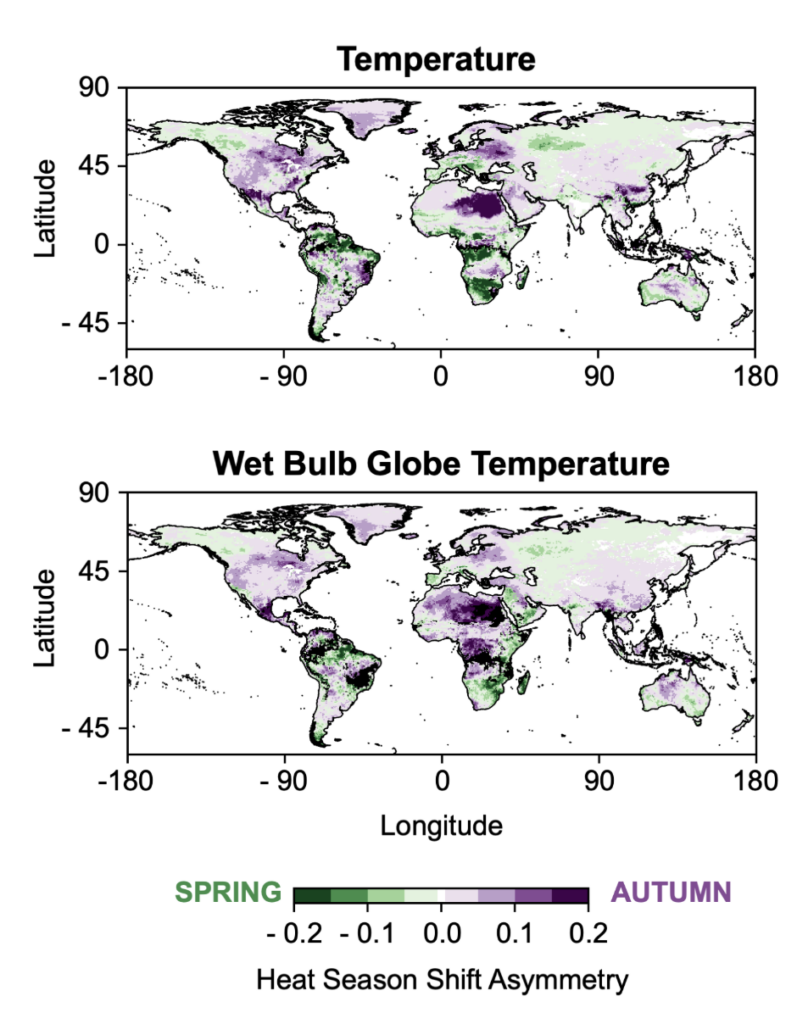
However, over the last four decades, the edges of these seasons have begun to blur. The research shows that in more than half of the world’s land area, extreme heat events are spreading unevenly into the shoulder seasons. The movement is geographically distinct: in Western Europe, Southern Africa, and Northwestern India, extreme heat is increasingly occurring in the months preceding the historical summer peak. Conversely, in the United States, Eastern China, Northern Africa, and Eastern Europe, the heat is extending deeper into the autumn months.
Factors driving the seasonal shift
Initially, one might hypothesize that these shifts are simply the result of an even, linear increase in annual average temperatures—a "rising tide" of heat that pushes everything upward. However, the study’s synthetic modeling, which shifted baseline data by the average temperature increase over the last 45 years, proved this hypothesis insufficient. While uniform warming explains the intensity of heat within the traditional season, it fails to account for the specific, asymmetrical expansion into spring or autumn.
The researchers suggest that several complex environmental drivers are likely at work. Changes in seasonal precipitation patterns and soil moisture levels play a critical role; as soil dries out, more solar energy is converted into sensible heat rather than evaporation, potentially amplifying heatwaves in specific months. Furthermore, land-use changes—such as the expansion of irrigation or the conversion of forests to agricultural land—can locally modify the thermal response of the surface. Finally, large-scale climate oscillations, such as the Pacific Decadal Oscillation and the Atlantic Multidecadal Oscillation, create inter-annual variability that can influence whether a region experiences "early" or "late" heat anomalies.
The challenge of compounding hazards
The expansion of the heat season introduces a heightened risk of compounding climate disasters. When heatwaves overlap with other seasonal hazards, the resulting impact on public safety and economic stability is magnified. In the Western United States, for instance, the extension of extreme heat into the autumn months directly coincides with the peak of the wildfire season. High temperatures dry out vegetation and increase the volatility of existing blazes, making containment exponentially more difficult.
In the Eastern United States, the later arrival of extreme heat threatens to overlap with the Atlantic hurricane season. The combination of intense heat and the infrastructure damage associated with tropical storms creates a "cascading failure" scenario, where power grids, cooling centers, and emergency response teams are hit by multiple, simultaneous crises.
Adapting to a new reality

The findings from the AGU Advances study serve as a wake-up call for urban planners, policymakers, and public health officials. Existing heat early-warning systems, which are often activated only for the "summer months," are becoming obsolete. To mitigate the rising human and economic costs, these systems must transition toward year-round monitoring and flexible, trigger-based responses that do not rely on the calendar.
Public infrastructure, such as cooling centers and energy management strategies, must also be recalibrated. If the period of highest risk is widening, then the duration of peak power demand will also expand, necessitating improvements in grid resilience to prevent outages during these extended heat events. Furthermore, occupational safety regulations for outdoor workers—who are at the highest risk for heat-related illnesses—must be reviewed to ensure they provide protection during spring and autumn heat spikes, not just during the summer months.
The scientific community acknowledges that while this study provides a global overview, the specific drivers of these shifts are highly regional. Future research must focus on localized impacts to provide the granular data necessary for effective climate adaptation. Understanding whether a specific region is trending toward a "spring-heavy" or "autumn-heavy" heat shift is essential for prioritizing resources and developing targeted, site-specific strategies.
Ultimately, the shift in extreme heat seasons is a clear indicator that the climate system is moving into uncharted territory. The "new normal" is not just hotter; it is more unpredictable. As the distinction between seasons continues to fade, the ability to adapt to these shifts will become a defining metric of resilience for nations and communities worldwide. The era of defining heat risk by the calendar is over; in its place, a more agile, data-driven approach is required to protect populations from a hazard that is no longer confined to the summer months.

This research, led by C. Ivanovich and colleagues, marks a critical step in quantifying these changes, providing the evidence base needed to modernize emergency management systems. By recognizing that extreme heat is a year-round threat, society can begin to implement the necessary safeguards to minimize the mortality and morbidity associated with this intensifying global crisis. As the world continues to grapple with the multifaceted impacts of climate change, the ability to anticipate and manage these shifting seasonal hazards will be paramount in safeguarding human life and critical infrastructure in the decades to come.